
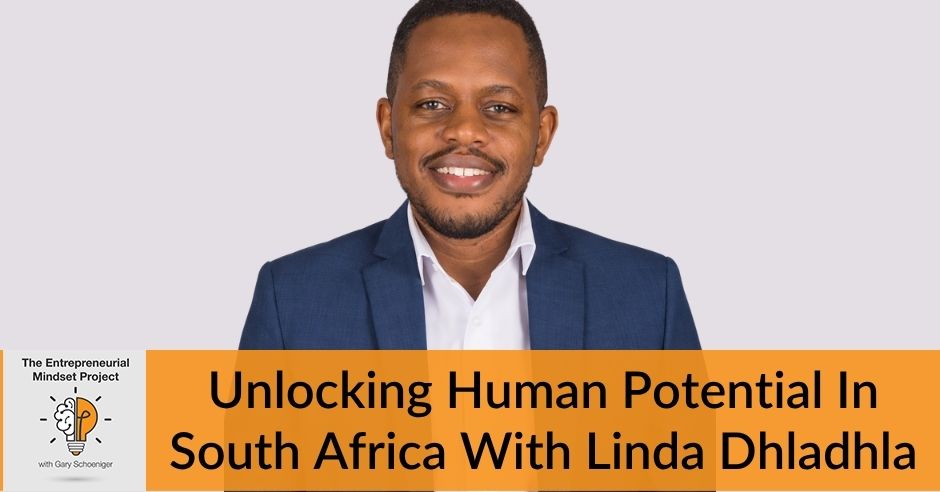
In a country grappling with high youth unemployment, what if the solution wasn’t finding jobs, but building the capacity to create them? This is the mission of Linda Dhladhla from Allan & Gill Gray Philanthropies in South Africa. In this conversation, we explore the powerful idea that unlocking human potential in South Africa requires a massive mindset shift. Linda’s story—from his mother’s side-hustles to her work shaping national education programs—reveals why ‘entrepreneurship’ is less about starting the next big venture and entirely about cultivating entrepreneurial competencies in every student. Discover how prioritizing discovery learning, agency, and adaptability can equip an entire nation to thrive in an evolving economy.
—
Listen to the podcast here
Unlocking Human Potential In South Africa With Linda Dhladhla
In a country where youth unemployment is sky high, what would it look like to build an education system that actually helps young people create their own opportunities? Welcome to another episode of the show, where we explore the hidden logic that enables ordinary people to do extraordinary things. I am talking with Linda Dhladhla from Allan and Gill Gray Philanthropies in South Africa. His story starts at home.
A mother side hustling to pay school fees. A grandmother running a dry cleaning service. An uncle in construction. All quietly modeled self-directed value creation long before he ever heard the word entrepreneur. As a young man, Linda followed a traditional path. He got the degree. He got the good job until a side project pulled him into the world of entrepreneurship education.
There, he is now helping shape national programs that embed entrepreneurial competencies across South Africa’s education systems. That includes TVET colleges, which are essentially career and technical colleges, universities, and now basic education. In this conversation, Linda and I explore the broader idea that entrepreneurship is less about starting businesses and more about helping young people become entrepreneurial, whether they are in school, at work, or in their communities.
We talk about the tension between managerial and entrepreneurial paradigms, why discovery learning is missing from most classrooms, how small projects build agency and self-efficacy, and how shifting the mindset of a single teacher can change the trajectory of thousands of students’ lives. Most of all, this is a conversation about unlocking human potential at scale, moving from producing entrepreneurs to cultivating people who can think and act entrepreneurially in any context. Without any further ado, I hope you enjoy my conversation with Linda Dhladhla.
—
Linda, welcome to the show.
It is a pleasure and an honor to be here, Gary. I have been looking forward to having a conversation with you.
Early Exposure To Entrepreneurship Shapes Mindset
We met some years ago in South Africa. You are working with the Alan Gray Orbis Foundation to promote entrepreneurship across South Africa. Talk to me about how you like it, and why entrepreneurship is important to you. How has it impacted your own life?
First and foremost, it is something that I saw my mom doing, side hustles while she was still a teacher, trying to find ways of getting additional income to support the family, to pay for our school fees because we were in a multiracial school. My sister and I and the fees needed to be paid. She would start selling, they were called AMC pots, and she would just get orders, and she would sell encyclopedias.
Those are old books. I am sure you know them, but it was our Google back then. Anything you need, you just go to the encyclopedia, and you find the information. One of my uncles was actually in the construction space. I just saw the freedom that he had in life to be able to buy the things he wanted to buy, live the life that he wanted to live, and drive the cars that he could afford at that point in time.
Growing up seeing that entrepreneurship happening within my family, and also my grandmother had a dry cleaning service. Every afternoon after she fetched us from preschool, we would drive around with her in the different houses, collecting people’s jackets, pants, and delivering other ones. That got me excited, and I really wanted to know about entrepreneurship.
You probably did not even have a name for it at the time. It is how that lands, especially in a young person’s brain. You see one person just going off to work every day, and then you see another person going off to work, but then side hustling, or a person going off to work where they are in charge of it. You have to wonder how that is processed in the mind of a young person. That is an important distinction to make, and it is worth digging into. Talk to me a little bit about, you made a comment a second ago, Linda, about your mom being side-hustling to pay school fees because you went to a multiracial school. Could you unpack that for me?
Around 1994, South Africa had already gained independence, apartheid was ending, and schools that were in the white areas of South Africa were then allowed to have more black students in them. There were a few, but they were allowed to have more black students. Obviously, any parent wants a better education for their children. We were then part of a group of kids who were starting off in multiracial schools.
Moving from schools that were within walking distance to now traveling 30 to 40 kilometers away, where there is public transport, costs more. There is a different lunchbox, a different school uniform, textbooks, and all these other things that need to be in place. That led my mom to start looking at alternative ways of bringing additional money so that you could be able to take care of those things, because there were also extramural activities, playing sports in the afternoon.
That meant you could not take the common bus that was there, which left immediately after school. Now you have to take a taxi. She needed to have additional money for taxi fare so that we could be able to make it back home safely. Her income was very limited, and she could not take care of everything at the same time. She needed to find ways of making sure that she has extra income so that we could also do these other activities at school as well.
How old were you when that was going on? You had to be really young.
Nine, ten, somewhere there.
Was that culture shock for you? Going into a white school, do you remember experiencing that?
I do not remember much of it, but it was definitely a culture shock because we were in a school where we spoke predominantly Zulu in our home language, even though we did speak English here and there, but now you go into a school where you have to speak English. All subjects are in English. When you are even playing on the playground, you are no longer playing and using your mother tongue.
Generally, you were speaking English. You are now exposed to this language that you have to speak most of the day. It was a culture shock leaving our community where houses are quite packed closely together. Now you are traveling to a different place where there are robots, there are nicer buildings, there are massive trees, beautiful houses, and the infrastructure is properly in place. It was a shock to see some of the things that you had never seen before. It definitely was a culture shock.
It is interesting because I just wonder if that opened your eyes to bigger possibilities in the world, seeing the bigger city. I have a friend who has been on this podcast, Hakeem Croom. He grew up in Harlem, and his parents were struggling with drugs, were very poor, lots of violence in poverty and despair. His friend went off to a private military school and came back at the end of the summer break and said, “Hakeem, you should apply for a basketball scholarship.”
His friend said, “There are white people there, and we eat twice a day.” Hakeem said to me that it opened his eyes to a whole different world, just being immersed in a different culture. There were people there from Saudi Arabia, from Africa, from all over the world. It was that exposure that gave them a broader vision of the world. Did you make up your mind that you are going to be an entrepreneur, or did you follow a more traditional path, go to school, get the degree, and get the job? What were you thinking along your educational path?
I followed what I was told at home, Gary. My mom is a teacher. Her first instinct is that you need to be a teacher. There were particular careers that you could choose from. Doctor, teacher, lawyer, police officer, and so forth. I followed the academic stream because no one knew what entrepreneurship was. We called them business owners.
That person is a business owner because they run a shop or they do this and that, but because there were not so many of them and it did not look like an opportunity that one could sustain themselves and live off it. Our parents thought that we should go the academic route. These are the possible career choices that you have. That is the decision that I had made, that I was going to go to school, learn, and hopefully one day I will be like my mother, become a teacher, and earn a monthly salary that could help me sustain my family.
It is interesting to note the cultural differences. You raise an interesting point that there are lots of people who are self-employed or business owners, but they are all struggling to eke out a living. They are not wealthy. They are like merchants, or they are struggling. That is not appealing at all to a lot of people. That is just a struggle. That is an important distinction to make.
When you say a small business owner, you think of somebody who is at least earning a couple of hundred thousand dollars a year, who lives in the suburbs. You are taking the traditional path. You go off to college, and you are following your parents’ advice. How do you wind up at Allan Gray, or what happens after college?
How I landed up here is that while working, I had this passion for creating a publication called Campus Africa, which would focus on the higher education space in South Africa or on the continent of Africa, just to drive that conversation. What are the changes that are happening in the higher education space? Where are the shifts? Where are the opportunities for graduates? Which courses do people need to focus on? While doing my research, I struggled to sell my first copy of the magazine.
That was one of the biggest lessons. I gave it away for free. When I was supposed to sell from those to know whether this is viable or not. I had just quit my job, and I took all my savings and I put them into this magazine because I was convinced that this was the way to go. Fast forward, in a couple of months, I came across an online radio station called Africa Business Radio, and then took the online publication onto that platform.
I said, “I want to start talking about this thing. Hopefully, I will build traction, and I will get to be exposed to more people, and it will help.” I got to meet quite a number of people in the higher education space on the continent, and had conversations with them. While I was having these conversations, I came across a new program that was being developed in South Africa with a focus on entrepreneurship, and it is called Entrepreneurship Development in Higher Education.
I then invited the director for a conversation, and they started off. Obviously, they needed the publicity, and they needed to tell their story. We had a couple of conversations on the podcast. The two episodes with her, Dr. Nora Clark, following that, we would share their posts on social media. I followed them. Facebook was the thing then. shared everything that they were doing, shared their articles, shared their events, and spoke about the work that they are doing.
Because of that, she then asked me to consult for them. In consulting for them, that was me coming to the events, taking pictures, posting on social media, and helping them ideate how to reach more students and drive this culture of entrepreneurship. During that process, she then said she has been thinking about doing a competition for students. I said to her, “I have the blueprint.”
While I was working on this and being on the podcast, I had also been mulling over the idea of a student entrepreneurship pitching competition. We sat through it, I shared the idea that I had, we workshopped it, and we piloted it. In the pilot, we went and spoke to the CEO of Allan Gray Orbis Foundation, then Yogi, who said immediately she would back this. We had not even tested this out. We did not even say that we have already worked with one university.
She said, “Definitely, as an organization, they are willing to pilot this with us because Allan Gray Orbis Foundation supports fellows or young people to access better education.” With that, they also drive this culture of entrepreneurship within their fellows as well. What that meant for us was that this would be a platform for their fellows to also showcase their businesses, showcase their ideas, and so forth. It was an opportunity to work with the 26 public universities in South Africa.
That really was where my journey started off in working with Allan Gray Orbis Foundation. I was not employed at Allan Gray Orbis Foundation, but I was employed at EDHE. That led me to work closely with AGov. Fast forward, while working with AGov, I then learned that they wanted to also venture into the TVET space, that is, the Technical Vocational Education and Training in South Africa. When I learned that, they shared the post that they were hiring people for that position.
I then applied because I am a TVET graduate myself, and I had experience in running a competition, working with the public universities, and building this culture of entrepreneurship for student entrepreneurship. I then got that job and started working at the Allan and Gill Gray Philanthropy South Africa, which is a sister entity of AGov as well. That was quite a long one, but that is how I landed here.
I love that story, Linda, because you were very entrepreneurial. You are out in the world. One of the things I have gleaned from exploring entrepreneurs, like interviewing them, studying them, and observing them, is that they are not the big risk-takers who jump off the cliff kind of people. The data just does not support that.
I have actually found studies that show that entrepreneurs are actually more risk-averse than non-entrepreneurs. You talked about at the beginning of your journey, you were sure you had the next big thing. I talk about that a lot. The first trick of entrepreneurship is not to fool yourself, and you are the easiest person to fool. Your story is really interesting to me because what do they call this complexity theory?
Evolution happens when you preserve the core, but you are exploring the edges of chaos. That is where evolution happens. That is the optimal place to be. You have a college degree, you have some kind of stability, but you are messing around with a radio show and a magazine. It is exploring. That is how you wound up at Allan Gray. That is a really cool story. People need to understand that you do not need to quit your job to be entrepreneurial.
You are right, Gary. That is one of the things that we tell our program participants, even working in the higher education space, is that we are exposing you to entrepreneurial competencies so that you can be entrepreneurial. You do not have to start a business. You could be entrepreneurial in someone else’s business as an employee because it is the same principles.
We have got these fourteen competencies that speak around growth mindset, resilience, similar to the Ice House. We are saying these life lessons are important for everyone. Those who then choose the path of entrepreneurship will be able to apply them differently compared to the ones that are choosing to pursue a career or a job. They will apply them differently as well.
That is the holy grail as far as I am concerned, Linda. Here is how I think about this. I go to these conferences all over the world. I speak at these conferences, and they are talking about entrepreneurial ecosystems. When I step back, they look more like safaris. They are big game hunters. They are looking for the kid that has the next Uber, the next Facebook, or the next Airbnb, and let us invest in him, and he will create jobs for the rest of us, or he will make us wealthier.
I am not denigrating the high-growth venture-backed entrepreneur. It is such an infinitesimal statistical percentage of entrepreneurial activity. If you round up to the nearest whole number, it is zero. There is this visibility versus representation issue. Because if we hear the word entrepreneur, we all think of that because they make headlines.
The broader point that you are making that I am so excited about is that underneath the top of the pyramid, you have a very tippy top, the venture-backed high-growth entrepreneur. You have all these small business owners. In the US, 89% of all small businesses have nine employees or fewer, five employees or fewer, but they are creating the vast majority of all new jobs.
It is like five percent have between 9 and 20 or 5 and 9. The rest of them are over twenty employees. What you are talking about is where our work intersects with yours, which is mindset development. That is what we found. The vast majority of people who have been through Ice House programming will never start a business. They will show up differently in their jobs. They are better prepared to adapt, better prepared to contribute.
Importance Of Entrepreneurial Competencies For Adapting To Change
That is the thing I am so excited to talk to you about. Getting people to be entrepreneurial. When you add on that where we are in time, we are at the edge of tectonic economic shifts, the greatest since the industrial revolution. If you cannot think like an entrepreneur, you are going to become increasingly vulnerable. That is how I think about it.
You are right, Gary. What you are talking about is something that we have realized. You see my background. It is a new program that we have established within Allan and Gill Gray Philanthropy South Africa, which is called Inspire. Entrepreneurship education and training really seek to identify a problem that learning environments across the education system are not adequately equipping young people in South Africa with the entrepreneurial competencies that they need to thrive in an evolving economy. We share the same sentiments that if you cannot be entrepreneurial, you will not be able to survive.
If you cannot be entrepreneurial, you cannot thrive. These skills let you adapt to any change—economy, life, or circumstance—and survive. Share on XEverybody is talking about AI, this disruption that is happening, it is going to take people’s jobs. What we are realizing is that when you have these entrepreneurial competencies, you would be able to say, “Things are changing. How do I adapt? How do I learn this AI so that I do not become irrelevant? I can acquire a new skill. How do you become resilient in this time of uncertainty?” We are saying that with these entrepreneurial competencies, no matter what happens in the economy, no matter what changes you face in life, you would be able to use these skills and adapt as needed.
What is happening in the world is that this shift is going away from other-directed value creation towards self-directed value creation. That is the fundamental shift that needs to happen. I wrote about this in my new book. I do not know if that is available in South Africa. We need to figure out how to get it there.
Not yet. I was told.
That is the fundamental shift that needs to happen. The point that I want to make here, Linda, we could probably dig into this. I do not think a lot of folks understand that. What is missing from education is discovery. It is all about the transfer of knowledge. Here is how the world works. Here is what we know. Prove to me that you know it.
That is not all bad, but what is completely absent from the curriculum is discovery. I coined this phrase in my book Entrepreneurial Discovery Learning. What I am advocating, Linda, I would love to hear your take on this. Start in middle school, again on the edges, and encourage young people to just engage in entrepreneurial projects of their own.
Loosely, what I mean by that is figure out how to make yourself useful to other humans without the guidance of a professional teacher or without the benefit of a proven system or pathway with a predictable outcome. Not only does that cultivate entrepreneurial attitudes and skills, but what we are really getting at is agency and adaptability. If you are in a classroom where somebody is telling you what to do, when to do it, and how to do it, prove to me you know they are actually undermining your agency. Does that make any sense to you?
Integrating Entrepreneurial Learning Into Classrooms
It definitely does, Gary. What you are talking about is what we have realized as well. The challenge is that our curriculum in South Africa, I do not know what it looks like in the US. Young people are just learning to memorize information and regurgitate it. They are feeding it back to the teacher or the lecturer to say, “One plus one is two.” What we have realized is that the most important thing is how we integrate these entrepreneurial competencies, entrepreneurial learning into the curricula.
For us, what it looks like is exactly what you are saying, allowing learners or students to pursue or identify projects that they can be able to come up with solutions for. We are starting to look at lower grades. We are still designing as a team, looking at grades 5 to 7, and to say, can we help them define, firstly, expose them to what these competencies are, and then bring in processes that will help them to be able to identify a problem.
How do you identify a problem in your community, which is something that you speak about in the Ice House? Problems are opportunities. Once they have identified these problems, we then say, “Now that you have identified this problem, what are the potential solutions?” Once they have gone through this design thinking process, we then say to them, “Part of this challenge is that we are creating a competition so that there is a reward system. Hopefully, this does not only end up in the classroom, but it is something that they can see as an opportunity that they can pursue outside of the classroom.”
“Now that you have identified this problem and this potential solution, can you look at starting a business? What does a business look like for them? How do you take the solution into your communities?” We are hoping that this will then be able to change that mindset, to change that thinking within our learners, but most importantly within our education system, so that we can be able to evaluate if there is a shift. Right now, all we know is that this learner has moved from grade five to grade six. This is the report.
They were able to remember 60% or 30% of the information that was given in the classroom. We want to get to the point where we say even as much as they have remembered so much information in the classroom, through that process, they were able to develop these competencies that we believe they should be able to sustain throughout their education, provided that there are opportunities for them to reinforce them within their grades as well.
Moving From Extrinsic To Intrinsic Motivation
I love that, Linda. The only pushback I would have is that I have talked to Yogi about this, about the G20 summit and policy recommendations around some of this stuff. We have the EU’s entrepreneurial competency framework, and that is probably what you are referring to. The trick here is that you cannot go, “Here is the competency framework, we are going to teach you these competencies.”
What I’m saying is that the desire to contribute and the desire for autonomy are very powerful. When we start asking students, stop asking them what they want to be and start asking them what problems they want to solve and what they need to learn in order to solve them. We get a much deeper level of engagement. The former is extrinsic motivation. Letter grades, salaries, gold stars.
The latter is intrinsic motivation. I do it because the task itself is the reward. You and I would agree to this. Entrepreneurial thinking enables us to access a deeper level of human potential. Here’s my point, Linda, to my way of thinking, you do not need to tell the kids this is a class about agency, adaptability, value creation. Do not teach them any of that. You do not even need to tell them that.
Ask them to get with a friend, give them $5, and ask them to come back with more than $5, or 50 Rand, or whatever it is. That is just one example. I think of currency as just evidence of usefulness. It is not about making money per se. It is science. When you have 50 Rand, and you come back with 250 Rand, you have evidence that you did something useful. By engaging young people in these kinds of activities, entrepreneurial competencies will evolve as a byproduct. Trying to hit it straight on is the mistake. What do you think about that?
I totally agree with you, Gary. The approach that we are taking is one where we show the teacher what competencies could be developed through this lesson. When it comes to the learner, we use the task or the activity, and we do not point out that this is the competence. We are not saying that when you are doing this, you will be learning autonomy, resilience, this or that. We are saying here is an example. Identify a problem.I’ll give you an example.
One of the teachers was talking about a water crisis in one of the communities in Hammanskraal, where the water is not good enough for people to drink. They gave that challenge within the classroom. They said, “This is your community, and there is a water problem, and the water is not drinkable.” Here are questions that help them think through the problem. Who is affected by the problem? How many people are affected by the problem?
It is also to say go into the community and ask these questions so that when you design a solution, you know exactly who that solution needs to be speaking to. You did not actually say to them that you are learning communication. The fact that they went out of the classroom to speak to people and came back into the classroom to present what they had learned. As a teacher, you are able to observe.
We have a rubric that we have created that then says to the teacher, “Are you able to observe these key behaviors within this activity?” As you input your score, it is then able to calculate for us to say, “This learner has demonstrated the ability to communicate with people and come back into the classroom and provide feedback on what they have said.” I totally agree with you. It is how we use these activities to really help the learner develop the competencies without us telling them exactly that.
This is what you are going to learn. When the feedback sessions happen, you then say through this activity, “What have you learned?” You will find that most of the learners will say, “I learned how to speak to people. I was scared of talking to people.” They realize that they were able to communicate, which is such an important thing to learn.

Human Potential: Being able to communicate is an incredibly important skill to learn.
Managerial Vs. Entrepreneurial Paradigms
Let me back up a couple of steps. One of the things that I figured out and I documented in my newer book is that I learned about this from studying culture and anthropology. It hit me like a lightning bolt that mindset is to a person what culture is to a group. It is the same. You can read the literature on culture, organizational culture, whatever, and scratch out the word culture every time and put mindset and apply it to the individual. It fits perfectly. That gave me a framework.
When I started writing Mindset Advantage, there was nothing really concrete. There was nothing clinical or structural around the mindset. It was all fuzzy. The first place I looked was Carol Dweck. She just calls it a way of thinking, which I found inadequate. When you look at mindset, we acquire these beliefs, they are deeply held values, taken-for-granted assumptions, and mental models that we acquire either consciously or unconsciously.
Once our brains accept them as the correct way to perceive, think, and feel, they drop beneath our conscious awareness, but they are still driving our behavior. One of the things that became clear to me is that I am an entrepreneurial anthropologist. The entrepreneurial person only seems mysterious to the extent that we are steeped in a managerial paradigm. I tell the story in my book about a parable. Two young fish swimming along pass an older fish.
The older fish says, “Good morning, fellas. How is the water?” The two young fish just keep swimming along until one of them looks at the other one and says, “What the hell is water?” What I’m trying to get to this is managerial and entrepreneurial paradigms, if you put them side by side and look at the underlying values and taken-for-granted assumptions of each, managerial paradigms assume that the useful thing has already been discovered.
We are all engaged in the replication and distribution of a useful thing that is already known. The central focus is efficiency. It is an error-reducing paradigm. We need that. That was the dominant paradigm of the last few centuries. It is still important. What people have to realize now is that entrepreneurial paradigms are almost the polar opposite. They are self-directed, whereas managerial is other-directed. They are exploratory. They are not efficient.
They are error-inducing, not error reducing. What you and I are both getting at, Linda, is that students need both. There are two points I want to make. Students need both. They need to be able to code-switch to understand which situation you are in and which mindset to apply. The deeper issue is whether education systems or organizational leadership needs to understand the extent to which managerial paradigms, including schools, are not conducive to exploration, experimentation, and adaptation. We have to carve out space where that is encouraged.
Employers keep coming to me saying, “We want their people to think like owners.” They are oblivious to the fact that you have created this whole culture in the organization that punishes people for not performing. That’s the big thing that we have to reconcile, an education to carve out some of that space. I would love to hear that you’re getting us at younger and younger ages. How do you guys measure this? How do you think about that?
Shifting The Focus Of Measurement
That has been one of our biggest challenges. In our education system, when you bring in a possible solution, we believe that entrepreneurship is one of the ways to eradicate poverty in our country. I will give an example of the work that we started within the TVET colleges. There was not really much happening when it comes to entrepreneurship. We found ourselves in a situation where we were measuring numbers. How many lecturers have been trained?
How many students have been trained by those lecturers? How many colleges are training students? How many students are participating in the competition itself? You saw we filled the room with almost 300 lecturers because they were so eager to learn. The biggest problem was that we were measuring numbers, but we were not measuring the shift.
We were not measuring the mindset shift to say, “You are coming into this particular training before you come in, where are you at a baseline level,” and then post the training, where are you at the end line. We are now looking at measuring integration into the curriculum. We are asking the lecturer or the teacher, “How are you using this in your classroom?” We do not want to be training for the sake of training.
We want the lives of the young people in the classroom to be transformed by the knowledge that we have given to the teacher. For us, what is important is that there must be a transformation within themselves first before it can happen in the classroom. We are measuring now how they are integrating this. How are they bringing it into the classroom? Also, we’re measuring the learners themselves, that self-assessment where they take a baseline and an end line.
True classroom transformation begins with the teacher. The knowledge we give must first transform them before it can impact the students. Share on XWe are hoping that you will be able to let us know if the activity is happening in the classroom. What we are also thinking of doing is we are now looking at the different subjects. If you are doing technology and the topic is designing a process that identifies the internet within your community. This is within the textbook itself.
What we’re looking at is we are looking at changing the question within the textbook, not to say “What possible solutions can you bring,” but to say “Design possible solutions that you could bring into your community.” If you say, “What’s possible?” it is easy to go to the internet and say, “What possible solutions are there for the internet?” You get a list to copy and paste.
If we say design, that means you have to go through a process of having a conversation, interviewing people, and sitting with that information to possibly come up with a solution. Through that, as I mentioned earlier, we will then be able to get a score for your activity, but we are also able to get that competency that says this is what you have learned. That’s part of our measurement.
We were then able to say, “This learner at a baseline level showed these competencies, but now that they have been working through these activities within the classroom, they have been able to develop these competencies as well.” It is something that we are still figuring out internally, but there has been a request to let us measure numbers. We are not measuring how many people were in the room, how many babies you feed, how many coffees you drink in a day.
It is a challenge, Linda. What you are talking about reflects this idea that we cannot solve today. Let me back up. This is something Peter Senge, a great systems thinker, has said for a long time, Yesterday’s solutions become today’s problems.” There’s one way of thinking. The system is thinking. The challenge in measuring this is a reflection that we cannot solve today’s problems with yesterday’s thinking.
The need to measure is in and of itself a managerial function. I do not know the answers either. I have seen some literature that shows that young people who are exposed to entrepreneurial experiences in school have their academic achievement scores go up. There is a residual impact there. When I was experimenting in a local high school in 2006, I taught an entrepreneurship class, and at the end of the year, the students presented their ideas.
Parents started calling me, saying, “What are you giving away? I could not get my kid out of bed in the morning, and now she cannot wait to come to this class.” What the students were saying at the end of the year was, “I understand how the world works. I see myself playing at a higher level, and I understand the importance of higher education.” Those are self-reported outcomes and an indication of agency. Unfortunately, you cannot stick a needle in somebody’s brain to measure agency.
It goes back to what you said or mentioned earlier, that we need to create these environments for young people to test out entrepreneurship.
Where failure is encouraged. Like, “Over here. Keep doing that. That’s fine.” You have to realize you are punishing failure. Students are trained to walk into the room, “Tell me what I have to do and I will do it.” They are little stimulus-response bunnies. You have to carve out some space over here. I did some work in Cameroon a little over a year ago for the Minister of Small Business. I spoke at this inaugural colloquium about entrepreneurship education in Cameroon. They were all talking about university. I said, “Wait a minute, who is the biggest soccer star?” “Lionel Messi.” Do you think they start training this guy to play soccer when he is nineteen years old?
No, definitely not.
Think about this for a second, Linda. We put kids through this other-directed learning system for twelve years, and they show up at university, and now we are saying, “Do a startup,” which is fairly complicated. We have to recognize that entrepreneurial self-efficacy is a muscle that has to be built. Starting in middle school, selling bird houses, magazines, or something.
Ultimately, what you and I are working on is the same problem. There is a massive reservoir of untapped potential that we just cannot get to with managerial thinking. I remember being with you in Johannesburg when we had the 300 TVET lecturers in the room. I was struck by the disparity. The TVET teachers were expressing a great deal of concern about there are no jobs. The youth unemployment rate was extraordinarily high.
In the evenings, I would go across the compound and interview entrepreneurs from South Africa. They were all saying opportunities are everywhere. I would walk back into the conference hall the next day and interact with a bunch of TVET lecturers. They live in the same communities. They live in the same country. Just two different ways of looking at the world. That is to me why it all comes back to mindset.
You are right, Gary. Even with the interviews that we did in the evening with those entrepreneurs, they kept saying opportunities are everywhere. That is when you realize it is the lens that you use. If you are using that entrepreneurial thinking, you are able to see these opportunities. If you are using that managerial thinking, you are part of a system that says think in this way and behave in this way. We see it with a lot of young people as well.
When we go into the training within the classroom, I sometimes also go into the classroom, especially on the entrepreneurial mindset. Whenever a college lecturer says I am starting off, please come through, I go in there, and I take a few lessons. Whenever we get to these problem opportunities, one of the examples I use is load shedding.
There is a time when electricity is not available at different stages in South Africa. That is a problem that everybody is experiencing. What is a problem to one is an opportunity to others. I always use this example. If you are a petrol station, it is an opportunity for you because the one who is using a generator needs petrol. If you are focusing on the fact that you also do not have electricity, you are going to lose out on that customer.
If you are able to service the generator, there is a business opportunity because the generator can only run for so long. At some point, it is going to need new plugs. For you, as an entrepreneur who knows how to fix it, you can put up your services and say, “Where is your generator? I’m available.” I totally agree with you. Those opportunities are available. It just depends on the lens that the person is using. It is a conversation that came out in the room as well. Once you went through the content, a lot of lecturers were saying, “Now I see why I was not making it in life.” That shift happened.
Shifting Mindsets To Unlock Human Potential
That is so exciting. If we can shift the perspective of the lecturer, the secondary and tertiary impact of that is phenomenal. How many people is that lecturer going to influence over the next 5 years, 10 years, or 20 years of their career? The way I think about this, Linda, my work around entrepreneurial mindset is 99% mindset, and it is 1% entrepreneurship. That’s how I think about it. I want to go back to a point you mentioned about opportunity recognition.
The way our brains work, we are inundated with billions of bits of data every second, pouring into our five senses. They can only handle like twelve. Our brains automatically filter out everything that is deemed non-threatening or irrelevant. Do you remember we did the training with the basketball and the gorilla? The people passing the basketball, and you do not see the gorilla walking right in the middle, because you are counting basketballs.
It’s important just reorienting the brain, these subtle little shifts in our mindset, have just this enormous impact on our trajectory and our impact that we can contribute to the world. Remember my iceberg model, like the three levels? To me, it is about having conversations where we excavate our level three values and assumptions that are driving our behavior that we might not be aware of. Bring them up into the daylight and talk about them.
There is a buffet table over there with the beliefs and assumptions of everyday entrepreneurs. Go have a snack over there. That is a way to think about it. I am so happy to hear that the way you guys are going about this is exactly the right way, which is to not think about it as you are just going to start a business or you are going to be an employee. That is the future in my view.
It is engaging with the likes of ELI and our CEOs and Peter, who has really helped us to change our view. When most of us got into the space, it was to produce entrepreneurs. That is what we thought was the solution that we needed. At some point, it is not for entrepreneurship’s sake. We are really producing young people who can be entrepreneurial, whether they start a business or not start a business. That shift has really helped us, even in how we are designing or delivering the programs. The intention of the training that we bring as an organization is so that young people can be entrepreneurial.
Here is something I am struggling with. The word entrepreneur, because people just hear that word and then they go yes or no. “Entrepreneurship is not for me. I am not considering a business.” I do not know what the answer is. People keep coming to us and asking if we can find a different word. I cannot, but I understand what they are saying. What we are really getting at is unlocking human potential.
It is just a mental framework that enables us to access a deeper level of human potential. I got invited to do a book talk at Harvard when my book came out last year, in December, at the human flourishing program, not at the business school. That is really where I am trying to take this work, to broaden the conversation with people like you. I am so grateful for this conversation because we need the world to hear this. I will say it like this, Linda.
When we developed the Ice House program at the Kauffman Foundation, we were the first in the world to use the lived experience of unlikely entrepreneurs to illustrate entrepreneurship as an accessible pathway to individual empowerment and economic mobility. We were the first in the world to do that. We were also the first in the world to emphasize the mindset to not necessarily focus on what they are doing, but why they are doing it.
What are the underlying values and taken-for-granted assumptions that are driving the behavior? This is the intersection of our work and how we met, like Allan Gray Orbis Foundation, and the first training we did in 2012 or something like that, or 2013. I do not remember. What we saw, Linda, was that we just thought we were making an entrepreneurship program accessible for ordinary people to try to get away from the high-growth venture-backed model of entrepreneurship. The program got adopted very quickly and widely.
What happened, Linda, was so interesting. The program started being used in ways that were further and further away from the startup. People started embracing it in student success. They noticed a 28% impact and persistence in community colleges in a blind study. It started being adopted in workforce programs, second-chance programs, and leadership development. That is where the work is taking me. This entrepreneurial spirit is the human spirit.
I am just delighted to have you on this show and to learn more about what you guys are doing in South Africa. I had a three-hour meeting with the Ohio state senator last week. I said to him, “Here is the work I am doing in South Africa, Brazil, and Mexico. The world is waking up to the idea that all people will need fundamental entrepreneurial competencies. What are we doing? Nothing.” It is a deeper dimension of human potential. Linda, winding down, any final thoughts you want to share? What is next? What are you excited about?
Firstly, thanks to you, Gary, and the ELI team for this amazing work. I am sure somebody else would have done it at some point, but it has really been great working with you, helping us to navigate the content and ensuring that we reach and expose as many people as possible in our country through the content that you have shared with us. What is next for us is really expanding the work that we have started on the entrepreneurial mindset side.
We are looking at supporting colleges and making it some sort of a module and a credited or accepted module within a program. When you start, at some point, you need to do the entrepreneurial mindset. You are right, we have seen some students completing their academics because of having been exposed to an entrepreneurial mindset. One lecturer actually shared that he was doing a session for 400 students online.
After doing the entrepreneurial mindset, he became entrepreneurial himself and said, “How can I expose as many students as possible in my TVET college to this material?” If you were to do it in person, it would be impossible. He took it online for almost a week. That allowed him to reach over 400 students at a go. One of the students said, “I was about to quit my studies because I did not see the value in them.”
When he went through this, he understood that at a mindset level, these are the challenges that I am experiencing. When he was able to reframe things and see things differently, he then decided to continue with his studies. I did not follow up if he has completed, but you know the assumption that once you are able to realize that, just assume that you will do what is necessary to continue. For us, it is how do we introduce this to even basic education?
We are looking at exposing the material to teachers within the schools. We have been speaking to our counterparts in entrepreneurship development and higher education to say we would like to pilot this with university lecturers as well. I have a few of them come to us and say, “Make sure that you have the material.” The University of Venda is one of them that is constantly knocking at the door, asking for this material. We will be looking at working with them to train more lecturers so that they can reach as many students as possible.
The most exciting work is the integration part. We want to see this living within the curriculum so that we can see the effects of it. As soon as you label it and say entrepreneurial mindset, it is what you said. “Nope, it is not for me.” We want to get to a point where all learners or all students see it as something important that they need to pursue. I like that definition and the words that you used, unlocking human potential. If you see unlocking human potential, just know that it is based on what you have just said.

Human Potential: We want to reach a point where all learners see an entrepreneurial mindset as something important to pursue.
This is not a shameless plug, but look at the sub-headline. I would say this to people, Linda. If you were walking in a bookstore and you read that, “The Entrepreneurial Mindset Advantage: The Hidden Logic That Unleashes Human Potential,” you could think that sounds hyperbolic. That sounds like an exaggeration. You understand that it is not.
I am so grateful for the opportunity for this conversation, Linda. I am so excited to hear that you guys are doing that. I am doing some work with a very prominent university system in Mexico, Tecnológico de Monterrey. There are 120,000 students across 30 campuses. There’s a number four entrepreneurial university system in the world. We are now training non-entrepreneur faculty how to infuse entrepreneurial thinking into their discipline, regardless of the discipline.
What is so exciting to me is that their mission is for every student to graduate with, in Spanish, emprendedor mentalidad, the entrepreneurial mindset with a humanistic outlook. Let me just end with this, Linda. Here is my thinking about this. I put this in my new book. Have you ever heard of self-determination theory?
No.
You are going to want to look this up. These two psychologists, Deci and Ryan, I will send you the paper when we get off the call. These are the guys, Deci and Ryan, who are largely responsible for bringing us out of the dark ages of behaviorism. Carrot and stick, punish and reward. For most of the last century, it was believed that motivation came from outside the individual with carrots or sticks.
These guys brought us into a new understanding of extrinsic and intrinsic motivation. Intrinsic is the most potent form of motivation. It goes like this. What these guys are saying, Linda, is that humans are like acorns. We are all born with the capacity and the desire to become all that we can become. That is in every living thing. You have seen a little seed trying to grow out of a crack in the concrete.
Humans have three fundamental psychological needs, which are autonomy, competency, and relatedness. That means we need to feel like we are part of a tribe, part of a group, respected, and contributing. When those three psychological nutrients are attainable, human flourishing ensues. Lifelong growth, social integration, and psychological well-being. It is very predictable. Take away any one of those three, and suboptimal outcomes ensue. Here is my entrepreneurial mindset theory. Are you ready?
Yes.
The entrepreneur unwittingly stumbles into that trifecta, and they flourish. To the outside observer, it just looks like “Linda is unique or special and has some special DNA.” I am not saying you are not special, Linda, you know what I mean? When those three nutrients are attainable, we can access a deeper dimension, that intrinsic motivation that is the unlocking of human potential.
What I said in the close of my book to the individual is, “Look, I just told you how to create the conditions, how to consciously and deliberately create the conditions that are conducive to your flourishing. If your boss will not let you or your mom will not let you, that excuse is out the window.” I am also saying to leaders, “Stop complaining about the lack of engagement and look at the way the system that we are overseeing is predictably producing that lack of engagement.”
It is up to us as leaders to create those conditions that are more conducive to flourishing. That is the big play with entrepreneurial mindset education. Linda, thanks so much for being on the show. I cannot wait to share your story with the world. Thanks for spending the time with us, Linda. We will follow up soon.
Thank you so much, Gary. It was an absolute pleasure.
Important Links
- Linda Dhladhla on LinkedIn
- Allan Gray Orbis Foundation
- Allan Gray Orbis Foundation on LinkedIn
- Allan Gray Orbis Foundation on Instagram
- Allan Gray Orbis Foundation on YouTube
- The Entrepreneurial Mindset Advantage: The Hidden Logic That Unleashes Human Potential