
If nearly two out of three Americans say they have a business idea, why do so few ever act on it?
That question sits at the heart of today’s conversation.
Welcome to another episode of The Entrepreneurial Mindset Project, where we explore the hidden logic that enables ordinary people to accomplish extraordinary things.
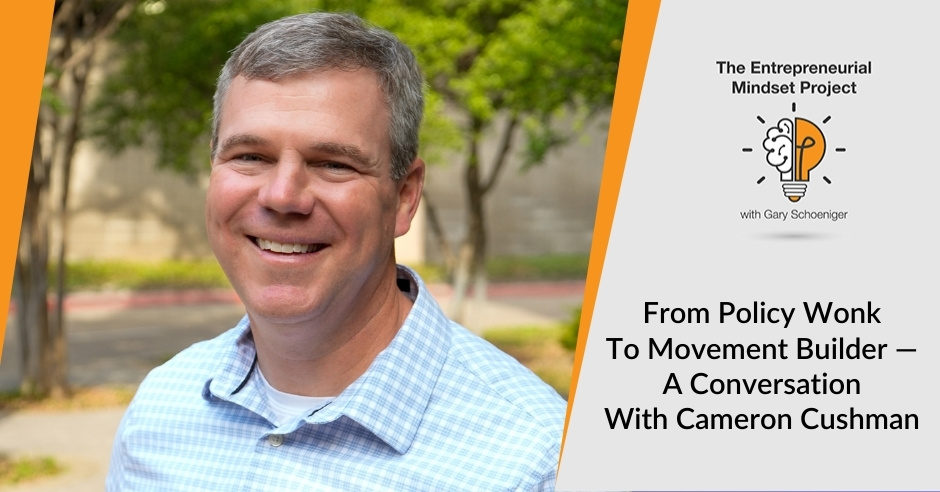
Today I’m joined by Cameron Cushman, co-creator of 1 Million Cups — a simple Wednesday morning experiment that grew into a national movement supporting entrepreneurs in communities across the country.
Cameron began his career in trade policy at the U.S. Department of Commerce, helping share the “secret sauce” of American entrepreneurship with the world. But it wasn’t until he arrived at the Kauffman Foundation in Kansas City that he discovered something important: the real secret wasn’t policy — it was community.
In this conversation, we explore what actually helps people move from intention to action — why community matters, why “weak ties” often prove stronger than close friends and family, and why, as Cameron likes to say, a dolphin tank beats a shark tank when it comes to real growth. Most importantly, it’s a reminder that entrepreneurship isn’t reserved for the venture-backed elite. It’s a way of thinking — and engaging — that becomes possible when the right conditions are in place.
I hope you enjoy my conversation with Cameron Cushman.
—
Listen to the podcast here
From Policy Wonk To Movement Builder — A Conversation With Cameron Cushman
If nearly 2 out of 3 Americans say they have a business idea, why do so few actually start? That question sits at the heart of this episode’s conversation. I’m joined by Cameron Cushman, Co-creator of 1 Million Cups, a simple Wednesday morning experiment that grew into a national movement supporting entrepreneurs in communities across America.
Cameron began his career in trade policy at the US Department of Commerce, helping share the secret sauce of American entrepreneurship with the world. It wasn’t until he arrived at the Kauffman Foundation in Kansas City that he discovered something important. The real secret wasn’t policy, it was community.
In this conversation, we explore what actually helps people move from intention to action, why community matters, why weak ties often prove stronger than close friends and family, and why, as Cameron likes to say, a dolphin tank beats a shark tank when it comes to real growth. Most importantly, it’s a reminder that entrepreneurship isn’t reserved for the venture-backed elite. It’s a way of thinking and engaging that becomes possible when the right conditions are in place. Without further ado, I hope you enjoy my conversation with Cameron Cushman.
—
Cameron, welcome to the show.
Thanks for having me, Gary. It’s super exciting to be here.
Yeah, we’ve known each other for quite a while. I don’t know, we were running around at Kauffman together back in the 2010s, ‘12, something like that.
That sounds right, yeah.
My first question to you, Cameron, is how did you get mixed up in the entrepreneurship game?
Cameron’s Entry Into Entrepreneurship/Kauffman Foundation
It’s not where I thought I was going to end up with my career or with my life. I’ll go all the way back to the beginning. Born and raised in Texas, studied Political Science in school, and you basically have two options in political science, you either go to law school or you move to the state capital or the nation’s capital. I moved to Washington DC, served in the Bush administration, and I’ll fast forward through a bunch of stuff. My last role in Washington in the Bush administration was at the United States Department of Commerce.
I had a boss at the time who was one of the early internet entrepreneurs and had had an experience selling cars on the internet very early on, selling jewelry on the internet very early on. Here I was at the Commerce Department doing trade policy. He puts me onto this deal that they had with the Kauffman Foundation. This latent MOU that nobody had really been able to do anything with, a Memorandum of Understanding.
Said, “As one of your projects working on this team, again, doing trade policy, I want you to go figure out what this arrangement could look like with the Kauffman Foundation in Kansas City.” I’d never heard of Kauffman, didn’t know anything about it. I knew that the Royals played in Kauffman Stadium and that was about it. I get matched up with this guy Tom Rue, who is obviously good friends of yours. Tom and I just started talking about what this could look like.
What we settled on was this really interesting public-private partnership between the United States federal government and a private nonprofit foundation focused on education and entrepreneurship to essentially share the secret sauce of American entrepreneurship with the rest of the world with this idea, again, we had to tie it back to the trade aspect in the Commerce Department, that if we could increase economic growth in some of these strategically partnered countries, it would help everybody. They’d be able to buy more American goods, we’d have more openness, more transparency, and everybody would be wealthier because of it.
We did events, we created a little entity called the Program for Entrepreneurial Growth. That was really two things, we had events in what they used to call the BRIC countries, Brazil, Russia, India, and China, where Kauffman would bring in some of their top experts from around the world to travel to those countries and basically share the secret sauce of American entrepreneurship. The other piece of this was a website called Entrepreneurship.org and Entrepreneurship.gov.
Yes, we did get the.gov, which back in the day was pretty remarkable. It was a terrible word, terribly hard to spell, but we did it, and we shared a bunch of resources on those sites as well. Now after the Bush administration ended, that.gov site went away, but Kauffman kept entrepreneurship.org as a site for the next decade or so.
Along the way, Kauffman called, my buddy Tom called and said, “Would you be interested in a role at the Kauffman Foundation? There’s a position open and I think you might be a good fit for it.” I said, “Sure, Tom, thank you, but I’m already set. I’m already ready to go to grad school. I’m going to study International Affairs at the University of Chicago. Thank you, but I’m going to go do that instead.” This was 2008.
I go interview at the Kauffman Foundation anyway, and I’m literally in the meeting with the President and CEO at the time, Carl Schramm. He says, “Don’t go to grad school. Come here, you’ll learn way more than you ever would in grad school.” Carl had a PhD, a JD. An entrepreneur himself, he knew way more about all this stuff. For whatever reason, I took him up on it, and I believed him. I said no to graduate school and then moved to the Kauffman Foundation in Kansas City, which I think in the summer of 2008 was a very good idea because we all know that the economy fell apart right after that. I was very glad to have a job and not have a bunch of graduate school debt I was running up at the time.
Basically, I did three distinct jobs when I was at the Kauffman Foundation. I started as the Chief of Staff to the President and CEO. Ran his office, lots of correspondence. He was very active, big writer, nutty professor type, just loved to think and write and was great in that regard, big thought leader. Managed the board with him and helped do a bunch of different tasks. I got to sit in on all the senior leadership meetings, which was just such an incredible learning experience. Especially as the economy melted down in 2008 and everybody said, “Entrepreneurship is the way out. This is the way we need to figure this out.” We’re uniquely positioned at the Kauffman Foundation to be the answer to some of these problems that are ailing our economy.
After a couple of years in that role, I then went on to research and policy and was working for Bob Litan, who’s an incredible guy and academic who had worked for both President Carter and President Clinton. They sent me back to Washington. They were doing all this research on entrepreneurship, most of which we just didn’t know. They sent me back to Washington to share the secrets of American entrepreneurship using government data that the government just didn’t know. They weren’t even thinking about this.
Kauffman unearthed some really interesting research and policy tidbits that we were hoping was going to drive policy. At that time Kauffman was spending, they were the largest private funder of economic research in the country, which probably meant the world. I think over about a decade, Kauffman spent $100 million researching entrepreneurship. It was really fascinating. Anyway, did that for about a year.
To be fair, I’ve said this before, Cameron. I feel like on one hand, when you recognize the economic impact alone of entrepreneurial activity, you’d think like why isn’t everyone focused on this? Why isn’t this in our schools in a regular? More importantly, I think that our understanding of entrepreneurship in 2025, let’s say, is on par with our understanding of management 1925. We’re still at the Frederick Winslow Taylor days of entrepreneurship. In the very early stages of understanding what it is and what the underlying causes are.
Yeah, absolutely. A lot of times, we were just regurgitating federal government data to these policymakers that the data already existed, they just hadn’t looked at it through that lens of, what does this mean for economic growth? What does it mean for innovation? What does it mean for job creation? What does it mean for wealth creation? They had just never really thought of it that way.
It was so funny because I’d go into some of these meetings on Capitol Hill, you’re meeting with young staffers, trying to get somebody to sponsor a bill or something, and they would say something like, “Are you right-leaning? Are you left-leaning?” I was like, “Dude, we’re just some guys in Kansas City that are looking at this data in a unique way. I’m not a think tank, I’m not a lobbyist, I’m just a guy that’s starting to realize in my own life and my own career the importance of entrepreneurship for all these things that you care about.”
You don’t think about this because, guess what? The people who come in here and talk to you about this all the time are the right-leaning guys, the left-leaning guys, the guys funded by this rich guy or company. We were just some people from the Midwest that were looking at it in a very different way. At that time the Kauffman Foundation, still does now, of course, but just had tremendous impact for this relatively small, little private foundation in the heart of the Midwest.
You keep using this term like the secret sauce. Can you share a few or 1 or 2 of those insights? What is the secret sauce? I feel like it’s so baked into my thinking and maybe collectively we just take it for granted that some small percentage of the population will go off and start businesses and that somehow mysteriously happens, and that they’re going to create jobs for the rest of us.
There are a couple of ways I could answer that, Gary. One is the secret sauce of American entrepreneurship is the American Dream. It’s this idea that you can start just about any company that you want and run it with minimal government interference. You’re going to have an opportunity to go live out your dreams. You may or may not be successful, but you’re at least going to have that shot.
The secret sauce of American entrepreneurship is the American Dream: the idea that you can start almost any company you want, run it with minimal government interference, and have a real shot at chasing your dreams. Share on XAnother way I could talk about it is to tell Mr. Kauffman’s own story. He came back from World War II, was literally going around to the seafood restaurants in town and getting all of their old oyster shells that they were throwing out, grinding them up into pill form, and then selling them by day. He would sell them as a calcium supplement to pregnant women. This is way before the FDA. You could never do this now. He saw a need in the market, he hustled, he fulfilled it, and then ended up growing that into one of the largest employers of Kansas City at the time.
He named the company Marion Labs, after his middle name because he didn’t want anybody to think he was the only employee, because he was. When he started, he just said, “I’m going to go do this and we’re going to make it happen. On the day he sold in 1988, he made millionaires out of over 100 people in Kansas City. He had a tremendous impact and literally started from grinding up oyster shells in his mother’s basement and then selling them by day.
You can talk about the secret sauce, but a lot of people in a lot of other countries in a lot of other places, they don’t wake up every day and think like that. They’ve got to get permission, they’ve got to get a permit, the government makes it very hard for them or their family doesn’t support that. It’s not just about the government, their culture doesn’t support that.
It’s just allowing 1,000 flowers to bloom. I may get the right idea, I may not start with the right idea. It may fail, it may take off, I don’t know, but I’m not going to know if I don’t try. It’s that ability to try and embrace failure and take on that risk. I think that’s the secret sauce right there. Much of it is just, as you would say, Gary, a mindset that this is what’s important, and you can go out and try it from there.
You reminded me of a funny story, Cameron. I was in Azerbaijan doing some training lecturing for the State Department. The embassy driver picks me up in a black car and is taking me to the event, and I’m sleep-deprived, jetlagged. I’m in the back seat of the SUV and I’m talking to the driver through the rearview mirror. I’m telling him, basically, I’m studying everyday entrepreneurs, people who start with nothing and how do they do it? What’s common in their underlying beliefs?
He looks at me in the rearview mirror with like a troubled look on his face and he said, “Mr. Gary, I’m sorry to tell you this, but that’s not possible here.” I’m on my way to give a talk about this at an event sponsored by the State Department and the driver’s telling me that. I just had an, “Oh crap,” moment. I just found the cultural edges of this. Now I’m completely knocked off my game. I walk into this event and the first person I meet is this young girl, 22 years old, that built a bridal empire with $200, with five stores across Azerbaijan. I think to your point, a lot of people think it can’t be done and then they transmit that belief to others. If you can’t see it, you can’t be it.
Yeah, that’s exactly right. I think it also goes to the fact, this was one of the research nuggets that we unearthed while I was at the Kauffman Foundation, is that people come here to start companies. Immigrants start companies at rates twice that of natives. We are seen as this shining beacon of entrepreneurship around the world, and people want to come here and live and be a part of the, “American Dream.”
They view that there is this secret sauce to determining your own life and being able to start and run a company and make money and do all the things that entrepreneurship can provide to you if you come to the United States. I think we forget that. We forget that starting a company is really hard. Living out those dreams is hard. Guess what? It’s much harder if you don’t speak the language. It’s much harder if you don’t understand the customs. It’s much harder if you weren’t born here. I think overcoming those things, they have so much more to overcome these immigrant entrepreneurs, and yet they still do it at twice the rate of people who are born here.
I had this conversation often with Uber drivers, who are very often foreigners. On multiple occasions, where this conversation has gone, Cameron, is like the guy again is looking at me in the rearview mirror and saying to me, “I don’t understand how anyone could live in the United States and be poor.” They’re not saying it from a judgmental perspective. It’s not that at all, it’s not political leaning. They see it as the land of opportunity. It’s incomprehensible how someone could live here and be poor.
I think similarly, the government, one thing I realized after five-plus years working in the government, the largest bureaucracy in the world, they think they have the answer to all these problems. What I started to realize after several years at Kauffman is that like no, the government doesn’t really solve problems, and when it does it doesn’t solve them very well. Who does solve problems really well, Gary? Entrepreneurs.

Movement Builder: Government doesn’t really solve problems—and when it does, it often doesn’t solve them very well. You know who does? Entrepreneurs.
Defining The “Secret Sauce” Of American Entrepreneurship
Another way to say my story is, is that I’ve really devoted the rest of my career and my post-government life to helping entrepreneurs for exactly that reason. They solve problems, they build wealth for our society, they create jobs for people in their communities and the country and around the world, and that is the thing that’s really going to move the needle when you talk about some of the things you talk about on this show, Gary.
Human flourishing and problem-solving and taking on our toughest challenges. Entrepreneurship has to be a piece of that for a whole lot of reasons. I realized that pretty early on in my career that the government wasn’t going to do it. It was up to entrepreneurs. I’ve really made a career pivot at that point to focus on that as is trying to be my life’s work.
I think your own career, the story you’re telling thus far, Cameron, is an example of what I talk about all the time. We need to broaden our thinking about entrepreneurship. We have to stop thinking of entrepreneurship in binary terms. You’re either going to do a startup or you’re going to be an employee. You, Cameron Cushman, are a perfect example of that. You’re entrepreneurial in whatever job you find yourself. What folks don’t understand is when you think that way, work isn’t work anymore. We shift from a, “Thank God it’s Friday” to a “Thank God it’s Monday” mindset.
Founding & Scaling 1 Million Cups
Yeah, and it’s interesting because I’ve been able to use some of the things you talk about all the time as a part of how I’ve been able to have success in the roles that I’ve been in without even really thinking about it. Just to continue my story, the next job that I have at the Kauffman Foundation is to build the entrepreneurial community in Kansas City. I got to work in the entrepreneurship department, which if you were at Kauffman, that was the cool place to work. That’s where the cool kids were, that’s where the great work was really happening. The research was fine, the education was fine, that was all super important as well.
I reunited with Tom Rue at that point. We’d gone different ways at the Kauffman Foundation, just didn’t really work together. He said, “Why don’t you come on my team? I want you to figure out how we can build the Kansas City entrepreneurial community.” To be clear, there wasn’t a thing as entrepreneurial community builders. None of this existed. I teamed up with my former intern turned staff member, Nate Olsen, as you probably remember Nate.
Fresh out of school, 22, 23 years old. Nate and I got to go build the Kansas City entrepreneurial community. One of the first things that we realized was that despite working at the Kauffman Foundation, which at that point was a nationally, if not internationally, known philanthropic and thought leadership institution, we didn’t know what the local entrepreneurs who the local entrepreneurs were that were operating right under our own noses. Nobody else in the foundation did.
We studied this, we talked about it, we thought about it, we funded all this stuff to try to help entrepreneurs, but we couldn’t really connect with our own local entrepreneurial community. Nate and I thought, “That’s the first place to start. Why don’t we try to figure out who these local entrepreneurs are and then get to know them? Ask them what they need. How can we help them? How can we connect you to opportunities? How can we connect you to research or customers or whatever? Let’s don’t assume that it’s up to us to help them. Let’s just ask them what they need.”
Nate and I go down this path and I’ll cut to the chase. We end up starting this thing called 1 Million Cups, which is a weekly program for entrepreneurs that basically just connects entrepreneurs and gives them an opportunity to present what they’re working on. It’s not a pitch, it’s just, “Here is what I’m working on.” It all started by a dumb accident where we just invited two local entrepreneurs that we knew in for coffee on a Wednesday morning at 9:00 AM. We had twelve of our local colleagues in the Kauffman Foundation in the audience.
It was the simplest and easiest idea I’ve probably ever had, and yet 1 Million Cups continues now. It’s in its 12th or 13th year and it’s literally in over 100 US cities right now and also went international under a different brand called Startup Huddle. You talk about the Uber driver in Azerbaijan, I’ve been on some of those calls with people who want to do a version of 1 Million Cups called Startup Huddle in their own communities, and they just don’t feel like they have the ability to do it.
“Nobody gave me permission to do that.” We just say, “Do you need permission? Let’s just do it. All you’re doing is gathering people around entrepreneurship. That’s all you’re doing.” That has been super surprising to me. We also got to accomplish a bunch of other really cool things in that time frame in Kansas City just by interacting with the local entrepreneurs and letting them lead and tell us at the Kauffman Foundation what they needed. It was an absolute blast to be a part of it at that time and really got to grow a really cool community of entrepreneurs that may not have grown if Kauffman hadn’t decided to make that pivot and really focus locally on the local entrepreneurs that were operating in and around the Kansas City area.
Cameron, there’s so much I love about that story, but I’m not a huge fan of pitch competitions. In my work, I distinguish between entrepreneurial and managerial thinking. They’re two different paradigms, and I’m not arguing that one is better than the other. I am arguing that we need them both. I think that pitch competitions are hierarchical in nature. They’re like an artifact of managerial thinking. You need permission from a person above you with authority, a funder, to move forward.
That’s not how entrepreneurship works. You get permission to move forward from the people whose problem you’re solving, not from an authority figure who’s got the money. That’s what I love about 1 Million Cups. It’s not a pitch competition. I think I’ve talked to you about this story offline, but I remember being at one of the early 1 Million Cups events at the Kauffman Foundation.
There was a young kid there who was a student at UMKC who was side-hustling by adapting video game consoles, like adapting ergonomically for professional players. I don’t know what he was doing to them. He had generated like over $100,000 in his spare time in a 12-month period like living with his parents while he’s going to school full-time. He stood up and told this story and the community asked, “How can we help you?”
The guy said, “My mom’s going to kick me out. I can’t do this at home anymore because the paint fumes are coming up from the basement.” There was a guy in the audience that had a business with some extra warehouse space and said, “You could use my warehouse for a year.” That’s the thing I love about 1 Million Cups. It goes back to this idea of, and I’m borrowing heavily from William James here, that the community needs the entrepreneurial impulse of the individual, but without the support of the community, that impulse will die away. That’s what’s so beautiful about it.
Yeah, and you’re hitting on so many of the core tenets of 1 Million Cups, which is it’s a presentation not a pitch. You’re not pitching for money, don’t pitch for money. Use this as your opportunity before a friendly crowd to get the bugs out, to get good feedback on your presentation. You make all the mistakes in front of a friendly crowd instead of in front of a venture capitalist, an investor, your first customer, a banker.
Whatever it is that you need, use this live studio audience feedback that you get from 1 Million Cups as a presentation, not as a pitch. Work through all that and take that feedback and make your presentation better, make your slides better, make your words better as you’re describing what it is that you do. It’s also a friendly audience. We all love the show Shark Tank. All you got to do is turn on CNBC and you can watch Shark Tank reruns all weekend long.
1 Million Cups is not a Shark Tank. It’s a friendly Shark Tank, so we call it a Dolphin Tank because everybody’s friendly. Who doesn’t want to hang out with dolphins? We have to remind people that sometimes. One of the things that happened over time too, as we continued to convene people on a Wednesday morning at 9L00 AM, is that the last question the audience would always ask is, “What can we, the 1 Million Cups community in Kansas City, do for you and your startup company?”
We got it so many times we just decided to go ahead and bake that in. It really connects the community, whatever community you’re in, with your local entrepreneurial community. It really puts the burden on the community to jump in and try to help. To your William James quote there, it you do have to have this community aspect. Entrepreneurship is a team sport. Starting a company is one of the hardest things most people do in their entire lives.
Entrepreneurship is a team sport. Starting a company is one of the hardest things most people will ever do in their lives. Share on XWe tend to love what they create, be it a restaurant or a nail salon or it doesn’t matter. Whatever it is that’s started by an individual in your community is probably going to make your city a better place. It’s going to be the place that you want to hold up is, “My city’s cool because look at this cool restaurant or look at this cool concept that somebody’s trying to launch. Look at this cool tech company that you can put on your phone,” or whatever it is.
If you don’t have the community behind you and even know what you’re working what you’re working on, then there’s no way that they can help you. If nothing else, what 1 Million Cups does is it connects the people who are starting companies in your region, in your area, in your city to the community by giving them an initial sense of what it is that you’re working on and then 1 Million Cups puts the onus back on the community to say, “Here’s what I need. How can you help me?”
Yeah, but there’s more going on there as well, I think, Cameron. It’s like what 1 Million Cups is also doing is saying to the community, “Do you guys recognize the power of this? Do you understand how necessary this is for creating vibrant, equitable, sustainable communities?” It’s signaling to the community like, “We need your support in in in this activity.”
There’s another dimension of it that I love Cameron, which is I don’t have any data for this, maybe you do, but I would say for every person that actually jumps in the entrepreneurial arena, there are 10,000 more who have the desire and the capacity, but they think entrepreneurship is about venture capital some new invention, some IP. What 1 Million Cups does is help dispel a lot of those myths, it normalizes it.
I don’t know, I’ve been sober for a long time, more than 40 years. I see 1 Million Cups as Alcoholics Anonymous for entrepreneurs. What I mean by that Cameron is the premise of Alcoholics Anonymous, which arose after at the end of prohibition, when alcoholics were like dying in the streets, they were locking them up in like insane asylums calling them laughing academies.
What these two guys discovered is that the preacher can’t help you, the psychiatrist can’t help you, a counselor can’t help you, your parents can’t help you. The person that can help you is somebody who’s also sober. That’s the real power of 1 Million Cups. It’s not a college professor telling you about spreadsheets and market analysis. It’s another human being that you can relate to and you’re seeing that person doing it. That’s huge.
Do you want some stats, Gary? I just looked up some stats from another thing I was working on. Most of this comes from Right to Start. If you don’t know about Right to Start, Victor Hwang and the great work he’s doing, you’ve probably even had him on your show before. He’s fantastic. They did a poll a few years ago and they said the results were that 94% of voters say, “It’s important to America’s future that citizens have a fair opportunity to start and grow their businesses, but 92% say that it’s difficult to start a business today.”
To your point previously, this is based on SBA data, 62% of Americans have a dream business in mind, 41% would start in six months, if they could, but less than 2% actually do. According to their polling, entrepreneurship is very important to Americans. This is something we care about. What poll, Gary, do you ever see where you have 94% and 92% of people agreeing on anything? That’s another thing I love about entrepreneurship and I can say this because I’ve done the policy work before. It’s a non-partisan issue. Everybody wants more entrepreneurship. Everybody wants more innovation. They might differ on how to get there but in general, this is a non-partisan issue.

Movement Builder: 62% of Americans have a dream business in mind. 41% would start within six months if they could—but less than 2% actually do.
It’s more than that, Cameron. It’s a uniting issue. It’s something we can get together on. It’s not just something we agree on.
It’s imperative. We have to have these people starting these companies in order to bring new innovation to market, create these jobs, we talk about and really build well for our society and compete with other countries who are doing a way better job at making it easier for people to start businesses than we are. However, 62% of Americans have a dream business and only 2% of them do. That’s a real problem, Gary. There’s a whole lot of reasons we could unpack for why that is but that’s a big problem.
The Need To Go Upstream
Let me try to start that unpacking conversation. I think a big part of the problem is this. I think for a lot of folks, the default assumption is that entrepreneurial behavior is trait-based. I’ve looked at the literature, Cameron. Psychologists have, for two decades, been trying to correlate entrepreneurial activity to dispositional traits. It’s a fool’s errand. No matter how you slice it, it’s a fool’s errand. First of all, how do you define entrepreneurship? Start there. Are you talking about Elon Musk and Mark Zuckerberg? Are you talking about a farmer or small business owner? It just gets very wonky very quickly.
I think that’s part of the problem. We take it for granted. We just assume that somebody every once in a while comes rolling down the chute with a good idea and they create jobs for the rest of us. What I’ve tried to say in my work and my most recent book,The Entrepreneurial Mindset Advantage is that non entrepreneurial behavior is learned. Were all born with the in a capacity and desire to be Innovative and entrepreneurial.
The desire for autonomy, the desire for competency to desire for relatedness are the three essential ingredients for human flourishing. An entrepreneur’s unwittingly stumble into that trifecta into those circumstances that act upon them in ways that appear to the casual observers like, “Cameron’s just passionate. That’s just who he is.” You’re not taking into account the circumstances that you are in that are eliciting, that behavior from you. I think that’s a big part of it.
All that is to say, what if? Give me just the economic impact of entrepreneurship. Never mind the developmental impact on the human. What if we treated entrepreneurship like we treated athletics? What if middle schoolers were encouraged to do entrepreneur projects of their own in the margins like Pee Wee league? What if parents started showing up? What if we had 1 Million Cups for middle schoolers and parents were showing up, cheering the kids on? Local business owners agreeing to support them more, encourage them or guide them. I just think we need to go upstream. It’s all well and good that we support the people that jump into the entrepreneurial river, but we need to go upstream and find out why so few are actually jumping in.
Yeah, and I think for with 1 Million Cups in particular, it starts with the name. We named it 1 Million Cups because the thesis was that if we could drink a million cups of coffee with our local entrepreneurs, our community would never be the same. It would fundamentally change the way that my city thought about entrepreneurship. If you’re a 10-year-old kid and you show up one day or you’re 60, 70 and you retired and now you’re wanting to do your next thing, entrepreneurship can be for everyone.
To the degree that we can just have coffee with these people and hear what they’re working on can be hugely transformative for that person’s life, that innovative idea, that problem that needs to get solved. I’ll tell you, Gary, I love going to 1 Million Cups every week. We’re recording on a Wednesday, I was there this morning, and I learned something. I didn’t present, I just am a guy in the audience, and every week I learn something about an industry I didn’t know about, a problem I didn’t know that needed solving, or someone that’s solving a problem that I knew about in a different and unique way.
Just being able to be a part of that ethos and that crowd and that discussion every week is such an incredible learning opportunity for me because I can learn from entrepreneurs in a way that I just wouldn’t learn from something else, a YouTube video, a college class, or even a colleague. You really can learn from entrepreneurs in a totally unique way, and that’s another critical way that I think 1 Million Cups serves our community.
There’s something I just learned about. A friend of mine, Matt Lee from the Human Flourishing Network at Harvard, edited and co-authored a book called Leadership for Flourishing. There’s a science called Sense-making. Have you ever heard of this?
No.
What’s mind-blowing is you reveal your mindset with your use of nouns versus verbs versus future tense orientation. If you’re just using too many nouns, like you’re boxed in. If there’s more verbs, you’re more action-oriented. The point I’m trying to get to, and I think it speaks to your point, Cameron, is, I think the single most important factor that distinguishes the entrepreneurial-minded person from a non-entrepreneurial-minded person is what psychologists would call Transcendent Thinking. I see something that doesn’t yet exist. I see beyond my current circumstances.
The research is quite astonishing on this, that that ability to do that enables us to access cognitive problem-solving abilities that are otherwise not available. Again, like the entrepreneur is stumbling into circumstances that optimize them, which is ultimately the way I see entrepreneurship. When you’re pursuing something that’s interesting to you, as you are, Cameron, in ways that are useful to other humans, you become intrinsically motivated and optimally engaged. You benefit, and the world benefits because the world gets your gift.
I have three sons, Gary, and one of the things I try to do on a regular basis is I just ask them, what problems did you see in the world?
That’s it. That’s the question.
Of course, they sometimes they can come up with one, sometimes they can’t. Doesn’t matter, I’m going to keep asking them the question. Sometimes, then it elicits a whole conversation about well how could you solve that? It empowers them to then take that on their own to say, “I could solve that problem and here’s how I think I could do it.” Even if you just think about the simple and trite example of, “I’m going to open up a lemonade stand.” “What problem are you solving?” “I live in Texas, it’s really hot. There’s joggers and runners and walkers that walk in the park near our house.”
What if you set up a lemonade stand? What problem are you solving? You’re solving thirstiness, you’re solving dehydration. It’s not that hard. If you think about it from that problem-first perspective that I think entrepreneurs are so good at, it totally changes the way that the solution ends up coming out. If you go to a government or a big corporation or somebody else, not only are they not very nimble and can’t go figure out that solution, but they don’t even think in those terms.
I couldn’t imagine what a government would come up with on how to solve the thirstiness problem in your park. It’d be a terrible solution that would cost way more than it should. Just by asking that question, my hope is to instill in my kids that not only problems exist all around you, but that also you are empowered to go and solve them in maybe a creative, a different and unique way, and hopefully in a way that that brings a return to you and your family and your bank account.
Not only do problems exist all around you, but you’re also empowered to go out and solve them—maybe in a creative, different, and unique way, and hopefully in a way that brings a return to you, your family, and your bank account. Share on XWhat you’re cultivating there is something really, really important that’s worth double-clicking on here Cameron. The default mode, I believe, broadly speaking, formal education and societal norms more broadly teach us to think like employees, which is basically an underlying assumption that someone else will figure out what needs to be done and we will do it.
You’re helping your children shift that underlying mindset from passive employee to active contributor. That’s the fundamental shift that needs to happen. Once that shift happens, it doesn’t whether they own a business or work in an organization. It doesn’t matter. It seeing themselves as contributors awakens a deeper, a deeper dimension of human potential when you’re able to contribute.
There’s another point that I want to raise about. I have a chapter in my book about raising entrepreneurial children and I studied a bit about evolutionary psychology and how humans have learned and how kids learned tens of thousands of years ago. A lot of indigenous cultures seem to place a higher value on the naivete of youth. I don’t know how old your kids are but you get a 13 or 14-year-old, they start getting a little argumentative or combative or whatever.
It’s difficult when you’re the parent, I have two kids. There’s also something important there. They can see the world through fresh eyes. They can see things we can’t, we’re too steeped in. Most of what they see is wrong, but not all of it. Honoring that I think is also an important part of raising entrepreneurial children. Super important.
Yeah, and part of that is they just see it through a different lens. Have you ever heard the stats about how kids view magicians and they’re much better at like figuring out how the tricks are done because us old farts are all like, “That can’t happen,” and so we’re actually more easily fooled by a magician versus a kid who’s just like, “Yeah, there’s a so-and-so on the so-and-so.” I’m not going to spoil anybody’s tricks here.
They see it through a different perspective and that allows them the creativity to go beyond what they think is possible and come up with some really interesting and creative solutions. That’s Entrepreneurship 101. You’re solving a problem in a new and unique way and if there’s value there you can build a company around that or just change your current work environment, doesn’t even have to be starting a company.
This is a different problem of the way that I’m taking out the trash or that I’m solving a problem for my neighborhood or for my city. A different perspective is always good, which again I think is one of those underlying things around 1 Million Cups. You’re just telling people what you’re working on but you’re going to get a lot of different perspectives on whatever it is you need help with. Some financing options you hadn’t thought of before, a person you hadn’t thought of a potential customer you hadn’t thought of before, but unless you share that with your community, you’re never going to get that feedback.

Movement Builder: A different perspective is always valuable. When you share what you’re working on, you invite insights and feedback you wouldn’t get otherwise.
A lot of that feedback is wrong a lot of the time too. That’s the harder part. There’s something interesting you’re also clicking on here. Amar Bhide wrote this book. I think it was in ‘99 called The Origin and Evolution of New Businesses. It’s like 40% of Inc. 500 founders had no experience in their field. In the entrepreneurial domain, like naivete, the lack of experience can work to your advantage. I’ve looked at other research showing that in times of dynamism and complexity, the novice has an advantage over the expert for reasons you just explained.
I think that’s exactly right. It’s just you’re looking at the problem in a new way. You may or may not be successful but it doesn’t matter because hopefully, you’re going to try something that fails, and we need to embrace failure because failure is a huge part of it. If you keep trying, you’re eventually going to figure it out. That’s what I love too about kids. They just have this unending sense of energy and optimism typically and they’re going to keep trying until they figure it out.
That’s from whether or not they want to build a ramp for their bikes or something. They’re just going to keep trying until they figure it out. Sometimes they may break their arm along the way, sometimes they may scrape their knee, and that’s okay because sometimes knowing what doesn’t work is just as important as knowing what does work.
Cameron talk to me about 1 Million Cups. I don’t know if this is fair game for the public discourse, but you’re about to launch on a new project around 1 Million Cups. Are you okay to talk about that?
Book Project On 1 Million Cups & Movement Building
Yeah, absolutely. I am writing a book to basically share the origin story of 1 Million Cups. It was clear to me over the summer, this was summer of 2025, that that story had been lost to time and I thought it was very important that it get told. I was basically one of the only people that could tell the story. I called up Kauffman and said, “What would y’all think about working together on potentially writing a book to chronicle this?”
Not just stopping there but also talking about some of the things we’ve talked about on this show already. What did we learn along the way as we created 1 Million Cups about what worked, what didn’t, and how you could potentially leverage that into whatever movement you want to start in your own community. We started a movement around entrepreneurship, which has hopefully unleashed a whole bunch of other movements because entrepreneurs go solve problems and then they build communities and customers and investors and pipelines and things like that. They do all those things.
However, what are some of the lessons that we learned about building an entrepreneurial community through the 100-plus US sites for 1 Million Cups, which is all run by volunteers by the way, which I think is a huge aspect of its success. How do we tell that story? How can we tell that story that no matter what you’re passionate about, if it’s cycling or lemonade stands or your church or whatever movement you want to start, what are the lessons that we learned along the way from 1 Million Cups to help you on that own on your own journey? Yes, it’s going to be an origin story of sorts, but it’s also going to explore some of these larger themes around movement building and what that looks like.
I think this is fantastic, Cameron. I’m super excited to talk about this because I think 1 Million Cups is probably the most potent catalyst I’ve ever come across for igniting entrepreneurial behavior in a community. If I can throw a question over the over the bow here, as you continue to write this book and travel around the country and visit all of these now more than 100 sites and even more across the world, I would also want to know why people that aren’t starting businesses are showing up at those things. That’s fascinating to me. The entrepreneur adjacents. What’s going on there?
I think, Gary, no one is more surprised than me that 1 Million Cups even still exists. This was a simple little idea that me and my co-worker Nate Olsen had that just took on a life of its own. It’s because of that fact, is because volunteers picked it up, they wanted it in their communities, they brought it to their communities. This was not something we ever had any idea about scaling but it was because people felt like they needed it for their own communities.
They volunteered, they launch it, they find their own location be it a coworking space or a coffee shop or wherever they want to host it. They find their own sponsors to either pay for the coffee or maybe the coffee’s not free. They’ve always kept certain aspects of it that I think are critical to the to the program. One, it’s all volunteer-led, so these are typically entrepreneurs leading this initiative for other entrepreneurs in their community. Two, it’s always free to present, it’s always free to attend.
To your point, I meet people and I’m like, “You should come to this thing 1 Million Cups.” “I can’t do that.” “Just come once.” “I’m busy.” I was like, “Okay, great. You tell me another Wednesday at 9:00 AM when you’re not busy and put it on your calendar. I don’t care if that’s six months from now. Mr. Mayor, local politician, business leader, you come on, we’ll be there. You can’t be busy every Wednesday at 9:00 AM. You’re going to have an opening eventually. We’ll still be here, same bat time, same bat channel featuring 1 or 2 local entrepreneurs.”
You meet the people who are like, “I don’t know, I’m so nervous. I don’t know if I could present.” We have done everything we can to try to remove every objection you could have and every barrier for you to get up there and present. It doesn’t cost you money. Yes, it costs you time, but it doesn’t cost you money and you can sign up and we’ll schedule you as soon as we can get you there, and you’ll have an opportunity to get some real-time feedback with your business or your idea if it’s not even a business yet, for free.
It’s so funny these people that just like, “I’m so nervous, I just don’t know.” There is no downside to doing this other than it may take you a little bit of time to prepare. I don’t know why you’d start a business without jumping into something like 1 Million Cups because why wouldn’t you want that feedback? Why wouldn’t you want those real potential customers saying, “I don’t understand slide seven,” or, “I hate your tagline,” or whatever.
It was interesting, Gary. In 2017, I started my own company, long story, and I basically ate my own dog food, I drank my own medicine, and I applied to 1 Million Cups with this startup that I was doing. I’m there presenting and I finish the presentation and I’m feeling really good about it. I was like, “I’m under time, everything went well, this is great. I can’t wait to get the feedback.” A guy in the back that I knew raises his hand and he said, “That’s the dumbest idea I’ve ever heard.” I was like, “That’s terrible.”
Your worst nightmare unfolding.
A) you just turned the Dolphin Tank into a Shark Tank. B) you violated one of the fundamental principles of what we’re trying to do here. That was absolutely crushing. To just have someone call you out like that was just soul-crushing. It was funny because how it played out after that, another guy that I also knew was on the other side of the room and he’s like, “No, I disagree with you. I think this is a great idea and here’s why.”
These two guys start going back and forth and I just become like collateral damage at this point. They’re debating my own idea back and forth. It was fascinating because I was learning the entire time. Person A thinks this is a dumb idea, Person B thinks this is a great idea. How do I internalize the points and counterpoints that they’re making to help me grow a better business?
Why wouldn’t every entrepreneur want people to have that debate about their business? Check your ego at the door. Entrepreneurship is hard, don’t go start something without some of that validation and some of that understanding about what you’re getting into. By the way, if the only thing that’s holding you back is an hour of your time, that is about the lowest barrier you’re ever going to find to get that feedback.
I’ll just make a pitch, Gary, or I’ll make a ploy for your audience, if you haven’t been to a 1 Million Cups, go to one. If you don’t have one in your town, start one, or make the drive. If you’re on a work trip, go check it out in another city. Pretty much every Wednesday at 9:00 AM in a hundred US cities, you can find a 1 Million Cups. If you haven’t gone and experienced the magic of it, absolutely get out there and do it. Whether you’re an aspiring entrepreneur, someone who cares about entrepreneurship, or just someone who cares about your community, go engage with these people, these doers, these dreamers, these makers who want to build stuff and bring new ideas and companies and concepts to your city.
I love that. Where do people go if they want to start a 1 Million Cups? What does that look like? Can you talk to us a little bit about that?
Yeah, absolutely. The Kauffman Foundation, when we started, we had no idea. We were like, “I don’t know. This guy from Des Moines showed up and is like, ‘I think I want to bring this to Des Moines.’” “Okay, what would that look like?” “We have no idea.” “I have a friend who runs a coffee shop.” “Okay, well that’s a good place to start.” There’s a process now that Kauffman has developed over the last decade plus to really work through a process, schedule you, give you all the benefits of working with the Kauffman Foundation and 1 Million Cups.
We’ve learned a lot along the way. I think what people forget is they assume that they know how to do it on their own. You can do it on your own but don’t. Why would you want to go against these lessons that have gone through hundreds of cycles in different communities? It’s easy to think your community is special and communities are different and you want to make sure that it has your own community’s feel, but learn from the lessons that Kauffman has learned over time.
What people forget is that they often assume they have to figure everything out on their own. You can do it alone, but why would you want to ignore lessons that have already been learned through hundreds of cycles and across different… Share on XThe easiest way to do it is just go to 1MillionCups.com. I think there’s a link on there where you can get in the process of applying. You will need some organizers, you will need a space, there’s some certain things that you’ll do. You’ll probably need about 6, maybe 9 months in advance to launch it. You’ve got a lot of work to do on your end to go and build your community and organize in advance to prepare for that launch and make that happen.
It is so rewarding to be a part of and I still volunteer at the one in Fort Worth. We have 6 or 7 I think in the metroplex here that are all operating within 20, 30 miles between them, but we share entrepreneurs, we share presenters, we share audiences. I was in North Richland Hills, the Northeast Tarrant chapter. I presented in Arlington which is about 20 to 30 minutes from my house on this new company that I’m working on, and it’s just so fun to have that ready-made audience of people who all think the same and are all under the same umbrella and the same flag that are there to help entrepreneurs.
Cameron, have you ever seen what Nassim Taleb wrote about, like an homage to entrepreneurs? Have you ever seen that?
No, but I’m a fan of his work. I read one of his books.
Yeah, Antifragile. I’m not getting this exactly right so I don’t want to offend anybody, but he was saying something to the effect of, we should treat failed entrepreneurs in a similar way we treat fallen soldiers. Not with the same level of reverence but thank you for trying and failing, because you’ve somehow advanced understanding and the community even recognizes that. With the work you’re doing, it’s worth probably looking up. I think it’s an important thing to acknowledge in this space that you and I occupy. The odds are against you that it’s going to go.
Having said that, I think there are a couple of real easy fixes that can improve those numbers drastically. I’m happy to talk about that. One of which, I think, Cameron, and I’ve probably interviewed 700 or 800 entrepreneurs around the world. Most of them have failed once or twice before they got it right. I think the fundamental flaw in the logic, the people that fail are the ones that want to start a business because they want to be their own boss and they like to do X.
Fundamentally, this is why I’m such a mindset guy, the underlying assumptions that are driving the behavior that they’re not necessarily aware of is it’s about them. “I like to do this, I want to do this, I don’t want anybody to tell me what to do, so I love to knit so I’m going to open a knitting store.” They fail. The ones that succeed are the ones that find the problem first. There’s another orientation that I think is an underlying assumption of entrepreneurs that like it should be a fundamental question anyone asks themselves, like what problem is this solving? For who is it solving the problem?
The other thing I think we could do to improve the success rate is encourage people to micro-experiment. It really chafes me when I see like Reid Hoffman talking about entrepreneurship is about jumping off a cliff and building a parachute on the way down. That’s just BS. I’m sorry. I love the guy but what a typical entrepreneur. “Don’t quit your day job, don’t mortgage your house, don’t go doing that.” F around in the margins, like reappropriate some modicum of your discretionary time and effort in your spare time and prove the concept, take the risk out of it, and then move into a more committed stance.
For the Reid Hoffman comment, you can do it that way.
If you’re a billionaire.
The Importance Of Community & Networks In Entrepreneurship
It’s easy for him to say. The other thing too that always shocks me, Gary, is when people do a startup or they start a new company or whatever it is that they’re pursuing, without accessing their community first. Why would you want to do it alone? It’s really lonely as it is. Why wouldn’t you want to access all the resources and people and collective knowledge that is in your community that are your neighbors and your kid’s school teachers and things like that? Why wouldn’t you want to enable all of those people to help you along your way?
It also becomes selfish when they when people don’t share what they’re working on, and yes, there’s some IP concerns in certain companies and I get that. In general, you should be able to talk about what you’re doing without violating the IP. You can tell me you’re trying to cure cancer without telling me the biomarkers to make that happen. If you can’t talk about it and you can’t talk about it in the context of a 1 Million Cups six-minute presentation, then it’s going to be too complicated for you to explain to an investor anyway, so just get used to talking about it.
Start with that problem and then take that to your community and see how they can help you. There’s so many resources that people don’t know exist in their local communities. 1 Million Cups is one of many. Typically, what happens is, they show up at a 1 Million Cups, maybe they present maybe they don’t, and then they say, “I need a good lawyer. I talked to this guy, he’s great. Don’t talk to this guy, he’s terrible. Did you know about the SBA? Did you know about the SCORE mentors that you can access completely for free?
Did you know about our local tech incubator or our accelerator program that exists? People just don’t know that these things even exist. Everybody has their own network. When you access a node in the network like a 1 Million Cups, you get to access a bunch of other networks without even necessarily knowing it. This gets back to your point too about everything used to function in a hierarchy and now it’s all about the network, now it’s all about the connective tissue.
1 Million Cups is a way to expand your network and your connective tissue not just with the presenter on that day, but it’s everybody in the audience as well who’s probably facing something similar to you, or they’ve just overcome that. Why would you want to do that in a vacuum? Go access those people and those resources and that knowledge in your community because I guarantee you it’s there, and if you’re in the biggest city or the smallest little tiny town, it’s still there.
At the risk of sounding like this is a lovefest, another powerful thing of 1 Million Cups, and I talked about this in my first book, in the Who Owns The Ice House? book is the power of social networks. I don’t know if you’re familiar with the work of Nicholas Christakis. He’s an MD that studied networks, he does a TED talk about this, but like the impact on your behavior of not just your immediate friends but your friends’ friends and your friends’ friends’ friends. Immersing yourself in a network of entrepreneurial people, that in and of itself can have a just an amazing impact on your behavior, shifting the way you think.
Part of it, I think, a lot of people think, “I got the greatest idea since sliced bread. All I need is the right this and I’m off to the races,” and surrounding yourself with other entrepreneurs, you’ll quickly disabuse yourself of these notions that overnight, you start to realize overnight success takes a couple of decades and those are table stakes. That’s the price of making it happen.
That’s just another really potent part of human development. I wrote about this in the new book. By default, we tend to surround ourselves with people who think and act more or less like we do, and it just creates a self-reinforcing mechanism. If your friends are all successful and play a good game of golf and all whatever, that’s fine. If you’re trying to get somewhere you’ve never been, if you’re trying to pursue a vision that only exists in your head, I can’t overstate the importance of surrounding yourself with other people who are doing it.
It’s also this notion too that it’s not your top connections. It’s not necessarily your family or the people that you went to high school with that you’ve known forever. It’s these weak ties that can have a huge impact on you. It’s the connections that if you call they’ll call you back because you’ve met them before, but they’re not necessarily the people you invite to your birthday party or that you overlap with at church and school and other places. It’s these people that are in your network.
Weak ties can have a huge impact on your life. Sometimes the people who help you the most are those you only know a little—connections that are just strong enough that they’re willing to help when you need it. Share on XThey will become that.
Maybe they will become that. It’s this notion that those are the people that can really help you in a disproportionate way because they can answer that question for you, they’ve been down that path before. It doesn’t have to be your best friend. In fact, it shouldn’t be your best friend because your best friend probably has the same network that you do. The weak ties are the people that yeah you have a relationship with them but it’s relatively weak but strong enough to where they will help you. Don’t forget, you can help them too.
Brad Feld talks about this in his new book Give First. The entrepreneurs are great at giving back to one another. They’re great at giving back to the community. You don’t always know what you’re going to get back for it, and that doesn’t really matter. If you can help someone, then that is worth its weight in gold in in that ability to build your community, bring something new to market, help out that person, create a job, whatever it is that they’re doing. Brad’s a big fan of networks over hierarchies. That was in his Boulder thesis, going all the way back to his first book on startup communities, that that’s really what drives the future of our economy and our world, not the hierarchical top-down approach.
This is something I talk about a lot in Ice House training and other work, that this is an unimaginably powerful resource that is available to anyone. I don’t care where you came from, how broke you are, how uneducated you are, how poor you are. Successful entrepreneurs will help you. Not 100% of the time, not 100% of them, but chances are very high that their life has been so profoundly impacted by their own entrepreneurial journey, when they see someone else trying to climb up this ladder, they’ll help them.
If you don’t like use that resource, you’re an idiot. It’s just a really powerful thing and 1 Million Cups like makes that possible. To earlier point about someone being nervous about even showing up there, get over it. I remember when I was thinking about launching ELI in 2007. I went to a guy who’s like a billionaire. I was so afraid to talk to this guy, my teeth were sticking to my lips.
Now I’ve got his number in my cell phone, I can call him up. We’re not buddies, but I know him on a casual basis. The point is also it goes back to 1 Million Cups is this guy said to me, like, “I’m not sure how to help you, you’re not like funding ready, but you should keep going. This is an important thing you’re doing.” That put more gas in my tank than money would have at the time.
To use another word for that Gary is cheerleading. You need other people to cheer you on because it is hard, it is lonely, the deck is stacked against you. To know that other people in your community are rooting you on and are applauding you from the background can be hugely valuable for your startup.
To touch on one more thing regarding that, Cameron, the other side of the coin, I think, is like when you’re if you’ve never launched something, if you don’t come from an entrepreneurial community family, whatever, the people that are closest to you, the people that love you the most, are not the best always to try to help you. In some cases, they’ll just poo-poo your idea. The dinner table conversations, “If that was such a good idea, someone would have already done it,” conversation or it’s the opposite. “Yeah. That’s a great idea. I’ll buy one of your whatever it is,” because I want to just cheer you on and it’s false. It’s false positive. It’s not really a customer.
Have you ever read the book The Mom Test?
No.
That’s the thesis. It’s like your mom’s probably always going to buy your product because she’s your mom. She has to buy it. That’s not a good test. That’s always a false positive. It’s finding that first real customer. Whether that’s a volume deal or you’re at a Startup Weekend and someone actually buys your thing, your prototype from Facebook or wherever you put it. That’s what actually really matters. It’s that real feedback. That doesn’t mean that you don’t need a lot of moms behind you saying, “Keep going. You can do it.” Your mom has a network. Access that too.
The way I think about new venture creation or entrepreneurship more broadly, Cameron, is like, you got to be a little bit crazy. There’s got to be some hubris. You need that. Without it, nothing important ever happens. You also have to learn to balance that hubris with a little bit of scientific skepticism. I stole this from Richard Feynman. The first trick of entrepreneurship is not to fool yourself and you’re the easiest person to fool. The motivation to be your own boss, to contribute in some meaningful way is powerful, and when it’s tapped into, it can be a really powerful force. It can also make you vulnerable to all manner of cognitive biases.
I love your story about the billionaire that encouraged you. He didn’t write you a check that day, but you’ve obviously gone on to have a great relationship with him. I think another really powerful motivator for entrepreneurs that we don’t talk about a lot is spite. It’s when people tell them they can’t do it.
If you look at a lot of entrepreneur stories, and Gary, I know you’ve talked to a lot of entrepreneurs, somebody says, “That’ll never work,” “Nobody can ever do that.” Maybe it is your mom or your dad, maybe it’s your former boss. It doesn’t really matter who it is, but so many of those stories are like “that’ll never happen, nobody can ever do that” and people just take that to heart and they say, “I’m doing this just to prove you wrong.” That can be a powerful motivator as well.
Adjacent to that point, Cameron, I think it’s extremely rare that your original idea is the right idea. Almost never happens. It’s some adjacent thing. On the other hand, like clinging stubbornly to an idea without being open to the adjacent opportunity you weren’t even thinking about when you stepped into the arena is also important.
Iterating On Ideas & Collaboration For Success
Which is also another reason to go present at a place like 1 Million Cups, share your idea because somebody may have a better idea, and/or you may find somebody who is already building that piece of technology that you need and maybe you’re stronger as two co-founders than you are just doing it on your own. This happens sometimes. I helped to run a Techstars accelerator in Fort Worth around physical health. This didn’t happen in our cohort at least yet.

Movement Builder: Share your idea—someone may have a better one, or you may discover someone already building the technology you need.
What will sometimes happen is they’ll pull 10, 12 companies together and put them all together over a 13-week period typically in a in a similar industry vertical, not always. What will sometimes happen is you’ll start the cohort with 10 and you’ll emerge with 9. Not because somebody went out of business. It’s because these two companies that are operating in adjacent industry areas realize that they are stronger if they combine forces. If you’re not telling people what you’re working on, if you’re not hanging out in those circles, if you’re not sharing what you’re working on at 1 Million Cups, that’s never even a possibility for you because nobody knows what you’re doing.
You might remember when we used to do the our Ice House training at Kauffman, like this video we played from Steven Johnson from his book Where Good Ideas Come From. That’s what you’re talking about. That’s another benefit of 1 Million Cups. You only have a piece of the hunch. It’s not a eureka moment. It’s like the idea is evolving over time. Super important.
Another fun part about that book, Gary, is that there’s a line or maybe a paragraph in there. I remember Nate Olsen finding this at one point I think it’s that book, and he basically says that the entire thing that launched the enlightenment was the fact that people stopped drinking wine and beer and they switched to coffee. They were caffeinating themselves instead of being inebriated drinking alcohol so their ideas got better, they stayed up longer, they were more inspired, they worked on their ideas more. They started choosing uppers instead of downers and that literally led to one of the most creative and impactful periods in American history or in world history, frankly.
I didn’t get the caffeine part of it but yeah, the coffee houses of the 3nlightenment, or the Parisian salons where they were drinking wine but the idea is when people get together that’s what 1 Million Cups is. It’s a 21st century version of the coffee houses of the enlightenment. I love it.
In fact, on the back of the T-shirt I’m wearing right now, it says, “Caffeinating an Entrepreneurial Nation.”
I love it. Cameron, I can’t wait to see this book come out.
Me too. I got to write it.
This is super exciting. I’ll put links in so people can go contact you. We have your contact information. People can find you on linkedin, social media everywhere. We also have links to the 1 Million Cups people want to apply for it, or how to find one in their neighborhood. We’ll put that in there. Any wind-down closing thoughts about your own entrepreneurial journey or the impact that entrepreneurship has had on you?
Topophilia & The Future Of Economic Development
Yeah, absolutely. I find myself in a unique spot now where I’m starting another company. Just think of it like a consulting company. Consulting communities, economic development organizations, universities, cities on how to build an entrepreneurial community like this. There were so many other examples in my career that I’ve gotten to either lead or have a great contact with that there’s strength in numbers, there’s strength in connections. Don’t do it alone.
Also the governments, the economic development organizations, need to pay attention to who the entrepreneurs are that are in their own local communities. They spend so much of their time smokestack chasing trying to convince a company to move from one place to another, and yet there’s incredible energy and entrepreneurial activity happening right under their noses and they don’t know how to support it and they don’t know how to build it.
One of the things that I’m hoping to dedicate the future of my career towards is how do we do that in both my own community here in Texas but also in other communities who want more of that entrepreneur-led economic growth which tends to be stickier. It’s no easier or harder than it is to recruit a big company to move here.
It also taps into this idea of are you familiar with the term Topophilia, Gary? This idea of love of place. People start things in their own hometowns because they love where they live. They love being a Texan or they love being from Cleveland or they love being wherever it is that they are. They’re a lot more likely to stick around, not pick up their company and move to a new location simply because of that aspect of topophilia. They love where they live and they want to build their own local communities.
I love that, Cameron. Just to build on that, Tom Rue, the work he’s doing in North Carolina, NC IDEA, they’re starting to collect some really mind-blowing data on the aggregate impact of small businesses, small sustainable businesses, $50,000 to $100,000 in top-line revenue. It has an enormous impact in the aggregate. When people talk about ecosystems, they’re often really talking about big-game hunting. They’re not really talking about ecosystem-building. I think that’s another important piece of the of the 1 Million Cups story. Thank you, Cameron, thanks for being on the show.
Thanks for having me, Gary. This was a lot of fun. You and I could talk about this all day long. We have to end the episode at some point, don’t we?
We do, but we’re going to have to have you back when the book comes out.
Sounds like a plan. I’ll be back.
Awesome. Thanks, Cam.
Important Links
- 1 Million Cups
- Cameron Cushman on LinkedIn
- Entrepreneurship.org
- The Entrepreneurial Mindset Advantage
- Leadership for Flourishing
- The Origin and Evolution of New Businesses
- Antifragile
- Who Owns The Ice House?
- Give First
- The Mom Test
- Where Good Ideas Come From