
What happens when someone with slightly-above-average talent learns how to optimize their mind? That’s the question at the heart of this conversation with Evan Bush — a professional goalkeeper in Major League Soccer who, at 39 years old, is still competing at the highest level.
At 15, Evan discovered he could train his brain the same way he trained his body — through visualization, mindfulness, and intentional preparation. More than 25 years later, those same techniques are still the foundation of his performance.
This is not a conversation about sports. It’s a conversation about intentionality, incremental goals, and the idea that life is supposed to be an adventure — not something that just happens to you.
—
Listen to the podcast here
The Mindset Advantage With Evan Bush
A Master Of Self Optimization
What happens when someone with slightly above-average talent learns how to optimize their mind? That’s what this conversation is all about. Welcome to another episode of the show, where we explore the hidden logic that enables ordinary people to accomplish extraordinary things. I’m speaking with Evan Bush, a professional goalkeeper in Major League Soccer and someone I would describe as a master of self-optimization.
I met Evan nearly twenty years ago when he was playing at the University of Akron. At the age of 39, he’s still competing at the highest level. By his own account, Evan isn’t the fastest, the tallest, or the most naturally gifted athlete on the field. What set him apart was something he learned at the age of fifteen when he attended basketball camp called Yes I Can.
It was there that a coach taught him how to train his brain through visualization, mindfulness, and intentional preparation. While the other kids giggled and laughed, Evan leaned in. He bought a visualization CD that week and saw results almost immediately. More than 25 years later, he still practices those techniques and listens to that same CD before every game.
In this conversation, we explore how incremental goals compound over time and why most people avoid the mental tools that could transform their lives. We discuss why professional athletes must learn how to think like entrepreneurs. We talk about how mentoring a young player competing for his job became one of the most meaningful chapters of his career.
This is not a conversation about sports. This is a conversation about intentionality, human flourishing, and the idea that life is supposed to be an adventure, not something that just happens to you. Most of all, it’s about tapping into the power of your mindset to get where you want to go. Without any further ado, I hope you enjoy my conversation with Evan Bush.
—
Evan, welcome to the show.
Gary, thanks for having me.
Professional Athletes Must Think Entrepreneurially To Build Their Brand
Listen, this is going to maybe seem weird for our audiences, your professional athlete. I have known you for almost twenty years. What does a professional athlete have to do with entrepreneurship? I think we will get to that. As you know, like I am a mindset guy, I am always under, I am really interested in how ordinary people like to optimize themselves by thinking about their own thinking.
In that way, not about IQ or credentials, but that internal analysis, and you have always struck me as somebody who does that a lot, who thinks about his own thinking. We spoke a couple of weeks ago, and you said even as a professional athlete, we are encouraged to think entrepreneurially. We have to build our own brand, and it is like there is no one there really doing that for us. We are not necessarily following a script. Here is the thing I want to start with, Ev, if you are okay with this.
I remember asking you some years ago, like I met you when you were a lad playing soccer at the University of Akron, and it was some years after that you were, think you were in Montreal at the time. What set you apart from all the other soccer kids in high school, in college, even at the professional level? What got you there? I do not think you hesitated and said, “I went to a basketball camp, and this guy taught us how to use power visualization.” Can we start there?
Yeah, it is actually funny because I was talking with my mom sometime last week, I forget what we were talking about or who we were talking about or what it was, but she made a comment along the lines of my playing career and how I have been able to optimize my talent. Even though maybe my physical abilities are not at the level that you would expect from a high-level professional athlete, which I would argue with a little bit. I have a fair amount of athletic ability, even though at this point in my career, I am 39 years old and in year 18 of playing, they have diminished for sure.
What I think is optimized, or the way I have been able to optimize myself over time, is exactly what you are talking about. I feel like I have been able to separate myself, especially early in my career, when it was not as in vogue as maybe it is now. The idea of mindfulness, visualization, and proper preparation. When you talk to a lot of athletes, they think that proper preparation is dealing mostly with the body because that is what your tools are. Using your body.
Learning Visualization And Mindfulness At Basketball Camp
For me, it has always been a very even split. You have to prepare your body, but I think that your mind and your body go hand in hand. To your point about the basketball camp, when it must have been in eighth or ninth grade, I went to a basketball camp called Yes I Can. It was put on by a guy by the name of Stan Kellner, who passed away a couple of years ago now. He started this program at Hiram University, I believe, or maybe it was at Heidelberg, but one of those smaller universities in Ohio.
Your mind and your body go hand in hand. Share on XHalf the day would be spent on the basketball court, and half the day would be spent in a classroom setting. Learning about the mind, learning about cybernetic training, learning about visualization, and how different athletes, specifically basketball players in this case, were using it to improve their game. You would look around, and I went with three other friends of mine who were on the high school team with me at the freshman, JV, or whatever it was at the time.
On the basketball team.
Correct. Decent, good players. I would sit in the classroom setting, and I found myself being open to what the camp was about. I would try to do the visualization, and I felt good with it. I would look around and see kids my age. Kids my age, like 14 or 15 years old, were laughing, joking around, and doing what you would expect from that age group. What I felt during that week, and the way that I was able to lock in on what I was trying to do on the court later that day or the next day or whatever it might be.
My intentionality with everything that I was doing from that day forward was just like so much more precise and in focus than what a lot of these other players were doing. It is a tough age, right? When you are in your adolescence, you do not want to look different or try to be different than everyone else. You just want to get by with doing things that everyone else is doing, but just at a higher level. When they told me at that camp that Michael Jordan and Phil Jackson and the Chicago Bulls of the nineties were doing that, I said, “Who am I to say no to this?”
I did that with basketball. That was probably about 25 years ago. I did that. I still listen to that same CD that I bought at the camp at least twice a week, certainly the day before games, maybe the morning of a game. It is funny because I was talking to our sports psychologist that we have on staff here. I was telling him about this camp and how I listened to this album, and it is so ingrained in me what is said and the guided visualization in it that I do not even acknowledge that it is a basketball CD anymore.
The basketball part, the time I get to that part where they are talking about visualizing the ball going through the rim and all the different details of basketball, I have trained my brain now to think about those things in terms of what I am doing as a goalkeeper going into the next game. It starts out the first 7 or 8 minutes with different breathing techniques and all these things that you would get in normal meditation or visualization. It goes into the basketball portion, but I have since obviously changed that into more of a soccer portion for me. It just gets me right. It gets me more focused and intentional about what I am trying to do on the field.
There is so much I want to pack there, Evan. First of all, 15 years old, I think you said you were 14, or 15. Something like that. One point is like, ridicule is probably from your peers, and is equated to death. In terms of like things you want to avoid for a 14, or 15-year-old kid. Can you tell me a little bit about how you are sitting there taking this seriously? You are aware that your colleagues are not. Let us just say they are giggling and they are looking at each other, and this is where they are kind of blowing it off. Did you already think at that time already think like, “I am going to be a pro athlete?”
No, not at all. No chance. I was just trying to make the varsity basketball team.
Incremental Goals Compound Over Time
There was a goal. There was something you were trying to get to, right?
Over time, I have talked. You are familiar with the company that I was involved with, the mentorship company, a few years ago. Whenever I have talked to high schools or teams or whatever it might be over the course of my career and my adulthood, I have always said that the beauty of goals is that you can always find another goal after you have reached your first goal. I have alluded to it in conversation with you recently, where I do not know if high-performing athletes or anybody in any industry are ever.
Completely content or happy with where they get to, because they always feel like there is somewhere else that they can get to. That is a struggle, and that is probably more of a balance that you need to find from a personal level to deal with those types of things. People who are driven and have this desire to achieve certain things consistently want to reach that next goal. For me, it was making the varsity basketball team, which I was able to do in my second year in high school as a sophomore.
From there, I was able to be a consistent starter, which I was able to do. As I got towards the end of my basketball career in high school, I was obviously playing soccer at the same time. I was kicking for the football team. I had actually more scholarship opportunities and colleges approaching me to play basketball in college than soccer at the time. More like division two schools and lower levels, but those opportunities were there.
I looked in the mirror at that point and said, I am six foot one. I am probably not going to have much of a basketball future. Maybe soccer is the way to go. When I committed to the University of Akron, it was one of the only division one schools that was paying attention to me at the time. It was a really good soccer program. I jumped at the opportunity. Each of these little goals that have come up over time, when I went to the University of Akron, I got registered in my first year, and I was the fifth goalkeeper on the depth chart.
I said to myself, “By the spring season, I need to work myself into the number one or number two position.” By being intentional and being focused and using those same techniques that I used to figure out how to put a basketball through a hoop, I was able to put myself in a position to become the starter as a redshirt freshman and then start four years at Akron as a goalkeeper. At that point, then I started thinking, maybe there is a little bit of a future here as a professional, even though that was not all rosy, as you might remember, early in my career with different teams and just being a young pro.
One more thing, I got to go back to the basketball camp, and then I want to unpack more about the goals because there is a lot of there that equates to what I have gleaned from interviewing entrepreneurs. What I heard you saying a few minutes ago is that you are taking this guy seriously. He said, like Michael Jordan and all these other athletes were doing this, even though your peers were giggling at it and dismissive of it, or not really taking it seriously. It sounds like you were saying, pretty quickly, you noticed a benefit. Do you remember that?
Seeing A Physical Benefit From Visualization
There are a couple of moments I would say in the classroom setting. Whether I knew this was happening internally or not, my subconscious was starting to take control of the things that my body was going to be doing. That calms you a lot in doing what you are about to do, whether that is an athletic trait or athletic skill or anything else. If you can calm your mind and train your subconscious to act in a way that you want it to act.
Maybe it will not be perfect when you do it, but it will be darn close to that or much better than not thinking about it and not being, as I keep saying, intentional about those things. There was also another thing that is actually still vivid in my memory on the court at that camp. They took the opportunity to bring up like four or five different players. All different shapes, sizes, whatever it might be.
They had them do a quick, two-minute visualization of very simply visualizing yourself jumping higher and touching the rim. They measured these players before and after the visualization. There was an incredible difference. When I say incredible, you are jumping. You have a certain physical ability to do it or not to do it. Imagine a player who adds five percent to his vertical just by thinking about adding to his vertical before doing it. If you add five percent to anything you do, that is a drastic increase in the overall productivity and the final result of it. When I saw that translating directly to the court in that moment, I was fully on board with it.
Evan, I think I read a study about that. Something sounded very similar in basketball where they measured people who they measured people who were actually practicing free throws. People who were imagining practice free throws. The people who were imagining it improved at the same level or even greater without ever touching a ball.
I do something similar, actually. I have done it a lot throughout the course of my career, where as a goalkeeper, you are taking a physical beating and training because you are diving and hitting the ground and using your body to step in front of balls that are shot at you from 5 or 6 yards away. It is not always the most enjoyable position to be in training when other people are finishing and trying to score goals and stuff.
Throughout the course of my career, I would sit behind the goal, if I did not have to be in the goal, and just watch and be very intentional about how my body and my mind would react to each shot and the movements within the goal. Over time, a lot of my teammates and goalkeepers would be like, “You do not want any reps in the goal.” I said, “I am getting as many reps as I need right here without killing my body.” That was very similar.

Mindset Advantage: Throughout my career, if I didn’t need to be in goal, I’d sit behind it and study every shot—how my body and mind reacted, and the movement patterns in the goal. I’m getting all the reps I need without beating up my body.
It is just so interesting to me. You and I have talked about this in the past, which was even more interesting to me, Evan, is why more people in athletics or in any other field are not embracing this. I heard Jerry Seinfeld on Tim Ferriss podcast. He said, “The mind is infinite in its potential, but your brain is a stupid little dog that needs to be trained.”
That is what I hear you saying. You are talking about training your brain. I do not think like what you are saying has as much impact, or it sounds more like a woo-woo thing without a goal. No pun intended, but I mean like something you are striving to get better at, to improve, to achieve. Those two things together are like a superpower.
To your first point, about people not utilizing it as much as they otherwise could. There is an intimidation factor as well. I talked to Colleen about this, and my wife quite a bit. She has some health stuff where I think stress release, meditation, breathing practices, and visualization, and all these things could be beneficial, but she does not want to find the time to do so. This is not trying to put her on blast here, but she will scroll Instagram or whatever for a while. We are all guilty of doing it. I am guilty of doing it as well.
There are moments where I know that I should do some mindfulness or meditation or find a way to get level again and grounded, but you get so caught up in what you are doing in the moment that you do not want to take those 10 or 15 minutes to do so. When really those 10, or 15 minutes, of whether you call it meditation, visualization, preparation for whatever you are going into.
It is not a lot of time in the grand scheme of things, and it can provide so much benefit on the other end of it. Some people are intimidated to step into that and maybe be at peace or quiet and silent within themselves. There is also some fear that if they do something well, they have reached a goal, and they have to reach another goal after that. There is a lot of fear when it comes to that for people.
Am I going to open myself up to the possibility? That is scary.
A lot of people are content with where they are, and they do not want to be pressured to do more with themselves. There is probably fear, maybe even as you get later into life, that if you discover now all of a sudden that I could have been doing this and this could have been the result. There is fear that maybe you have wasted time before that.
It is like men do this more than women, but if you get a pain in your groin, or you get some, you will not go to the hospital by the time you do, it is too late. You really do not want to know. It is a little bit of that, but listen in defense of Colleen, I just have to tell you this. You just made a believer out of me. Karen is always telling me, “Take some time, pay attention to the breathing.” I am like, “Yeah, whatever.”
As a human, you want to just get onto the next thing. You have a list of things you want to accomplish that day. In reality, if you take those 5 or 10 minutes before doing it, you are probably going to be a lot more productive in doing it than you would have been otherwise.
Here is something, let me try to make this connection here. I do not think it is that far of a leap. I have interviewed all these entrepreneurs all over the planet. It is easy to miss this. Almost to a person, Evan. They have a vision. Whether they call it a vision, whether they do not, it does not matter. There is a goal in their head.
They are trying to create something exciting or resonant with them that does not exist now. There is a future, a psychologist would call this a future positive orientation. The research behind this is what researchers call transcendent thinking. It is astonishing. It enables you to access problem-solving abilities that you do not otherwise have access to. It is exactly what you just said. You are training your brain.
Flexibility And Opportunistic Adaptation In Goals
An interesting thing that you say is that now I have had to tinker with how I visualize over the course of my career, because I would get so consumed in wanting my visualization to be perfect. When something went wrong or something went differently in the competitive field after that, how was I going to be able to respond to that? Man, I did not visualize that. I have had to balance that, and I have had to train myself to also be flexible and adaptive within those situations.
To your point about entrepreneurs looking forward and trying to figure out things that do not exist yet, or build things that have not been built yet. Have you found that there is a lot of that same thinking where this is what I am seeing as the end goal, but along the path to getting there, you have to be flexible and adaptive, maybe was your vision all along?
Yeah. It is called opportunistic adaptation. Your first idea is almost never the right idea. As you are opening up an entirely different dimension of this conversation, Evan, because what stops people is that you have to get in the arena before you really know what you are doing, to use a sports analogy. Without being an expert, without having a firm grip of what is going to happen, what the outcome is going to be. That is what terrifies people because all of our lives, we have been taught to figure everything out, analyze the data, find the resources, and then do it.
That logic makes sense in some conditions, but not others. You have to step into the arena. Not really knowing what is happening, like what is going to come. The flip side of it is, like I have seen so many entrepreneurs fail because they just had this rigid adherence to like “My idea and we stopped listening.” If you are open to that flexibility that you just described, what happens is that adjacent opportunities emerge that you could never have anticipated when you began.
People are saying to you, “That is great, but can you make this thing do that?” There is a great example in Sam Walton. Guy came home from World War II, borrowed a couple of thousand dollars from his in-laws, and started a discount variety store in the middle of a cow pasture in Arkansas. Sears Roebuck was like Walmart, like Reims Supreme was like was then what Walmart is today.
Nobody is going, “Go, Sam. That is going to be a big thing.” It took him like seventeen years to get a distribution center. It was just like he was trying to make a living in the beginning. The idea unfolds over time if you are open, and people said, almost to the day he died, he was still going around stores with a tape measure, figuring out how to optimize.
That is actually a really good time to tell you this piece, but our ownership is the Haslem family, along with the Edwards family. For this story, it is Jimmy Haslam, Dee Haslam, and the Haslam family. I was talking to one of our front office members the other day, and he was saying that Pilot Flying J has things like 380 locations across the country. Jimmy has been to 379 of them. He is this guy. They take full control and ownership of everything that they do. When you are at that level, you pretty much have to.
There is a flip side to that also. I failed in business because I got to a certain point, and then I started taking the customers for granted. It was really more about me, and I was making money, and I had a Mercedes-Benz, and I was young. I stopped paying attention to the customer, and it all crashed. I guess the point that I am making is that it is an important point. Regardless, you still have to keep going. When you get to university, you want to get into a profession, you’ve got it. You’ve got to keep going. Here you are at 39 years old. You are still in the game.
My body feels like it sometimes, but here we are.
We talked about this a couple of weeks ago, for the life of me, that had such an impact on you. Almost immediately, you said, from doing the meditation, visualization, whatever you want to call it. You started seeing improvements in your own, like there is something there. For the life of me, I do not understand why that is not taught in like sixth grade. Why can’t that apply to any aspect of life?
It absolutely can. Depending on where you go to school and all these different things, and the level of the I should not say the level of the education, but the type of education you are getting, I think it is probably being taught in different ways in different areas now. Certainly, probably more so in like Montessori settings or private school settings, where it is easier to develop your own curriculum and stuff like that.
It should be taught elsewhere. It would actually help in a lot of different areas, not just whether you can become an entrepreneur or an athlete or anything like that. Just people, the stress levels and anxiety levels would improve drastically if they knew how to deal with their emotions and their thoughts in a meaningful way.
Stress and anxiety levels would improve drastically if people knew how to deal with their emotions and thoughts in a meaningful way. Share on XThe Single Most Important Factor Is A Compelling Goal
There is another piece of this that is probably worth talking about for a minute. I have said this probably more than once on this show, as far as I can tell, Evan, the single most important factor that distinguishes an entrepreneurial-minded person from a non-entrepreneurial-minded person is a compelling goal. That is like a full stop. The fundamental starting point. I studied this to a considerable extent.
What we do not realize is that most of us are drawing from the past to navigate the future. Your mindset becomes a mindset. It becomes a fixed way of thinking. It is just that simple. They are not really thinking about what could be different in the future. They wake up today and do what they did yesterday. They do tomorrow. They did yesterday. It is just a subtle underlying shift in perspective, but we can move on from this topic. I think the point I still want to make here is that this is something that is free.
It is available to anyone. You do not need to be an elite athlete to have access to this. You do not have to be at an Ivy League school to get access to these very simple tools. Talk to me a little bit about that journey. You just like the incremental. You did not start out at ten years old thinking I am going to be a professional soccer player. Talk to me about like the incremental, like I just want to get to varsity, and then I want to get to this, and I want to get to that.
Honestly, as I look back now and as I see the way that youth sports is now, I did not know what the possibilities were when I was that age. Now those possibilities are much more set in stone. There is a clear pathway now. There was no clear pathway before. Now there is a clear pathway to becoming a professional and making a living that was not possible 30, 25, 30 years ago in the sport. As a kid, a lot of kids at that age, ten years old, are thinking, “I want to be a professional athlete,” but they are not thinking about actually being a professional athlete. They are like, “I love playing Little League Baseball.” I would love to be a professional baseball player when I am older.
He got like four items on the menu of possibilities. As a fireman, a cop, or a professional athlete.
I did not know professional soccer was not even on the radar for me. Now it is for these kids. That is good. That is bad all at the same time, because a lot of these kids now are putting all their eggs into one basket. For me, if I had done that at that age, I do not think it would have probably gone the way it did for me, or it could have gone much better. I could have been an established professional much earlier in my life, much earlier in my career.
Maybe I would not have stayed at college for as many years because I would have had so many more training hours, and everyone knows the rule of 10,000 hours and all these things. Now these academies are actually tracking professional training hours for these kids in their academy system. They know exactly when you are 16 or 17 years old, exactly how many hours you have trained in that professional environment with professional coaches at their academy.
That was not a thing when I was 15, 16, 17 years old. I was just figuring it out as I went, like you are talking about an entrepreneur who is there, they are starting and figuring out as they go. They know that this is the goal. They do not know how to get there or what they are supposed to do. You have read books about other people, such as the Sam Waltons of the world, who have done it. How am I going to apply that to what I am doing?
I was in that same situation as an athlete, where I took advantage of the basketball camp. With that, I took on more of an interest in reading different ways to become high performing in different areas of my life, athletics included. I am taking all these things and trying to figure out as I go, with tremendous support from my family along the way, for sure. They just did not know how to do it either, because they were foreign to that.
You did not have parents who were just forcing you to do that, either.
Not at all. Now you almost have to you have to be committed to one sport or one activity, one hobby, because you think you are going to get left behind if you do not. At that point in my life, I was playing soccer two seasons out of four seasons, maybe two and a half. A big part of why I did not get recruited at a higher level is that I was playing basketball in the winter.
Now, if you are going to be at a high level in sports, you are playing that specific sport for four seasons. Unless it is football, because football naturally has a break. These kids are playing other sports, but if you are doing soccer, gymnastics, tennis, volleyball, any of these types of sports, you are doing a four-season sport, and you are missing out on the ability to learn how to progress from other sports and other ways of growing as an athlete and as a person, and to take it off track.
I have talked to you about this before. One of the best things that happened to me was the ability to have coaching from different cultures of sport. When I talk about how soccer coaches are, by and large, more open-minded. World is not the right word, but I think you understand what I am saying there. They know how to react to people in situations in a different manner, because most of them are not just from the community that you are from.
My coach growing up in soccer was an Iranian guy. I had, I guess, another two Iranian guys. I went to college and was coached by guys who have played professionally with other ethnicities and a lot of diversity in their lives. They were able to coach their players in such a manner that they grew up and understood the game. People in basketball, football, and baseball, you largely do not get that. Maybe it is changing a little bit in basketball, but when I was in high school.
International nature of soccer.
Exactly. When I was in high school, my basketball coach would coach me in such a way that he would get fired now, and probably the things that they would say to you at that age in football as well, although I was just a kicker, so I did not really get yelled at or even talked to by the coach. On the basketball court, they would inappropriately talk to you, but you had to figure out a way to deal with it. That was one of the best things that happened to me. I would go home from basketball practice and be emotional about the way they talked to me.
I did not know I was learning at the same moment how to deal with people moving forward and how those interactions were going to cultivate me into a better leader later in my career. I think so much of that to those two, three seasons on my high school basketball team with a guy that I did not really care for at the time, but I could not understand why he was doing that and why he acted in the way that he acted, because he did not know any different. It actually ended up helping me in the end.
That reminds me, I had a mentor like that when I was new in the home building business, and the guy was like my realtor, but he had an engineering degree, had been the CEO of a big company, and he was on top of me for details. The house is ready for the customer, and he would go through it on his own, and he would come back with this list that I thought was just BS, you know. The handrail, like the Newell Post, is not sanded well enough or just. I would get like annoyed and like, “I am the builder. You work for me.” Thinking in my mind.
I just had this reflection not long ago, man, I need to go back and thank that dude because he made me a way better builder. Should have been out of me at the time. Evan, do not know if there is any way you can quantify this. Let me back up with a story. I saw Bruce Springsteen give a talk on a video at South by Southwest. He started out joking around, and he was talking about it like he opened up by saying to the youngsters, “Listen up, this is how thievery happens.”
He picked up an acoustic guitar, and he took on an old song, which I do not know what it was. We’ve got to get out of this place. He showed how he just changed that into “Born to Run” or some other song. He took somebody else’s stuff. It was funny and amusing. He got dead serious, Evan. He goes, “I have slightly above average talent.” I got here because I just was, I was focused, it’s more or less what he said. I am not trying to put words in your mouth, but that is kind of what I take away from you in the multiple conversations we have had. You do not see yourself as like Uber, like innately talented per se. It is your mindset that enabled you to optimize yourself. Am I getting that right?
I think so. Bruce is a phenomenal storyteller. I have always loved listening to his perspective on a lot of things. To me, what he is saying there is that he did not envision himself becoming what he became. He just became it because he would love to do it. He was focused on the little margins and winning each day and winning within that day. In individual days, those add up to big wins over the course of time. Obviously, he has had an unbelievable career because of that.

Mindset Advantage: Small wins add up to big results over time.
That seems to map with your journey. You did well in high school, then you got to Akron, you started doing well at Akron, and you got recruited by quasi-professional soccer. You told me the story, you helped me remember this, but even in college, you were not really thinking like I’m going to be a pro soccer player. It is like, “I am getting good at this, but.”
There is a little bit of that. I would say when I went to college, I had no intention of being a professional soccer player. Honestly, if I look back and made decisions differently when I was in high school, we would probably make a lot of different decisions when I was in high school, but for this specifically, I am not sure if I would have ended up at Akron. I was so focused on going to Akron because of the soccer program, and it worked out in the end. If I think back, if it did not work out, maybe I would have chosen a different path, having all that different knowledge and thinking with a bigger perspective in terms of what the best path was for me forward.
I was so focused on what was right in front of me with that soccer program and trying to make the best out of that opportunity that I was fully into it. I never questioned it when I was in the moment. I was not questioning it. I was not going into each day of practice with hesitation. I was going into a full force. When I had some success my first year of playing at Akron, then that is when I started thinking about, “Man, maybe I could be a professional.”
Professionalism in soccer in 2005, that would have been as different from what it is now. The minimum salaries, I think, in Major League Soccer at that time in 2005, when I was still in school, were like $25,000. It was more like, “This would be a cool hobby to do for a couple of years and travel around and make a little bit of money, but that is not serious.” Just avoid being an adult for a little while. That was more of the thought process at the time, while also knowing that, “I am here to get my degree and prepare myself for what is actually next in my life, not just this hobby.”
What were you studying? What were you focused on other than soccer, like academically?
It was marketing management, and we talked about this when you are 18 or 19 years old, you do not know what the hell you want to do. For the most part, maybe some people do. I did not. To have to declare what you want to do and then spend the next four years studying exactly that. I would not have done that again. I would have done something completely different that would probably, which would have been more beneficial if this career path had not worked out the way it did.
My future is changed from what it might have been when I was 19, 20, 21 years old and going into the workforce, but still, it would have been different. That being said, I did not want to waste opportunities and lose moments and days because I was not taking advantage of them. We are all guilty of wasting days, and at times, but you do not want to waste too many of them because there are so many.
It is like exploration, you need time for exploration, but then there has got to be execution, and finding that balance is difficult. I agree with you. It seems insane to me now, I am 66 years old, forcing an 18-year-old to figure out a career path at really at age of 16 or 17. It is nuts. The percentage of people who wind up practicing throughout their life, and what they studied, is very low.
It is super low.
You are at Akron, and you are treating soccer as if it’s fun.
I am getting good at it. I got to pay attention to studying because soccer is never going to amount to much.
Setting Career Benchmarks After Getting Engaged
How does that change for you? When did that change? Why?
When responsibility and commitment entered the picture, it was not until after school that I got my degree, which I was there to do first and foremost. I was left undrafted in the Major League Soccer draft, which was unexpected and a blow to the ego at the time. It ended up actually being a bit of a blessing in disguise because then I could chart out my own path for the next couple of years. With that, I decided to go into the second division.
I had some opportunities to go to Major League Soccer as a third or fourth goalkeeper and basically train and maybe get some games with like the reserve teams and stuff like that. It did not really appeal to me. I went into the second division and got a lot of games over the next two and a half to three seasons. During that time period, I got engaged to Colleen. At that point, I decided consciously or subconsciously, probably a mixture of both, that I needed to decide what I was going to prioritize.
I started putting goals or benchmarks or whatever you might want to call them onto my career and said, “If I am not in major league soccer by the time I am 25, I must have been 22, 23 at this time when I got engaged, maybe 24.” If I am not in Major League Soccer by the time I am 25, then I am done playing soccer, and I am transitioning out of the game and focusing on building the next phase of my life.
At 25, I signed a Major League Soccer contract. Six months into that, I said, okay, if by 28 years old, I am not starting for a major league soccer team, then I’ve got to figure something else out because I am making better money now that the salaries had gone up at this point, but it still was not like this is not sustainable for the long-term type of money.
I cannot raise a family on that money.
By 27, I was starting in Major League Soccer and earning my second and third contracts, which were much more comfortable. I could think longer term and stay in the game longer. Every time I set a benchmark for myself, somehow, within that time period or the year before, I hit that benchmark.
That is crazy.
I am like, “Why the hell was I not doing this before?”
If nothing else, that is a huge takeaway for people listening to this show. It is back to that goal-oriented thing. I have also looked at the literature is back to the power of a compelling goal. What happens, Evan, is that in psychology, they call it default mode. They used to think that when you were not thinking, you were not thinking. Your subconscious mind is grinding away at the solution. You have trained your brain that that is a priority. When you are doing mindless tasks, your subconscious mind is still figuring out how to get you there.
One of the things that was important to acknowledge during that time period was that I got engaged to Colleen when we were living in Baltimore. I had an opportunity that winter to go on trial, which, in soccer, is basically just a trial. I told her, I said Montreal is going to major league soccer next year.They want me to come on trial. They really liked how I played this year, and they wanted me to come up. Colleen goes, “I just started my professional career. She is a dietician at the point she was working at Akron General or Akron Children’s, thinking as a dietician.
She said, “We are not married yet. I cannot get a work permit unless we are married up there. I would like you to try anywhere else but Montreal.” I said, “I am going to Montreal for a trial.” I got offered a contract. With the benchmarks that I put in place, I knew that I needed to start making bigger and bolder decisions. With that came sacrifice, not just sacrifice on my end, because I was chasing my dream. I was still chasing my dream of being a professional player, which I was before that, but it was not.
It did not feel like the professional player that my last fifteen years of my career have been. There was a sacrifice on my end by putting myself out there, taking a risk, and going to Montreal on my own. There was also a sacrifice from Colleen’s side. “Man, I just got engaged to this idiot who wants to leave the country and leave me alone for a year.” We had a meeting last night with league representatives, and we are talking about what we are grateful for.
I was the only person who said, “My wife.” It is not because, yeah, she is a great wife. She is a great mother and all these things, but early in my career, to help me establish my career and chase my dreams. She may have let go of some things that she thought were going to be in her life at that point. It ultimately worked out in a very good way for both of us. There was a lot of risk in that, and there was a lot of sacrifice on both sides. To be successful in anything, there are going to be moments where you have to make decisions like that and sacrifice and risk certain things.
To be successful in anything, there will be moments when you have to make decisions like that and take risks, including making sacrifices. Share on XThat was a litmus test of the relationship. You’ve got to Montreal. What I am hearing in your story, Evan, but let me say this differently. I hear people telling younger people, like, “Dream big.” I always wonder. I get what they are trying to say, but I think back to what you said earlier, like, it scares people. Self-efficacy is like your belief in your own ability. Those beliefs are not necessarily. You are not consciously aware of them.
They shape the goals you set for yourself. I remember the first time I said to somebody, I am writing a book. This is like in the early 2000s, like the words came out of my mouth. I felt like a fraud. It is like a couple of years later, I had a Pulitzer nominee for a co-author. I wrote a book that has gone all over the world. It is sort of the same thing. That muscle just develops incrementally.
Preparing For The Process To Reach A Big Dream
It is okay to dream big and tell kids to do so because you do not want to restrict them from thinking they can be whatever they want to be. You have to prepare them with what that process looks like and how they are going to chart their path to reaching that dream. Because you are not going to be ten years old and wake up tomorrow and be a professional athlete or a billionaire or whatever it is that you want to become. Is the ends, are you more focused on what that final result is of being a professional athlete or being a billionaire or whatever it might be, but not focused on why you want to be that or what is going to get you there?
That is the important piece right there, having the why. It is like, what is your why? If it is like, “I want the status. I want the money.”
It is much less.
It is not going to let me finish. That is exactly right. It is not going to last. That is what I think is a missing piece from entrepreneurial thinking. I remember saying to you once. As I said, Evan, how interested would you be in soccer if nobody showed up for the game? The point is that what people do not realize, even the entrepreneurs themselves, is that you are contributing something that is useful to the community, to the tribe, whatever it is, to the world.
That is where the motivation, that is where intrinsic motivation comes from. It is not what I can get from it? What can I give? I am not trying to go all woo-woo over here either, but the entrepreneurs that fail are the ones that say, “I want to be my own boss. I want to make a lot of money. I love to do this. I am going to open a business that does this.” Guess what? Nobody gives a shit about this.
The ones that succeed it is so subtle, but powerful evidence. What I have gleaned from these entrepreneurs is that the success formula is to find the problem first. By solving problems for other people, you empower yourself. It is really subtle, but it is powerful. That is how you tap into that deeper level of motivation that will keep you in the game when this gets hard.
Maybe you stay in it longer than you should. That is probably a different conversation. You see it with athletes, and you see it with businesses.
The 39-year-old goalkeeper.
That is exactly it. It is finding that balance of “I know why I am doing this still.” You still have a why, you are very still, still have a deep love for coming on the field every day. I would not be doing it any other place is I think the most important thing. What I tell people is that if I really give a shit about what other people think about my career, but a lot of people would say, “Man, you are still playing? Man, how does it feel?” I am like, “I enjoy it, and I am in a place where I want to be. I am at the same time progressing towards what my next phase of my life and my career will be.”
I would not be doing this if I were. I would not be picking my family up and moving them around. If I were going to live in San Jose for a year and to just follow a paycheck or whatever, or Houston or whatever it might be. I always throw out those two clubs for some reason. Maybe I have something against those two cities. I do not know. The fact of the matter is, I am in Columbus, and I am very focused on why I am in Columbus.
I came back here initially because I wanted to be closer to family, and I wanted to prepare the next phase of my life and career by integrating myself into the organization. I thought that would take one or two years, and then I would be done playing. I am in year six in Columbus now of still playing. It has basically been them saying, “We would love to have you continue playing. If you do not want to continue playing, we will find something for you.”
What that is, I do not know, but the more time I spend and the more time I am in the building around these people, the more I have a real idea of what I want moving forward. That is going to come to fruition day by day. You are talking about, would people still do this if no people were coming to the stadiums in my industry, or whatever it might be, fame and the fortune, or the fandom, or the attention, and all these different industries were not there. I always think about, there is this country song by Luke Combs. I do not think you are much of a country fan, are you?
It is called doing this, and it is all about whether he would be doing this if he were not packing out stadiums and he was not packing out arenas. The song is all about him. I would be on a stage of some no-name bar, singing for tips in a jar because he loves it. Whether that is true or not, I do not know. I do not know the guy, but it is a great thing for me to think about when it is natural that you can go in and take certain things in your life for granted. You need to realize why you are doing what you are doing every day. I do not want to waste days.
Everything that I have an affirmation that pops up every day on my phone at 9:00 AM. It says, “How you do anything is how you do everything.” For me, I want to have that same habit of doing everything with full conviction and commitment that I do everything else. If I am to do something, I want to do it the right way because if I start slipping up in one area of my life and doing things improperly or not putting the right attention towards it. That is going to phase into other areas of my life. That is not what I want to be or who I want to be.
That is it right there. That is the whole episode right there, Evan. It is what is available to anybody. That is what is so intriguing to me. How do you optimize yourself? It is these we were talking about that the other day, you and I, about the original philosopher, the first psychologist in the United States, his name was William James. He said something to the effect of, “If only the young could understand, before they know it, they just become mere walking bundles of habits.
They would heed their conduct while it is still in the plastic state.” I just think that is so powerful. What you just said, it is just like these little things you learn to optimize yourself, little habits, the message that shows up in your phone every day to remind yourself of training your brain. That is, starting with nothing can still put a life together. If you understand, I guess maybe what we are getting at here is you are operating on an assumption that you are in control of your life. It is not just happening to you. That is important.
There is some deeper analysis into the people would take into that. One of my teammates here mentioned something the other day, and you probably heard before, I feel like I have you form your habits, and then your habits form you.
You form your habits, and then your habits form you. Share on XThat is a mindset all day. It is all day long. Your mindset is shaped by all these influences. You are not aware that it is being shaped. It is 100% driving your life. The other thing that you reminded me of was that idea from Nietzsche, like he who has a strong why to live for can endure almost any how. That speaks to having a compelling goal.
Again, I do not think a goal can be in order for a goal to be maximally compelling. Let us say it has got to be useful to other humans. That is what I was getting at with the question about, like, how interested would you be in soccer if nobody showed up for the game? It is not that you are there for the prestige. This is useful to my tribe. That is a powerful thing.
I would probably have to find a different line of work if no one were showing up, because I do not think anybody would pay the bills. There is that. There are different phases and seasons in everyone’s life where they have to reevaluate why they are doing what they are doing. I kind of talked a little bit about mine with getting married and then having kids. Even when my time in Montreal was nearing an end, I lost my starting position. I still had a little bit of time left on my contract, and trying to figure out where I was going to go with my next move in my professional career.
I mentioned it, I said, maybe I can find a way to get closer to Cleveland. That is where I want my kids to be, around their grandparents and their cousins and their aunts and uncles and all these things. I never thought Columbus would be an opportunity because it just seems too good to be true. At that time, I had to figure out why I was going to make the next move. Was I going to let my ego stand in the way of making the right decision for myself and my family? My ego would have said, “I try to go find another place where you can be a starter because I am still at a level where I can be a starter in my sleep, which I was.”
The why popped into my head. As I looked at my three kids and my wife, who was living this life with me. I knew that I needed to think longer term, bigger and bigger picture, and not just for myself. I imagine that with entrepreneurs is the same thing. Somebody can make something that they want to make. If no one wants it, then who the hell cares? If they are thinking about why other people might need it, now you are drawing upon a bigger perspective and what is actually going to be useful and ultimately more successful.
I know you, and I have talked about this, Evan, touched on it at least. A lot of what you are doing now is, I mean, I do not, I am afraid to use the word coaching because you are not a coach.
No, it is fair.
Mentoring A Younger Goalkeeper As A New Challenge
You are coaching the younger kids who are in their twenties who are coming into it. You are 39 years old. Can you talk to me a little bit about that?
That was another moment in my career. This is more recent, where I had to swallow a little bit of ego or change my perspective, wherever you might want to phrase it. We drafted a goalkeeper, and this was probably 2022. Naturally, as an athlete and competitor, you are thinking, “Man, I am better than this kid. This kid does not like that I have been around this forever.” It happens everywhere. Every line of work. The hotshot from college comes out, and you are like, “Who the hell is this kid?” The coach, the following year, who came in, so the kid did not play much at all his first year. The next coach came in, and the kid was still like the third or fourth goalkeeper.
The coach came and said, “I want to try the young kid. I want to see what he is made of, and what he can do.” This is early in the preseason, the coach goes, “I want you to be helpful for that. I want you to mentor him.” The coach who had come in had known me for a long time from my time in Montreal. He was up there as an assistant coach and stuff like that. He knew who I was and the way that I prepared and why I was able to have that career that I had and all these things.
He wanted me to help this young kid who had been given a lot of things and entitled in some ways, throughout the course of his youth career, to this point in his career. Our career arcs were very different. The coach wanted me to help him understand the ways to develop that side of his game, the mentality, the approach, all those different things.
I had to make a decision at that point, which was, “Am I going to be helpful and use this opportunity to show this organization that I want to be part of for a long time, that I am capable of being more than just an athlete on a field?” I help people on a human level, which will help them on a professional level? Do I tell the coach, “Screw you, I am not doing that and then pout and moan and go for it?
Look at this kid as a competitor rather than a colleague.
Yeah, exactly. I chose to approach it in the way that was now a new challenge to me. How can I change the way I approach my game to help him with his game? It is not just about preparing myself for being on the field every weekend. It is about preparing myself. Yes, to be on the field, but also pushing him to prepare him and to improve him along the way. I have taken so much pride in the way that I was able to handle that situation, and pride in helping his development to the point where everyone in the organization knew his successes.
They have said this to me, and they said this publicly, and he will acknowledge it, that his growth in that 12 to 24-month period was a massive credit to the way that I was approaching that situation. I took so much pride in that because I try to do that with my kids. I try to do that in other areas of my life. Being able to do that in my professional setting and change the way that I viewed myself as an athlete was incredibly important, incredibly humbling, and incredibly rewarding to me.
That is such a cool leadership story. How did the how did this young kid, I mean, what it sounds like, and I have heard this like these the 4.0 whiz kids in high school, that I get to 4.5 GPAs in high school. Been in every STEM course, and they show up at Harvard, and all of a sudden, they are no longer the hotshot on campus right there in the middle or the low, even the lower end of it. It sounds like it might have been a little bit of that. How did this guy respond to your coaching?
His first year, I think he struggled with it. Not from me, because I was not necessarily tasked with that role in his first year with the club. He struggled going from always being the man to being much lower on the totem pole as most people would in that situation. It was a good year of growth for him. He figured out that it is not just a linear process, and anything you do, there are going to be ups and downs. I think he acknowledged that.
The following year, I think he really appreciated right from the start the way that I was helping him, and I did not want to be overbearing. I did not want to say, “I did it this way. You should do it this way or try it this way.” I had to be cognizant and intelligent when I was implementing my ideas to him or trying, because I did not want him to think he was just trying to take the credit, and he wanted me to be who he was, and these things. I did not want that. I wanted him to take both my successes and failures and learn from both of them.
How was I going to be able to communicate those things to him over the course of that season and moving forward, so he can be the best version of himself as quickly as he possibly could? It was not always easy. We have developed an unbelievable relationship, even from, I would say, not so much the first year, because we were not around each other as much, but that second year when he started playing, and I was more directly involved in his progression. Our relationship was, it became incredible.
His mom came up to me crying later in the year and thanked me for everything that I had done to help him, which meant a lot to me because that meant that he was telling her that I was helping him, because I had never spoken to her before. She probably felt like “Man, this might be uncomfortable for this older veteran guy to be helping my son.” To acknowledge that at that time, it meant a lot to me. The relationship is better than ever. You do not see it much in professional sports. I will say that.
Did you use the mindfulness techniques with him, meditation, and mindfulness?
Should I try to get him to do it?
Yeah.
Yes. I think that was more of a struggle at the start for him. When things have come easily to you, and you have not used them, those types of techniques or any take mindfulness or whatever, different techniques, but things have come easily to you prior to that. Why would you try to do something that could enhance it even more? It took him a little bit of time, and I would say that early or mid-season, like the following year, he kind of plateaued a little bit, and there was more expectation from the public because he had already shown what he could do a little bit. Now there is more expectation of doing it consistently. We plateaued, and there were some rocky moments.
I feel like at that point he came and really opened himself up from like an emotional and vulnerable standpoint. Where I was able to then see, say, “This is the right moment to bring to him these things.” At that point, I brought forward some books that you know that I would use in different phases of my life. I have probably five or six books that I go back to consistently based on knowing where I am emotionally and mentally, and knowing what I need to get back to a level area.
Judging where he was in those moments, I would recommend that maybe you should read this book, or I would send him excerpts from different books, different quotes from different books, to help him in different ways. That has been helpful for him. It is still a work in progress. He is still young. He is 24 years old. There is going to be a lot of growth and a lot more expectations and stuff like that. He went from being third or fourth goalkeeper his first year to this year, the World Cups in the US. He is in that conversation to be the second or third goalkeeper with the US national team this year. To see that progression and to know that I was even a small part of it. It is very rewarding.
That is a really cool story. I appreciate you sharing that. It also speaks back to how when we contribute to others, it is the most rewarding, rather than I just listened to something yesterday about that, like some research about how when people are other-focused, they are generally happier. When you are trying to do something for somebody else, they are generally happier. Before we go on to what is next. You startled me last time we talked when you, not startled, but like you said, “I have had to think like an entrepreneur as a professional athlete.” Can you unpack that a little bit for me?
There are a couple, a couple of pieces to that. Athletes are becoming more and more their own brand, and I never really bought into that. I have never been the type to market myself in certain ways and be all over social media and stuff like that. That is just not, maybe that is my brand. Maybe it’s just that the boring Midwest guy is my brand as a professional.

Mindset Advantage: Athletes are increasingly becoming their own brand.
The boring Midwest guy.
There is maybe there is some value to that. You look at some of these amazing athletes now, and there is a quote, I think it was from an athlete, that says, “I am not a businessman. I am a businessman.” It is basically saying that athletes are always regenerating themselves as their own brand. LeBron is the obvious example, Michael Jordan is an obvious example, but all these athletes, especially with digital media and social media now, you see that at a much higher level.
For me, I never really went down that path. Maybe a little bit, when I was in Montreal, I was never really comfortable there. The fact of the matter is, maybe athletes are less entrepreneurs than they are, like the way consultants view themselves, where you are going to pick up and go from one place to the next. It is not like it is a weird industry where if you want to stay in the industry, you are probably going to have to pick up and move. It is not like my dad.
He had a great career for himself, but it was never like we are going to pick up and I am sure there are opportunities for him to, but if you wanted to stay in the industry and do the things that he was doing, he could just go to another business, a different part of town. No problem. As an athlete, you cannot do that. You always have to be thinking and charting out what that path looks like.
For me, the boring Midwest guy, was how do I position myself to put myself in a front office in a place that I want to be as well. It is a very small window to try to do all those things. You build a network, and you do all these things over the court, and you have a reputation, and you build your character, and people see you for who you are. I built that in a good way.
In a mindful way.
Exactly. To find how I can fit that into a small window to do it where I want to do it is the art in it. I think that is the trick to it because I have connections all over the country in different teams. When I retire, I am sure I can call somebody, or they will call me and say, “This opportunity is here. Can you move here?” Those things will happen, but how do I do it where I am putting myself in a position to do it in Columbus? I can still build my life the way that I want to build it. What does that look like five years from now? What will it be like ten years from now? What does it look like when the kids are out of the house, and maybe I am more open and free to move around, and maybe an opportunity arises?
That is so good that I cannot pass it up, and we move again. Not saying we want to, but I want to stay flexible and open to those things while building all these relationships and not burning bridges along the way. I always have to be thinking about all these different angles because, as I said, when I decided to come back to Columbus, I am not making decisions just for myself anymore. I have not for a long time. I will be married for fifteen years this coming December. I have a twelve-year-old daughter and three kids total. I am last on the list of people I need to satisfy.
I want to back you up one step, Evan. The books you were recommending to the younger guy were those soccer-related books, or were they more broadly?
No soccer-related books at all. A couple was sports-related, but not soccer-specific. A couple of other ones were mindset. It is all over the shop. As I said, it is based on what I was feeling, which is why I started reading them and what I felt I needed to integrate into my current life at that point. If I were feeling unmotivated, say for example, then I would read something that is like a real kick in the ass.
I would read a book called Relentless, which was written by a guy named Tim Grover who was the trainer for Michael Jordan, Kobe Bryant, Dwayne Wade, and some other really high-level players. When you think about serial killer athletes, you think about those guys and their mental approach to the game. If I felt like I was too strong, then I would read like ancient Eastern wisdom stuff to try to find my Zen, exactly. Being mindful and self-aware of where you are in any given moment is important, and it has helped bring me back to where I need to be to find that middle ground.
Preparing For A Front Office Management Role
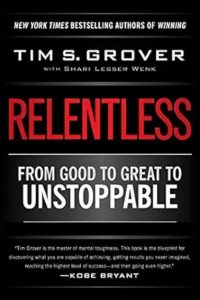
Relentless: From Good to Great to Unstoppable (Tim Grover Winning Series)
What is next? You are 39 years old. Your days are numbered like on the field. You talk about the good working in the front office and kind of bring in some of your other talent, abilities, and training to bear. What is the next like goalpost? I pardon the pun.
No, it is good.
That is a football analogy. I am thinking, “I am not a sports guy.”
It is close enough. You got it. I would say the first half of my professional playing career, I figured coaching was the next logical step, as most athletes do. As I got more interested in. The game holistically at the professional level. I got more interested in and curious, let us say, about other areas of life. I did not want to limit myself to that. I wanted to find what I can do to use my interests and my brain, and what I feel is like an intellectual curiosity, and apply that to the game of soccer. Management front office seemed like the logical step.
Later in my time in Montreal, like 2018, 2019, I would say somewhere in there, I started doing my MBA online and sports management. I really enjoyed it. I finished that, and I was still playing. I said, “I do not want to have empty areas on any potential resume moving forward. How am I going to fill that?” I had always done stuff with like the MLS Players Association, which deals directly with negotiating with the league on collective bargaining agreements and leadership stuff within your player groups and stuff like that.
I was already in those conversations and those leadership discussions. I had just finished my MBA. I had filled that area, but I was coming to a point where now what do I do? I was probably 34, 35. I am still playing. I do not really know what the next step looks like. We uncovered, actually, in MLS that there is a mechanism to buy down, let us call it your salary cap hit. This is essentially what the total cost of all the players on your team adds up to a total number. You have to stay under that number to be compliant with the league’s rules.
With this professional development role, which was in the collective bargaining agreement. It allows one player per team to take on this professional development role. You can get like half of your contract taken off of the salary cap while still receiving that compensation. We took that to the club and said, “This seems like a perfect opportunity. This is something that I want to do. This is great for your side, because this X amount of dollars will not count against your salary cap.”
They said, “Perfect, let us do it.” I do not really think that the first year, they had a real intention of having me do a lot with it. They just wanted to use it for more of the salary cap savings, which I was fine with. That was my entry into saying, “I have this on my contract. I am going to be in the building a lot more, and you are going to see me a lot more, and I am going to be doing a lot more with you guys.” I use that to my advantage and said, “I want to job shadow every department in this organization.” That first year, I job shadowed everything on the sporting side, from general manager to technical director, to Academy director, to coaches, to physical trainers, the medical people, but also the business side.
While you are putting in all the effort required of you to maintain your status as an athlete.
Correct. I knew I had access to all these people. When you are an athlete, you can open a lot more doors than when you retire as an athlete. If I make a phone call to, I do not know, name a business in Columbus, and I say, “I am a Columbus crew player. I would like to sit down and have a coffee with your meeting.” That goes a lot further than saying, “I used to play for the Columbus crew. Can we have a coffee or a meeting?” It does not hit the same.
I knew in those moments I needed to take advantage of where I still was. This all started within the organization. I met with the marketing people, the sales people, ticket sales, everybody. It started narrowing down what my interests were, whether I wanted to go on the business side and be more into, like the corporate sales or partnerships, stuff like that. Do I want to find a merge of that?
Integrating the soccer side and the business side, and looking to be more like a general manager, build out rosters, and still have that competitive fire. I found out a lot that first year that I really wanted to do that part. These last two years or two and a half now, or whatever it might be, I have spent a lot more focused time on doing things and working on projects with the sporting side, which is to talk about like asset valuation and stuff.
When I say asset valuation, I am talking literally about athletes. Athletes are the assets of the organization. How do you value a trade for a player or a draft pick? In the world of soccer, it is massive, and there are thousands of players all over the world, and anywhere from the US to Latvia to Congo to all over the place. How do you find these players? That is intriguing to me. When I get to that next phase of my life, I want to be like you are doing, I want to be able to move all over the world and experience different things through what I am doing in soccer, while also being seriously ambitious and driven to be really good at what I am doing.
I feel like that is like the perfect area for me to go to. That is really cool. It is a story of self-determination. I do not mean that like a bootstrap story, but the through line here is like, you have always assumed if it is going to happen, I am going to have to make it happen. You and I talked about this a couple of Sundays ago, but I do not have any data to support this.
It seems to me that when I encounter entrepreneurial people, and I would consider you in that category are just more likely to think about their own thinking than people who are just in a system and going through the motions. Just because they are being told what to do, they are being constrained by so many rules that lead a lot of people to think there is nothing they can really do. I will come here and do my time, but I will go home, and you are engaging.
That seems like a really tough existence for me.
It does.
I want to guard my guard against myself ever becoming that. There is a little bit of fear for me in that I am where I want to be in Columbus. There was also a feeling when we left Montreal that man, the adventure is over. Whether we lived in Montreal for ten years, Colleen and I.
You were like the LeBron of Montreal. I remember we came to visit once, and there was like a billboard, and there is heaven.
That was enjoyable. Learning how to move and live and succeed and fail and all the lessons that you learn in doing that. That was our mid-twenties to our mid-thirties, and those are some pretty formative years when you are a young adult still. There were a lot of really great experiences with that. It was not just because of the professional side of it.
It was because we were doing things on our own. As much as we love being around family and going to birthday parties and having help and all these things whenever we need it, mean being two hours away, still, but within reason needing that help. At the same time, we figured it out for ten years without that. Coming back to Ohio was almost like, “Man, the adventure is over.”
I have always wanted to protect myself from feeling that just because I am here, the adventure is over, because it is not. I want more adventures, but I want them to be on my terms. I feel like if I do things the right way and I work harder at it, my terms become a little bit more feasible than if I am not working harder and harder at what I am trying to do.
I have always wanted to protect myself from feeling that just because I am here, the adventure is over—because it isn’t. I want more adventures, but I want them on my own terms. Share on XThere are two things I want to double-click on there, Evan. One, the first is that life is supposed to be an adventure. I do not think a lot of people understand that learning, work, and play are all supposed to be energizing. Work is not supposed to be a beatdown. It is something you look forward to. You are energized by it. There are days when it is a beat down. Get that. I am not over romanticizing it, like, entrepreneurial people, people who are like, approach life as an adventure.
We are not saying “Thank God it is Friday.” We are saying, “Thank God it is Monday.” I love the way you characterize it, like that adventure is over. Like, “Where is the next adventure?” That is not the highlight. I will just sing Springsteen’s song Glory Days. I am not that guy. We touched on this a little bit, and I do not want to end this conversation without talking about this a little bit.
My interest in entrepreneurship has like very little to do with business. It has everything to do with human flourishing. That is the convergence of this conversation. What excites me about entrepreneurship is when people are able to develop their abilities in ways that contribute to the tribe, to the community, whatever. They flourish. They tend to experience lifelong growth and well-being. To me, that is what the story is all about. How are you making the most out of what you’ve got? It is awesome. Do you have a book recommendation, Evan? I know you are a reader. I know you are a thinker. Is there any? What is your go-to?
I would not say right now anything, anything on these topics. The book that I am just finishing now, I have been really more into longevity and like cellular help and cellular health and metabolism type stuff lately. It is basically just because I have been picking books off of Colleen’s shelf in her office that go with what she does. I am just finishing up Good Energy by Casey Means. It is interesting. It can get technical in terms of some of the stuff it talks about, but I think the stuff that I really find fascinating that is becoming more mainstream is some of the stuff we talked about with mindfulness.
I am sure Karen would agree that it is the foundation for everything else that you are going to do. If you are not mindful about what you are putting into your body, physically, spiritually, and emotionally, then you have no control over what you are doing otherwise. Starting with that and realizing the importance of it, and more and more people talking about that, and being more mindful about what we are doing daily, it is really cool to see.
It is about optimizing yourself. That is good. Evan, thanks for doing this. I really appreciate it.
It has been fun.
Important Links