
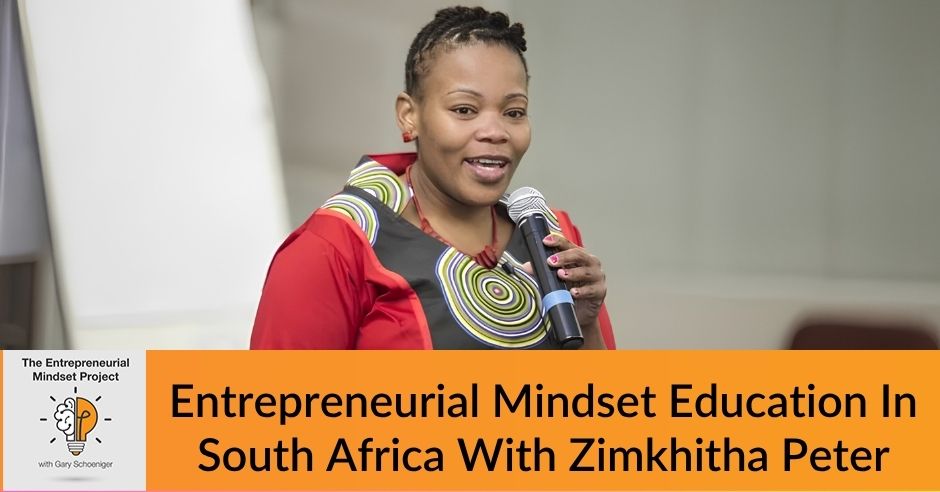
How do you keep students engaged when youth unemployment is hovering at sixty percent?
Today’s guest is Zimkhitha Peter, CEO of Allan & Gill Gray Philanthropy South Africa — one of Africa’s most influential foundations tackling poverty, unemployment, and inequality through entrepreneurial thinking. They’re also one of ELI’s most impactful global partners, and the first in the world to localize the Entrepreneurial Mindset Program for classrooms and communities across South Africa. Since 2023, Zim and her team have trained more than 600 educators and 3,500 students, with clear results: increased confidence, higher engagement, and a stronger sense of ownership, discipline, and initiative.
In this conversation, Zim and Gary dig into problem-finding and problem-solving as the skills education systems most often overlook, and what entrepreneurial thinking looks like when it takes root in communities where traditional jobs are scarce. It’s a conversation about what becomes possible when we stop preparing young people for a world that no longer exists — and start asking them what problems they want to solve.
—
Listen to the podcast here
Entrepreneurial Mindset Education In South Africa With Zimkhitha Peter
Discovering Entrepreneurship As A Powerful Lever For Social Impact
How do you keep students engaged when youth unemployment is hovering at 60%? Welcome to another episode of the show, where we explore the hidden logic that enables ordinary people to accomplish extraordinary things. Our guest is Zimkhitha Peter, CEO of Allan & Gill Gray Philanthropy South Africa, one of Africa’s most influential foundations dedicated to attacking poverty, unemployment, and inequality through entrepreneurial thinking.
They are also one of our most impactful global partners. In fact, they’re the first in the world to localize our entrepreneurial mindset program specifically for classrooms and communities across South Africa. Since 2023, Zim and her team have trained over 600 educators and more than 3,500 students. The results have been crystal clear increased confidence, higher engagement, and a stronger sense of ownership, discipline, and initiative.
In this conversation, Zim and I explore one of the big questions I think about every single day. What happens when you expose all students to the fundamentals of entrepreneurial thinking as an essential life skill? We go deep on problem finding and problem solving as the most important skills we could be teaching and why our education systems consistently overlook them.
We also talk about what it actually looks like when entrepreneurial thinking takes root in communities where traditional jobs are far and few between. This is really a conversation about what becomes possible when we stop preparing young people for a world that no longer exists and start encouraging them to think like entrepreneurs. Without any further ado, I hope you enjoy my conversation with Zimkhitha Peter.
—
Zimkhitha, welcome to the show.
Gary. Thank you so much for having me.
I’m really excited to have this conversation with you. We’ve been working together on and off for, I do not know, twelve years, something like that.
Yes, somewhere around there.
You’re doing some cool work in South Africa to push entrepreneurship across South Africa. Let’s just start the conversation. How did you get interested in entrepreneurship? Did it impact you, or did you witness it? What got you in this game?
Firstly, I must say that I got in here formally through the work of the Allan Gray Orbis Foundation at the time, even though now I’m with the Allan & Gill Gray Philanthropy South Africa, especially for South Africa, and this notion that entrepreneurship can be used as a powerful lever to attack poverty, unemployment, and inequality. After hearing it formally through this institution, reflecting back and realizing that I did grow up in an entrepreneurial family and it wasn’t called that at the time, but really all those mindsets that are wrong. What got me into this mostly was my passion to attack poverty, unemployment, and inequality in South Africa. Entrepreneurship is a powerful lever through which you can do that.
Entrepreneurship can be used as a powerful lever to attack poverty, unemployment, and inequality. Share on XIt’s funny you say that. You came up in an entrepreneurial family, but it was just normal for you. You did not even think it was different.
No, not at all. I did not think about it until school, and then I started seeing my grandfather from him. At the time, before reading Who Owns the Ice House?, I did not recognize that anything that he did was particularly entrepreneurial. Also reflecting not just on that, but when we did the mindset, realizing that while I did not apply it for myself, categorically in an entrepreneurial career by starting a business, I could recognize those mindsets in basically supporting any person to move out of poverty, even if it’s through employment, but all education, but what got them there with the different mindsets that get you there. The mindset issue was what brought the distinction and maybe made it attractive for me.
I love that you said that, Zimkhitha, and I’ll give you the $20 later for saying that. I do not. I think the world is waking up to the idea that entrepreneurship is an accessible pathway to economic mobility. That’s what Ice House is really the best thing. I’ve interviewed maybe 800 entrepreneurs all over the world. I’ve never seen a story as powerful as that that demonstrates entrepreneurship as such.
Also, like the power of teaching it to others, the impact Uncle Cleve had on his nephew. I just wonder if a lot of people still see entrepreneurship as just an alternative career path. Are you running into that? What I see in the US a lot, Zimkhitha, is that in colleges, they treat entrepreneurship like a career path. It’s like it’s medicine or it’s engineering or it’s science or it’s entrepreneurship.
I agree. I see that a lot. I hear that a lot when you talk to people about entrepreneurship, and they say, “I do not want to start a business.” You said, “Who said anything about setting up a business?” I do think that through this work we’ve been doing, slowly but surely around here, people are starting to see specifically an entrepreneurial mindset as being a skill and a mindset that’s necessary for all human thriving and all human flourishing, whether or not people are going to move into business later.
That’s so exciting to hear because I see it exactly the same way. About this in two ways, Zimkhitha. It’s like a way of thinking that’s necessary in change, in dynamism. It’s also a way of accessing a deeper dimension of human potential.
A hundred percent agree.
Cultivating The Entrepreneurial Mindset Inside Modern Organizations
I want to go down this path for a second and dig a little deeper into intrapreneurship. How do people embrace this way of thinking inside of an organization? Can you talk to me a little bit about that?
As all of us, when we talk about the world changing, I’m currently studying something called Leading in New Economies, talking about how the world is shifting with everything, with the big shifts around the world. Just think about, as you were saying, we talked about this idea of an entrepreneurial mindset when I met you about twelve years ago or more, when I read the book, and it resonated with me. I said, yes, I did not have words for this, but this is it because we’re navigating uncertainty.
I remember that first layer of saying it’s about being an investigator. It’s about going down a pathway. It’s not known. The path is not known. The waters are uncharted. Twelve years ago, I would even argue that it was more known than it is now with AI, with everything else that’s happening around us. We thought at that time we were navigating the unknown. Looking back, I’m like, maybe the world was more stable and more known. Yet those resources, that internal mindset, even in the workplace, as people are being thrown at these new tools and new things to do.
If you do not have that locus of control, you feel even at work that those things are happening to you. If you do not have that internal locus of control, if you do not have that resilience, if you do not have that resourcefulness, because you cannot go to any place and someone can teach you AI in one way. If we think about resourcefulness, we are requiring employees now to be more resourceful to learn, to navigate for themselves, to figure out how to make themselves useful.
I remember that you said that an entrepreneur of mine said, it’s not about people telling you what’s the most useful thing, but as an employee, you are now saying, as the world is changing, as the organization is changing, as all these other technologies are coming in, I need to find a way to make myself valuable. Instead of being worried that AI is going to replace my job.

Entrepreneurial Mindset: As the world is changing, as the organization is changing, as all these technologies are coming in, I need to find a way to make myself valuable instead of being worried that AI is going to replace my job.
On you, that entrepreneurial mindset now is more needed than it was probably when it was first conceptualized because the world has changed so much, and employees in our context, we call them talent, who do not possess this mindset will feel very lost and very replaceable because no one has a playbook on how to do business right now.
No one has a playbook on how to run an organization right now. No one has a playbook on how we’re falling off our feet on how to do the most basic things of business. If you are in communication, it’s changed now. People can come up with their own branding things. If you are in consulting, you are consulting.
If you are doing strategy, if you are writing board reports, even in our own context, whatever your job was, you have to rethink that job. What’s going to help you rethink that job is going to start with your own internal resources, your own mindset, in terms of how you are now going to navigate the fact that even if you ask your boss to say, “Give me what my job description is now, I do not know what the job description should look like.”
You tell me.
How AI is impacting your world and what you think is the value. When you enter jobs, people must tell you what value you must add. Now, I do not know. You tell me what value you must add.
I love that, Zimkhitha. I’ve been doing a lot of talks for CEOs. They all say, “I want my people to act like owners.” My question back to them is, “Why aren’t they?” I do not think people realize the way we’re training students in school fosters an external locus of control. Somebody’s always telling you what to learn, what to do, when to do it. It creates this mindset like somebody else is going to tell me what to learn and do, and I’ll do it. It’s a really subtle shift in perspective, like when somebody realizes, “I have to do my job, but I can look above my cubicle and see what else needs to happen.”
That’s affecting my job. That’s definitely true. Also, I think for leaders is to say that leaders have to change. You cannot also expect that people must come and be entrepreneurial, but yet your incentives, your performance management systems, and your environment are very punitive towards entrepreneurialism. You want so much certainty.
You have to create that environment where experimentation is allowed, where problem solving is allowed, where failure is allowed, because we are all figuring it out. How you align business incentives, how you align performance incentives, so you also have to create an organization that encourages people to say, “I want people to take more risks.” When one person does take the risk, and it goes wrong, they get punished. No one else is going to take a risk.

Entrepreneurial Mindset: You can’t expect people to be entrepreneurial when your performance management systems and environment are very punitive towards entrepreneurialism.
Building Environments That Encourage Experimentation And Risk-Taking
That’s exactly it. Zim, when my new book came out last November, I was invited to give a talk at the Harvard Human Flourishing Program. I walked into the psychology building. You know me, like, that’s my jam. Psychology is my thing. When you walk into it, it’s called the William James Hall. William James was the first American psychologist. There’s a quote from William James in the lobby of the building. It says something to the effect of, “The community needs the impulse of the individual, but without the sympathy of the community, the impulse will die away.”
That’s what you’re saying. We can teach people to be entrepreneurial because it’s a natural impulse. It’s not like we’re teaching everybody to be engineers or plumbers or scientists. It’s like it’s a natural inclination that’s dormant, but if we do not create the conditions, it’s not going to come out. It’s just going to die away, or it’ll manifest somewhere else. That’s how I think about it. There are two parts to it. We can teach students to think entrepreneurially, but if the rest of the classes are top-down, memorize and regurgitate, it’s harder to sustain that.
That’s also part of our work where we talk a lot about education ecosystems and entrepreneurial ecosystems that the system itself must encourage. As you say, it’s in all of us. You remember some of the talks. We say it’s not just in some of us. We are born entrepreneurial. We are born exploring something. We’re not trying to make ourselves.
What we’re trying to do with this training and mindset is to, again, help people rewire themselves to what they naturally are, but through schooling, maybe we learned we are not allowed to. To be who we are, to say, then how does that environment enable that? Just like for children that are curious and all of that, you create a playground. What does the playground look like for society, I guess?
I love that, Zimkhitha. You said something earlier, like we have to create the conditions that are conducive to what I would say experimentation and adaptation, but micro-experimentation, not disrupting. About this a lot, that there’s a managerial function in an organization that the useful thing, once a useful thing is known, we’ve got to figure out how to reproduce the useful thing and get it out into the world. That’s necessary. I do not want to say that managerial systems are bad. What you’re saying is we have to understand the difference between managerial and entrepreneurial functions.
Yes, and find a way for both of them to live in organizations. I’m also proposing, Gary, just like we would go to say where we are, maybe let me talk about where we are right now. If you had quadrants, if you said there’s an entrepreneurial system that must exist in the organization, once we figured out the thing to do, we must then spend time in the Mediterranean, which we need.
If, many years ago, just as recently as five years ago, we had figured out most things, so say we lived 70% or 80% of our time in a managerial quadrant because we figured out most things, and we spent 20% experimenting, I’m suggesting that the world has flipped. We now have to go back to most of the things. Something like in our organizations, we’re now seeing HR managing performance. We’re just talking about it at work. What do we do when a manager produces, what do we do when someone produces an AI-generated output?
Even the thing that we knew how to do, performance management in HR, a standard function, is HR. Now, with AI in all the new worlds, the things we thought we knew how to do, we know how to set performance targets, we know how to meet people one-on-one, we know how to run incentives. I’m suggesting that the world has changed so much that we need to go back and try to figure it out.
The world has changed so much that we need to tap into our entrepreneurialism because there's very little left to manage at this stage. Share on XWe need to go back again to figure it out, and then bring it back to this managerial season that we’re now in that season. Finance, we thought we knew how to do finance, even in organizations, and finance people are sitting there. Now there’s an agent that we can build on AI that can do that thing in two minutes. Now a finance person must figure out what I need to do? I’m just suggesting that, where we are in the world and with some of the other things that are happening, we have to go back and figure it out. We have to tap into our more entrepreneurialism because there’s very little to manage at this stage.
I agree with that, Zimkhitha. It’s like everything has to be reexamined. Is that what you’re saying?
Yes. The people who are ready now to re-examine are the people who have somehow been experimenting with that entrepreneurial lens with that thing. It started with COVID. We thought we knew people must come to the office. This is how you do offices. It threw us off. Now we’re hybrid. We got into it. More entrepreneurs to figure out what work is. What does it mean? Do I need people sitting in a seat counting the clock? From time to time, every revolution or major change or shift in the world calls on us to be more entrepreneurial in how we think about things.
We have to re-examine everything. Certainly, we are in our organization. I do not know what some of the roles must even do. Even mine, I said. People can ask questions about AI to tell them something. I need to say, what does it mean now to be a leader? What am I meant to be? What am I currently in my organization? I’m a manager and a steward of the mission and the vision, and the purpose of why we exist and the impact we want to create in the world. I’ve now become a manager of purpose. That’s the thing that’s in management.
Our purpose is not going to change. Our vision is not going to change. We want to attack poverty. How it’s going to happen, we are all re-examining. Those processes. We had mapped systems, Gary, here. We’ve got process maps of twenty steps on how to do something. We were in management mode. This is how you write a recon. This is how you write a report. This is how you do this. This is how management works. We have all the systems. All those systems have been thrown out. All our SOPs with protein consultants met processes. Now I’m not sure.
Redefining Purpose And Performance In An AI-Driven World
I love the idea of a manager of purpose. That’s powerful. There’s a thing about AI where educators are very worried about AI and kids cheating. I’m always asking the question, why are kids cheating? Just step back for one minute. This is an exercise in what you just said, only instead of HR, I’m saying in education. You’re worried about kids cheating with AI, and you’re spending all this time reading their papers to try to find AI language.
You’re spending all this time like being a detective, trying to figure out if they wrote it or whatever. I want to step back and ask the question, why are they cheating? The answer is very clear to me. They’re cheating because they’re in a system. They’re in a punish reward system. Cheating is a natural outcome of extrinsic reward and punishment systems.
That’s true. Also, because there are two universities here in our country, I won’t mention them. University Acts said, “We do not want AI. Do not use AI.” We’ve got all the detecting things that can detect it. Now even AI has got things that say, “Humanize us.” We can even ask it to make it sound more human. They said they’re gonna do that because when it comes back to test scores, what were schools examining? How well can you regurgitate information? The amount of information you can keep, memorize it, take it back, you get marks for.

Entrepreneurial Mindset: Every major shift in the world calls on us to be more entrepreneurial in how we think about things. We have to re-examine everything.
There’s no critical thinking. Your own brain is not involved, and other things are not involved. University X said, “We’ll find you, we’ll punish you,” and all of that. University Y took out a statement to say, “We’ve tried that. It doesn’t matter. We won’t dictate. We can do whatever.” We’re going to find very different ways of understanding that you’ve learned. I thought there was no force in the university.
It’s to say, “No, we do not get that. We can regurgitate information back to us.” We’re not going to spend loads of amounts of money trying to build AI dictators and spending a lot of time figuring out whether people have used AI to give us answers or not. What we’re going to do is going to find a different way of understanding whether learning has happened and what learning means.
That’s it. That’s super powerful. Last week I was in Mexico. We’re doing some work with Tecnologico de Monterrey. It’s the number four entrepreneurial university system in the world. It’s 129,000 students on 29 campuses, I believe, across Latin America. Zimkhitha, they hired me to train non-entrepreneur faculty on how to create learning environments that cultivate self-directed value creation, which cultivates entrepreneurial thinking for the same reasons you’re saying, like everybody needs this.
One of the things that’s so interesting to me, they gave me full permission to have meaningful conversations with faculty. I treat these sessions, Zim, like opportunities to bring our own deeply held values and taken-for-granted assumptions up into the daylight. Look at them and say, “Is this still appropriate? Maybe we need to get rid of this one and replace it.” One of the big questions we are asking is, we now live in a world where knowledge is at our fingertips.
I can have AI explain to me the fundamentals of physics instantly. I do not need to sit in a classroom and listen to a lecture on the fundamentals of physics. This is very threatening to the academy, first of all. The bigger question in my mind, Zim, is we now live in a world where knowledge is at our fingertips. What is the role of the educator in this world? It’s what you said about leadership. It’s about agency and adaptability. Now it’s about mindset. The way I think about mindset, Zimkhitha, is that knowledge and skills are important, but mindset determines how far you get with what you know.
Reimagining The Role Of Education For Human Flourishing
Gary, I couldn’t agree more. I was thinking, as we’re saying, that in terms of what is the purpose of education and what it is for. I was just thinking about this thing, this other research paper, and someone, firstly, you said you can learn physics or fundamentals of physics if you wanted to know, so that means it tells me that there’s something a mindset in you around self-directed learning, self-directed being a steward of your own learning, your own education, and what you want. For me, part of the role of the educator is to ignite that.
It is to ignite something in people that then causes them. I remember you had one of those quotes in your slides to say, “Do not ask children what they want to be growing up. Ask them what problems they want to solve.” While we have a lot of information in the world, we have a lot of problems. We have many, especially where I live. With all the information, the problems haven’t been solved. The problem of poverty, the problem of children. In our country, literacy and numeracy. There are lots of other problems that haven’t been solved at a local level, family level, or global level.
There are many problems. The information and the problems are there. We have to ask ourselves. If we had human beings as people, there are problems. There’s information. Where’s the agency so what are humans for? Lacking a better word, useful for, education must support humanity to solve its problems, not just knowledge being used for the problem. The role of education, the way I see it, is not to give people more knowledge. They know the knowledge is probably to support them in how to use the knowledge to solve human problems for collective flourishing.
The role of education is not to give people more knowledge, but to support them in using knowledge to solve human problems for collective flourishing. Share on XI absolutely love that. That’s it in a nutshell right there. What can you do with what you know? Zimkhitha, I’d love to hear what you think about this. I’ve been focused on three things lately. I’m focused on agency, adaptability, and the ability to create value in any context.
I love those, Gary. Agency, adaptability, and the ability to create value in any context.
Let me go one step further. This is scary. We’re building a new program called the Mindset Advantage Program. We’re going to take entrepreneurship out of the title. We’re going to call it the Mindset Advantage Program. I’m not running away from entrepreneurship. I’m not denying it. I’m saying this is a framework that we distilled from studying the lived experience of everyday entrepreneurs, but it’s a framework that applies to all aspects of life.
What I’m saying, Zim, is I’m afraid that too many, you said it at the beginning of this conversation yourself, people hear that word entrepreneur and they go, “I’m not interested.” What do you think about that? Do you agree with pushing the word entrepreneur out of the title, or do you think we should just own it and keep going forward?
It’s in the same way that actually a lot of teachers or educators have suggested that when we engage with them around the entrepreneurs, then they listen and listen. After some time, they say maybe what’s off-putting, they would call it off-putting, is the word entrepreneurship. If you’d given me this framework on its own, it selects people out because of certain connotations that they already have. You may know that some call it 21st-century skills. Some, they call it soft skills. They’re thinking there’s nothing soft about them. They’re probably the hardest thing to do and what’s necessary. I’m not sure why they’re calling it soft skills. They probably do not. That is true to master.
I would say push that envelope and let’s see how it goes. My idea was that it would be more inviting to the conversation, and it will be more, it will include more people who probably self-selected out of this very fundamental, what are called mindsets that are required, as this word we continue to use for human flourishing, because for humanity to flourish as a whole, individuals must flourish. You cannot have a system that flourishes without the main players in that system, which are humans, flourishing.
I often think about nations, countries, schools, any system that puts human flourishing aside and thinks that the system itself can flourish. People make up the system. They are the system, and there’s no country or nation that can outperform its people, the flourishing of its own people. If the resources in any nation, in any country, in any organization, in any school must be brought back to look after the flourishing of its people to ensure that the entire system flourishes.
Human Infrastructure: Distinguishing Entrepreneurial Discovery From Management
Let’s dig into that because I really like where you’re going with this, Zim. I’m now thinking of my work as like human infrastructure for an AI world.
I love that. Human infrastructure.
This is human infrastructure. Like knowledge and skills aren’t going to get it anymore, like you just said. It’s mindset enablement.
There is no country or nation that can outperform the flourishing of its own people. Share on XI was chatting to these other professors who talked about this human infrastructure, and they said, “We bring a lot of people into entrepreneurship programs. We train them on how to run a business, and we take them out there, and then we wonder in 3 months, 6 months, a year, when things get tough, why the people aren’t there, stop the businesses, or whatever.”
I’m thinking of this human infrastructure, and said, “I realized there’s something about the people’s heart studio.” She called it the heart studio. You’re right. It is the human infrastructure system that will flourish in this world. It is all about that. As you said, it’s less predictable, less predictable than when you started this work. Now people are scared and afraid and do not know which way to turn.
Also, in the scenario you just described, a lot of people, a lot of universities, a lot of entrepreneurship, programming, let’s call it, they conflate, or they confuse, entrepreneurial and managerial. They just mash them all together. What they’re really teaching, they’re taking the concepts from business school and putting some new paint on it, and they’re calling it entrepreneurship, and it’s not that. If I can connect these two ideas, maybe the attitudes and skills required to discover opportunities are entirely distinct from the attitudes and skills required to exploit the opportunity.
I agree 100%.
They’re just completely separate. This brings me to another point, back to an earlier point we were discussing, which is that not everyone wants to start a business. Pretty much everyone wants to discover opportunities. That goes back to you.
It brings me back also when we’re talking about being entrepreneurial. Where I work, people are trying to discover the opportunities for them to make the most impact inside this organization and inside the job and inside the work that we were meant to do. People are trying to find the best opportunity for me to do that. I 100% agree with you.
Sometimes when I speak to younger people, I would say to them, “Show up fifteen minutes early and stay fifteen minutes late and watch how quickly opportunity finds you.” That’s like entrepreneurship 101. What you and I are both getting at without really saying it is a subtle shift in mindset. It’s a subtle shift away from someone else telling me how to be useful, and I’ll be useful to myself- self-directed. I just think of it as other-directed value creation versus self-directed value creation.
More and more companies are looking for that, and more organizations are looking for that, and more people, like you’re saying, even in their own lives are currently looking for that. Currently, especially the big part of saying whether the education system is creating an environment that is supporting learners to discover that is yet to be seen. It’s probably one of the biggest outside the home, outside everywhere else. That is where we really need it.
Maybe that is why we are passionate in particular about the education system embedding and having the infrastructure for this thinking of being the right environment to ignite this in young people. If they can think of it that way, they can start discovering that, as it’s been said many times, they’re going to school for jobs that do not exist. Five years ago, ten years ago, we never said prompt engineer in my career.
Shifting Perspectives: Opportunity Discovery Vs. The Search For Jobs
I remember being struck. It was April of 23 when we did the initial cohort in Johannesburg. There were maybe 225 or 250 TVET lecturers. Zimkhitha, I remember it like it was yesterday. It was impactful for me in many ways, but one of them was that during the training, many of the teachers were expressing concern that there are no jobs. What are we preparing these kids for?
This youth unemployment rate was extraordinarily high. I remember 60% or something at the time. In the evenings, when we’d walk across the resort and interview South African entrepreneurs, young entrepreneurs, they all said to us, “There’s opportunity everywhere.” I was struck by, “Wait a minute. Do you guys live in the same communities in the same country?” You see the world very differently.
Remember, you’ve made two distinctions. The one said there are no jobs, meaning that there is no one who has figured out how to be useful, and how can I be useful? Therefore, come on board. The other person is saying, “I see the world and these problems, and I have figured out for myself how to make myself valuable.” The one was talking about a job. The other one was talking about an opportunity. As I say, sometimes people think there are no jobs, but there’s a lot of work to be done.
Sometimes people say there are no jobs, but there's a lot of work to be done. Share on XThat’s an important distinction. That’s an anecdote that demonstrates how the world is changing. How institutions are struggling to keep pace.
That’s where we talk now really also about the system, because we’ve instilled systemically in young people that go to school, get good grades, and when you are done, a job will be waiting for you. Societal systems, education systems, may have unintentionally let people down in framing a narrative that says, “Go to school, get good grades, a job will be waiting for you.” That’s what even the lecturers are alluding to. As we are training young people, we say we’re preparing you to get a job. When they end there, then there is no job waiting for them.
That narrative, even at a school level, needs to change so we are not setting up young people for failure. The other challenge that we also find, maybe nothing to save young people or one of their new jobs, is to let everyone start a business, which I also think is an unhelpful narrative, especially when some people are also struggling with bread-and-butter issues. I cannot even think. I do not have food on the table. I do not know where my next meal is going to come from, yet I have to sit here and suddenly become creative and suddenly come up with those things when my basic human needs are not met.
That’s why I was talking about an enabling environment, that we need all people playing their part. We need the system playing its part. We need everyone to make sure they create a social safety net. For them to be, and we also not to stop. Maybe it was true 100 years ago that you go to school and get good grades. I do not think we have changed that narrative, even though it no longer holds true. No one is saying at school, “Come here. We’re still going on in the old system.” That might have been okay in the Second Industrial Revolution for us to say that, but to realize that it’s changed.
Zimkhitha, I love that. That’s increasingly where my work is going. I love that you said, like, “That doesn’t mean everybody starts a business.” Please, for goodness sake, stop with that narrative. I go to these conferences, Zim, like Global Entrepreneurship Congress, and I hear this talk of the ecosystem. When I hear that word now, I get a little bit irritated because most of what I hear about ecosystems isn’t really an ecosystem. It’s a safari. They’re big game hunting.
They’re not nurturing the soil. They’re looking for the next Mark Zuckerberg or the next Elon Musk or the next Jeff Bezos. I’m saying that, if in the ecosystem, we’ve got to, I think mindset is like the mycelium of an ecosystem. It’s the, it’s, and I’ve been thinking about this a lot, Zimkhitha. Several hundred thousand people have been to our Ice House program around the world.
I do not know what the number is, but only a very small percentage of them have started businesses. You’ve seen it yourself. They start showing up differently. They start bringing themselves to their jobs. They’re more employable. They are adaptable. They’re better equipped to make a contribution to their organizations, their communities. They’re never going to start a business. Some of them will.
Overcoming Helplessness Through Agency And Early Resourcefulness
I couldn’t agree with you, Gary, and also with this idea. Again, why our organization was passionate about this in South Africa was seeing how it might, this entire idea of an entrepreneurial spirit and mindset, a human infrastructure, a human infrastructure, let me say that, how it might, and I think I mentioned this to you at some point, how it might bring healing at some point, because what happens is the lens of helplessness.
When you’ve been in a system where you feel like less than, or you cannot, and how, in itself, knowing that I have agency, I can be resourceful. If you learn that at a very young age, that’s why we’re getting this into schools, because we’re saying if young people can learn at a very young age how to be resourceful, it’s too late by the time a person leaves school, and they do not have a job. Now we are trying to get someone who’s hungry to be something that we did not show them this way of being.

Entrepreneurial Mindset: For humanity to flourish as a whole, individuals must flourish. You can’t have a system that flourishes without the main players in that system flourishing.
We owe it to young people to show them this way of being while they’re in a school’s sorry environment, to say well if for example you do not have X or you do not have Y. I’ll give you an example of another young person I had a story of they were going to a very good school but they got through the through support of others and they did not have and they realized that they were with kids that a little bit wealthier, and these kids would wear sneakers, and then they do not need them, and then they do not need them.
They said, “Can I take these sneakers of yours? They’re already in high school.” Can I take the sneakers that you do not need, clean them up, and go, “Sell them at a reasonable price to other people who still want this brand name?” For me, those are the things, or how people think about what I do, if I do not have a school bag, or I do not have textbooks. If we help young people solve for that, this other young person I was talking to said that they went to UCT.
They wanted to study actuarial science. They learned that for them to study actuarial science, they needed additional maths. Some maths’s called EdMath. Their school did not offer EdMath because it was a school in a low-resource environment. They knew that across town, there was a private school that did offer EdMath. They took a taxi, they went to that school, they knocked, and they sat in the office to ask a teacher to say, “Our school doesn’t teach EdMath. Can you give me old question papers and any material? We’ll go self-teach.”
That is one of the most successful entrepreneurs we have now in this country. The resourcefulness from the day they did not have a teacher who taught them maths. They were not running a business at the time. They hadn’t started a business. They learned to problem-solve for a school subject. They carried that mindset through, and this is probably their fourth most successful business. The other three businesses failed. That mindset, they have carried that mindset through. When I used to interview young people for an entrepreneurship program, we interviewed these young people in high school.
At that time, they hadn’t started businesses, but there were certain things they would say, “My school is very dirty, and I started a cleaning campaign.” That’s the agency. That’s doing something. That thing, if you do that, you spot opportunity. You do something. You’ll be like that in school. You’ll be like that at work. You’ll show up differently in your career at different times, whether or not you ever start a business. That’s why we are now inside Africa, trying to work so hard to say, can we have this in schools? Can young people do this if they can solve an academic problem? If they can become resourceful for not having lunch, whatever that is, then they will carry that mindset with them everywhere they go.
There’s a lot to unpack in what you just said, Zim. It’s so powerful. I wrote in my book something about how college is too late. Think about soccer. Think about soccer. Do you think Lionel Messi started training for soccer when he showed up when he was nineteen years old? He started when he was four. I’ve been thinking about this even when I was in Mexico last week. At tech, they have a similar problem. There’s a lot of energy around high-tech startups. That’s appealing to a very small percentage of the population.
They want all students to graduate with, I forgot how to say it in Spanish, emprendedora mentalidad. They want all students to graduate with an entrepreneurial mindset, but there’s this gap. They have a high-growth startup. It occurred to me, Zimkhitha, that in so many of the entrepreneurs that I have interviewed, these things were processing in the brain for a decade, or “I was selling candy in middle school or high school. I was mowing lawns. I was doing things. I was tinkering. I was trying to build this or that.”
We can use bamboo as an analogy. All this stuff is happening under the surface that’s invisible. The bamboo comes out of the ground, and you cannot stop it. That’s what we have to think about entrepreneurship. We have to cultivate this mindset. I’m even going to go one step further. I do not even know how to say this, but it’s not even that we have to cultivate this mindset in students. We have to just stop suppressing it. It’s a natural thing. The desire to contribute is innate. The desire for autonomy is innate. The desire to learn is innate. We’re stifling all of those things.
We’re telling young people, somebody else is in charge. Somebody else is going to tell you what to do. One of the things I want to dig into a little bit, if we could, is that I extracted, let’s say, this framework, this mindset enablement framework from studying the lived experience of everyday entrepreneurs. That happened to be dumb luck, Zimkhitha. I was always trying to, I’ve never really thought of entrepreneurship as a business discipline. I’ve always thought of, like, I’ve always been curious about how people who come from behind get ahead.
Unlocking Hidden Human Potential Beyond Academic Metrics
That’s the problem I’ve been trying to solve. It’s not ” How do you start a business?” It’s, “How do people who have nothing or have very little, how do they do that? That’s where my research led me, like interviewing these everyday underdog entrepreneurs. What I wanted to talk about a little bit is that a lot of these entrepreneurs were not remarkable students. I do not know how to think about that. You know what I mean? They’re like a very high percentage.
I haven’t kept track of the percentage, but a very high percentage of the entrepreneurs I’ve interviewed have said, “I wasn’t very good in school. I did not like school. I never went to college, or I dropped out of school. I do not know what you have to say about this, but it seems to me the lived experience of everyday entrepreneurs exposes a hidden dimension of human potential that we cannot get to. You just cannot see it with grade point averages or academic achievement scores. There’s this adjacent dimension of human intelligence.
It’s amazing that you say that our government system has also been trying to. We’ve been working with them, and I think we also tried to be allowed to say, They do not want young people now walking out of school just with the report card that talks about how they did in math and in English and others. They’re saying there’s got to be more. There’s got to be more than what you’ve gotten out of the time and the environment, or how do we design that environment?
Saying, “Even if you do not measure, in inverted commas, how do we give a more holistic report?” After someone’s time and so many years of learning about their problem-solving, their collaboration, and all of that. There is a sense that people walk out of school with more than that. Actually, the other one drives the education outcomes. I did tell you this story when we did a mindset in another school where the teachers came back saying, “Those kids that were very destructive in class,” that were doing badly, when they started doing this mindset stuff, even their education started changing.
Even their education outcomes started changing. We thought that maybe education outcomes drive entrepreneurship or entrepreneurial mindset, whereas entrepreneurial mindset can drive the education outcomes after, and entrepreneurial outcomes, and it’s the base that allows all other things to flourish. One of the reasons why, inside Africa, they think about what they’re calling a three-stream model is to say some people won’t go to education all the way to grade twelve or to university.
Even if they leave at a certain point, how do we ensure that they leave with something that they can use in the world? I keep asking myself, even with schools there, why do people go to school or to certain schools or to particular schools, and what is it that education has given them that gave them an entrepreneurial advantage? Sometimes what gave them the entrepreneurial advantage, the ones that have been to school, sometimes it’s the networks they built.
It’s the social capital they built in school, rather than it being because they knew this subject or that subject, or what school allowed them to build through sport. They learned how to build teams or to work in a team or to be in a team through leadership roles that they’ve had. They learned something else. Everything that is now happening made them succeed entrepreneurially when they went through a schooling system. Sometimes it’s been less about the academics, but it’s been every other skill they’ve learned through sports, through being involved, that has now helped them succeed in their entrepreneurial endeavors.
Creating Entrepreneurs By Design And The Economic Power Of Small Business
What you’re saying is, if I hear you, if I understand you properly, it is like we’re creating entrepreneurs by accident rather than by design. That’s insane. When you understand the economic impact alone, leave the human flourishing part out for just a moment because I think it’s more important, but policymakers are more inclined to look at the economic impact. Let’s go there for a moment.
The data is not controversial. My friend Tom Rue is running a foundation in North Carolina to promote entrepreneurship as a means of economic development. They bought 100,000 licenses of Icehouse. They trained 400 educators across middle school, high school, college, workforce, all these different programs. They doubled the number of startups in the state of North Carolina. The governor of North Carolina published a report, Zimkhitha, showing that in a state of eleven million people, what’s the population of South Africa?
Fifty-nine Million.
We’re talking about five plus five X, but anyways, North Carolina.
A state for us will be similar to a province in a way. There are provinces that have 5 million people, 9 million people, 6 million people, 11 million people. The sizes of the provinces vary.
What the governor’s report showed, and I’ll send it to you if you want to see it. By increasing the number of small businesses that get to between $50,000 and $100,000 in total revenue, which in US dollars isn’t that hard to do. You can do that with a lawnmower or a vacuum cleaner in a cleaning business. A five percent increase in those small businesses adds between $1.5 and $2 billion to the state’s economy every year.
I would love to read the report because we are currently going to provinces to advocate for that.
I’m happy. I’ll send it to you as soon as we get off the podcast. It just demonstrates the aggregate impact of cultivating small businesses, like these little small businesses. The way I think about the ecosystem is, the very top of the pyramid is a tiny fraction of high-growth entrepreneurs venture backed. There’s nothing wrong with that. I’m not denigrating it.
I need people to understand that that’s such an infinitesimal fraction of startup activity that if you round up to a whole number, it’s zero. It’s just a tiny percentage. When people talk about ecosystems, very often that’s what they’re talking about. Part of the problem that you and I are trying to fix is that people hear the word entrepreneur and they think that’s what that means. I’m saying, let’s look at the aggregate impact of just these little small businesses.
The broader impact is beneath the surface in mindset. Mindset enablement will definitely increase the number of small businesses, which will increase the number of high-potential businesses. We cannot overlook the people who just show up differently, like that impact. Ultimately, the human flourishing impact. I said this in my book, Zim. If we take care of human flourishing, like the economy, it will take care of itself. If we just focus on economic impact, it’s the wrong way to think about it, in my view.
I 100% agree with you.
Back to the education thing, one of the things I’ve been thinking a lot about that I’ve written about is this idea called self-determination theory, SDT. Are you familiar with that?
Yes.
Autonomy, competence, and relatedness are essential psychological nutrients to human flourishing. Why aren’t we organizing school around those fundamental things? I also think that the entrepreneur just blindly stumbles into that. They stumble into the conditions. They’re autonomously pursuing things that are interesting to them in ways that are useful to other people. They unwittingly create conditions that lead to their flourishing. Why aren’t we doing that on purpose? Do you see what I’m saying? School suppresses autonomy. It promotes other directions. I do not know. I just think the biggest lever we can pull is in school, and the earlier, the better.
Transforming Schools Into Entrepreneurial Learning Environments
I fully agree with you, and currently we have a program we’re calling Inspire. Really, it’s about how you go to school, and that’s something we’re thinking hard about, but we’re not thinking about how you go to school and teach students entrepreneurship. The question we’re grappling with is how do you make the schooling environment itself become that hub, so to speak, or make a learning environment unlock and get out of the way? You’re saying that people are born with it, do not suppress it, get out of the way, and find ways to nurture what people already have.
If the environment doesn’t do it, because what we’ve done maybe for long is to come inside the school and train entrepreneurship, and then when that intervention leaves, the facilitation or the training leaves, then the school itself is left to carry on, or what happens is that it’s seen as another subject next to the many subjects that are being done in the same way that we’re talking about. What we’re currently grappling with is how do you do that? For us, how do you do it at scale?
I can do it for 3 schools, for 5 schools, for 10 schools, but we are trying to figure out a model with a few schools we would like to pilot with and support them to say, “What does it take to make the school an entrepreneurial learning environment?” We’re calling them learning environments. How do you make the school an entrepreneurial learning environment? While we are talking to policymakers and that, and say, most importantly, how do you do that at scale so that the schools themselves transform themselves? While the school, we’re asking why we know those things, because people, you get out of the system what you incentivize.

Entrepreneurial Mindset: If we can agree on what an entrepreneurial learning environment looks like, human nature will follow. You get out of the system what you incentivize.
If we incentivize the marks and this and that, people will focus on what is the thing that’s being incentivized by the system. If we can agree, what does an entrepreneurial learning environment look like? That gets incentivized for schools to be like that. Human nature will do what gets rewarded at some point. We reward that. That’s the behavior. I’m a hundred percent with you. We certainly also do not have the answers. The question we’re asking with a couple of schools on board is, as you understand, we’ve trained lecturers. We ask ourselves, how do you make the environment itself and put what they need?
You make the garden or the soil fertile and put everything that the soil needs so that it’s not a self-selection. Something that every child you put into that school, it will be by design that they will all leave entrepreneurial, or they will all leave with this infrastructure and what they choose to do with it, whether it’s for a particular career, be a doctor, or start a business. What they choose to do it and do it 100% right, the more and more people can do. Lastly, for us, one of the initiatives we’re thinking about is making schools learning environments.
The other one with this thing we talk about, we are starting a roadshow in April to start talking to provinces to say, “How do you support your own province or your own district, your own community, to be more this, to be more entrepreneurial, or to have this environment so that we want to see how we can support, even as a philanthropy, because we want to see more and more people intentionally working to create economic opportunity through businesses more and more.
We’re seeing that if we do not have just a couple of startups up there in the top, and you’re right, they’re important, there’s high growth, but how do we, even at a community and local level and provincial level, double the number of businesses that are there, the number of SMMEs? In our environment, we’ve seen small businesses that create jobs and absorb a lot of people into them.
If we can do that in a province and try to understand what it is that province needs, we might be able to do our thing, be more successful sometimes than trying to do it at a big country level. We have nine provinces and 60 million people, more than if we try and tackle it one province at a time. Similar to this governor, if we can get the leader of the province to agree to buy into this, then we can find ways to put it into society. I’m just saying that whether it’s schools or whether it’s nations, whether it’s provinces, whether it’s districts, it has to be by design.
That’s where I’m going with my work, Zim. I’ve trained 4,500 facilitators through a certification program, which you’re well aware of. I’ve done thousands of workshops. It happens again and again. People will say, “I have no interest in entrepreneurship.” Once they are able to redefine entrepreneurship as just self-directed value creation, as opportunity discovery, as this skill set. I keep coming back to agency, adaptability, and value creation.
Ecosystem Orchestration: Balancing Top-Down Policy And Bottom-Up Training
Once they see how their students respond to it. I guess part of what I’m saying is that getting to the teacher is everything. If you cannot inspire the teacher, then this begs the question, Zimkhitha, and I do not know what the answer is. Is it a bottom-up, top-down approach? Do you make training and resources available to teachers and they can sneak it into the curriculum, or do you have to get the leadership to say, “We’re going to do this on a wholesale basis? I do not know what the answer to that is.
In all, my current view is that you do both. We’re learning through this work that you need an ecosystem of both, and one cannot wait for the other. For the schools that are self-selecting to come in and do that, we are doing that with them, as you might know, training them, supporting the teachers to do that. For the work to really happen at scale in the entire system. At the same time, we are talking to legislators and policymakers and seeing how that can be done.
At the same time, we are talking to the learners. For us, when we’re talking about an ecosystem approach, for us to say, “Who are all the key stakeholders? What’s needed? How can we play the role of being a coordinator and an orchestrator of making sure that these people are sitting around the table?” My sense is that, for example, if you only talk to legislators, things take too long in the system, and you do not have proof points. You will take forever. You might not even get there.
If you only talk to teachers, because all of us, our time is limited, our resources are limited, you can only go so far in our context. To only be able to reach 250 teachers, there are 20,000 schools in South Africa. Only 250 teachers get there. The government is responsible for education. If we can start with the 250 and write the case studies and write the reports, when I was asking about that report and showing the proof case, you use that as a pilot site to make it easier for you to influence the government.
At some point, when they say yes we’re ready. We do want this now. It’s much easier to scale. Also, for us, that’s the role of philanthropy and foundations and private organizations because we can deal with risk quite quickly. You can do the pilots, you can do the learnings, you can do the proof points, and you bring the legislators around. Say, “This is how it’s worked, these are the learnings, and this is how it might happen at scale.”
You still continue to bring the private sector to say, “This is how you might support it.” You continue to bring the learners along, ensuring that they do understand why this is an important aspect of their growth and development. As I’m saying, you do both, but in every place you need a strong coordinator and convener who can see the parts of the system, who can work with all parts of the system, and you need all parts of the system to be able to work.
I like that, Zim. Start where you are entrepreneurial, and start where you are and use what you have. Here’s the way I think about this, Zim. The role of Eli like we’re building this new mindset enablement platform. The way I think of Eli is that all we’re really doing is going through the world and saying, “We’re interviewing hundreds of entrepreneurs, whether they’re in South Africa or South America, it doesn’t matter.” This is a universal thing, a universal impulse.
We’re harvesting those insights. It’s like a big machine harvesting the insights and turning those insights into learning tools and materials that can be available to teachers, to leaders, to educators. I now see this work as, I was doing some work in Cameroon last year. Here’s my point, Zim. The greatest natural resource we have is human potential, untapped human potential.
I agree with you.
It’s right there. That’s part of, like, our shared passion, you and I. We’ve seen it. We’re trying to, like, shout to the world, like, “It’s just a couple of inches beneath the surface. It’s not 1,000 feet down. It doesn’t require it.” What I was saying to the Minister of Small Business in Cameroon, like, “Here’s this mechanism. You want to change the trajectory of your country. Start putting this in school. In ten years, you’ll be in a very different economic place.”
What I’m hearing us say is to make the argument for, I do not want to say hiding, but maybe burying the word entrepreneurial. It’s because people just hear the word and they shut off. Marge told me when I was in Johannesburg, she said, “When you mentioned entrepreneurship in school, that’s when the teachers get up to go make tea.”
Empowering Teachers And Re-Energizing The Purpose Of Education
That’s not my job to teach children entrepreneurship, and that’s not my job to teach. You’re right. They do leave because they’re saying, “I’ve got all these things to do to be able to teach. I need to teach my kids this subject, this subject, and that subject. I’ve got everything. I’m busy.” On top of it, you are coming to add on something else that I now need to do, and I’m already overwhelmed, and I’m already overburdened by a whole lot of things.
There’s so much that’s being demanded of our teachers these days. They say, “I’m already overwhelmed.” We sometimes struggle with big class sizes of 60 children. If you say now you are adding on that, I must teach them entrepreneurship. Surely I’m not equipped to. I’ve never been trained to. However, if we flipped that script and said, “No, what we are actually showing you,” you, as an educator, again, stewards of people, managers of people, “The idea we have to redefine even education. Why are we educating people? What is it for? Why must people go now, sit at a desk for things that they can gather with their fingertips? You can teach something.”
We have to redefine education, redefine what it’s for, and I think once we know what it’s for, we will know that this particular way of human infrastructure, human potential, is the best way to go. It will actually put less burden on the teacher because now, when you come there and young people, I think once we show this engagement step, they’re not sleepwalking through the day. They’re actually engaged. They’re actually driving their own learning.
They have this. Locus of control. They know why they’re doing it. It’s less on the teacher to be chasing after homework, chasing after compliance, chasing after whether you’ve done this or that, because they’re doing it externally. I’m just doing the homework because you asked me to do the homework. I’m learning this because you told me to learn this. The teacher is a police officer ensuring compliance.
The teacher is the police ensuring compliance. You tripped into something here, Zimkhitha. It’s important that I found it in our work. It’s that, if you read Karl Marx’s worker alienation theory, you can find it on the Internet. It’s not a big, long treatise. He really, in a powerful way, explained why workers are alienated from work, alienated from their species essence. They do not have any say in the production of their work. They’re alienated from fellow workers.
I wrote in my book that teachers and students are alienated from teaching and learning for precisely the same reasons. I’ve seen those, Zim, if you’re absolutely right. Part of what we’re building in this new platform is really robust training materials for the teacher. One of them is to relax. You do not need to know anything about entrepreneurship. You do not need to know anything about business. You are just facilitating a discovery process. That’s it.
You remember the lecturers that we trained towards the end, when they realized that excited them more. When they realized that I do not need to have. I’m just a facilitator of a process. I do want to come back to you, Gary, with the work you’re doing on the training, on making the tools and resources and all of that, to say, even to people listening, it has to work in a system. In that instance, we say, “What do you bring to this?” You can bring the enablement, the teachers, the materials, and all of that.
Someone else has to come and say, “This is what I will bring.” Someone will say, “This is what I will bring.” When it all works together, and I think that’s also why we’d come to you saying, “We do not want to reinvent the wheel.” If the facilitation of that already exists on our side, we have the teachers, and someone else can bring this, and we pull it together. Collectively, we can get there. There’s an African proverb, “If you want to go fast, go alone. If you want to go far, go together.” If we do go together as different parts of this, we will get much further than we could as one entity.
If we go together as different parts of the ecosystem, we will get much further than any one entity. Share on XThe power in the work that you and I are doing is that I think educators come to this work, and some of them come reluctantly, or they’re voluntarily told to come to our training. I’m going back to the alienation thing. They become re-energized. It reconnects them with why they became a teacher in the first place, the desire to make an impact in students’ lives, and what the work you and I are doing gives them like that connection back to the student, back to the human flourishing. What we cannot afford is to lose students.
There’s a great line from John Dewey, the education evangelist from the 1930s said, “Imagine how many young people lose interest in learning because of the ways in which it was presented to them.” That’s the power of entrepreneurial education. I want to wind down, Zimkhitha, and I want to be respectful of your time. You asked a question earlier. We do bottom-up. We do top down. We do the core out, outward in. I do not know what the right answer is, but I’m thinking of a model. Do you guys have soccer in school? Are kids encouraged to play soccer after school?
In some schools, yes, we do.
Maybe there’s a framework there to think about to put entrepreneurial mindset development out on the edges. Get parents to start supporting it. Get the community to show up and cheer the kids on, and maybe it’s right out on the edges. Maybe it’s after school. Maybe some of it’s in school. I do not think it’s that difficult. I do not think it requires breaking down the whole system and starting over. The solution is easier.
I think so too.
Zimkhitha, thank you so much for taking the time to be part of this show and my learning journey. I feel like it’s an honor to be working with you guys and like-minded people like you and organizations that are trying to impact entrepreneurship more broadly beyond just startups. That’s the bigger play.
Thank you, Gary. Likewise, excited, excited to have been able to use your insights, your work that you’ve poured into this for many years, and be able to take those ideas and spread them and share them. It’s been quite a privilege to have had that journey and opportunity. Thank you.
Thanks, Zim.
Important Links
- Zimkhitha Peter on LinkedIn
- Allan & Gill Gray Philanthropy South Africa
- Allan Gray Orbis Foundation
- Who Owns the Ice House?