
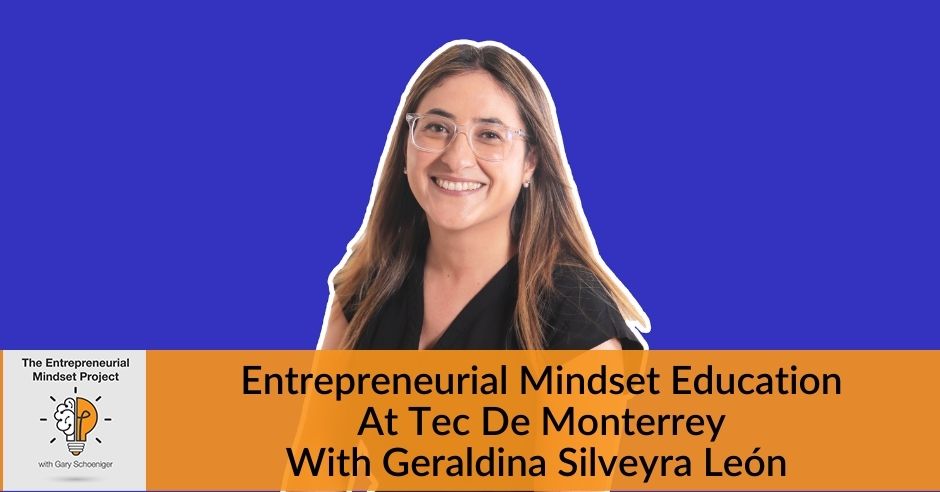
A true entrepreneurial mindset is not just about earning a profit but also creating genuine human relationships and experiences. In this episode, we dive deep into the ecosystem of Tecnológico de Monterrey (Tec), one of the most entrepreneurial university systems in the world. Geraldina Silveyra León, a transformative leader at Tec, discusses how the university has embedded entrepreneurship into the DNA of its entire system, transcending traditional academic boundaries. Sharing powerful stories about challenge-based learning, she talks about their culture centered on identifying incredible opportunities, creating positive change, and making meaningful contributions to society.
—
Listen to the podcast here
Entrepreneurial Mindset Education At Tec De Monterrey With Geraldina Silveyra León
Welcome to the show. In this episode, I’m talking with Geraldina Silveyra León, a transformative leader at one of the most entrepreneurial university systems in the world, Tecnológico de Monterrey, or simply Tec for short. I’ve had the privilege of working with Geraldina and her team for some time. I’m excited to share this conversation with you. Here’s why. At Tec, they don’t treat entrepreneurship as a business discipline. Instead, it’s embedded in the entire DNA of the system in a way that transcends disciplines and careers. Their vision? Leadership, innovation, and entrepreneurship for human flourishing. Clearly, these are my people.
In this conversation, we discuss how Tec evolved from teaching new business creation to fostering an entrepreneurial mindset across every field of study. You’ll read how the founder’s original vision helped shape a culture where every student, regardless of discipline, learns how to identify opportunities, solve problems, and contribute meaningfully to society, whether by launching a new venture, leading an organization, or creating positive change in their communities.
Geraldina shares powerful stories about challenge-based learning, the role of faculty as facilitators of discovery, and why even small actions can create profound impact. I hope that this episode will inspire other academic leaders to look beyond business to recognize the entrepreneurial mindset as a means of unlocking human potential on a much broader scale. Let’s dive in.
—
Geraldina, thank you so much for being on my show.
Thank you, Gary, for inviting me. I feel truly honored.
Why Tec De Monterrey’s Approach Is One-Of-A-Kind
I’m so intrigued by Tec de Monterrey, the university system that you work for. It seems to have entrepreneurship embedded in the DNA in a way that I’ve never seen in a college or a school system anywhere else in the world. How did that happen?
We have to go back to our origins. Our founder was a businessman. He had this entrepreneurial vision from the beginning. A series of milestones have contributed to leading us to where we are right now, into this concept of an entrepreneurial university. It started with having a mandatory class for all students, regardless of the program they were enrolled in. They had to take this entrepreneurship class, which at the beginning had a focus on business creation. It started to evolve by 2013. We came up with this vision of entrepreneurial spirit, which is more focused on the individual, himself and herself, to have these entrepreneurial outcomes, rather than just the start of a new business.
That to me is what’s so intriguing. It’s relatively new. You guys are breaking the ground. To go back to what you said a minute ago, you were founded by an entrepreneur in 1943. Do I have that right?
Yes.
That DNA is baked into the university system from the beginning. What you’re also saying is that you evolved from trying to have all students start businesses to being more mindset-oriented. Is that accurate?
Yes, exactly. In between, there are a lot of steps that are obvious. Throughout time, these different mechanisms emerged. We opened business incubators, accelerators, social incubators, and technology parks, all these different mechanisms. In 2013, as I mentioned, we launched the Entrepreneurship Institute to make sure we have all these different mechanisms in one place. We acknowledge the relevance of making sure that we connect with a broader audience from this perspective of focusing on the individual, the mindset, and the entrepreneurial spirit.
It could accompany our students and faculty as well in their different endeavors and make sure that they contribute to a difference in the workplace, whether it is by opening new businesses or joining new organizations. This evolution or this transformation that we had comes from receiving feedback from the different stakeholders of the university and them recognizing that spirit within our alumni. That entrepreneurial spirit is something that has characterized our alumni from different perspectives and different stakeholders.
You guys have broken free of something. People hear the word entrepreneur, and they tend to think of it in a binary way. “That’s business. That’s just for the students in the business school.” That’s so severely limiting that the business school is better for taking ideas that are proven and pushing them out into the world. What you guys have recognized is the broader implication of entrepreneurial thinking. It’s interdisciplinary. Are you struggling to help faculty understand it? I encounter this in colleges and universities all over the world. My friends in South Africa put it like this. “When you mention entrepreneurship, that’s when all the teachers get up to go make tea.”
That’s because of the fact that you already mentioned. Traditionally, entrepreneurship is related to new venture creation, which is one of the streams or venues of entrepreneurship. Having this wider perspective or this entrepreneurial mindset perspective connects with faculty in a sense that it connects to their own personal purpose. How do I not only transmit knowledge but also prepare my students to face the challenges out there? As engineers, architects, nutritionists, psychologists, or lawyers, how do we contribute to a larger conversation?
From our disciplines, how do we contribute to solving societal and environmental challenges? Entrepreneurship becomes a means to achieve that end. That is engaging. That change of perspective and paradigm is what is helping us connect with faculty throughout the different disciplines and go beyond the knowledge transmission. The mission of these entrepreneurial universities, from that wider concept, is not forgetting that there’s always a line of work, which is to develop new ventures, but it’s not the only one. It’s not the only path.

Entrepreneurial Mindset: Entrepreneurial universities are focused on teaching people that there is no one path to developing new ventures.
I love that. If I’m understanding you properly, here’s how I’m interpreting what you’re saying. Most universities are like, “Here’s the knowledge. Here’s what we know about X, Y, or Z.” You have that knowledge. That’s fine. What you’re saying is, “Here’s what we know. How can you add to this, or how can you use this to solve problems?” I don’t want to oversimplify it, but that’s what I’m hearing.
How can that knowledge contribute to societal and environmental challenges? Maybe this is naive, but what I’ve seen is that there is an alignment to a higher purpose. It’s not knowledge for the sake of knowledge. It’s knowledge for humanity’s purposes and for planetary purposes.
I love working with you guys. I want the whole world to hear that, Geraldina. People hear entrepreneurship, and they think, “That’s about profit and making money.” I need people to hear what you’re saying. You have to look beyond that. This is about human flourishing, ultimately.
That’s what is keeping us busy here at the Entrepreneurship Institute at Tec de Monterrey. How do we complement the disciplinary formation that our students are receiving? How do we add on to that and give students these perspectives that through this entrepreneurial mindset, they can put their knowledge and their experiences at the service of these larger problems that not only benefit themselves professionally and personally, but they also make a contribution to a world that could be better, more equitable, and more fair, with providing opportunities for other people as well?
There’s a nuance in what you’re saying. What you’re talking about is a shift towards a more internal locus of control. The student is then more intrinsically motivated. You’re not here to just get a piece of paper so you can get a job.
It’s how that job matters. What you do contributes to the larger booth. This is a concept that we have been working on, which we’re calling a significant incident. I don’t know if you agree, but sometimes, when we tell students to contribute to societal needs, etc., they tend to think, “I need to become a superhero. I’m not capable of that. I’m a simple person. I don’t have the superpowers, so I don’t dare to go there.” What we’re saying to them also is that regardless of the size of your actions, you have an impact. You have the potential to impact and to make a difference out there.
Regardless of the size of your actions, you have the potential to impact and make a difference in the world. Share on XThe size of the action doesn’t matter. It can be a greeting. It can be the work you’re delivering to your teacher, the way you engage in trying to understand problems, and how you empathize with the world around you. As you say in your book, these small shifts in the perspective nurture that internal locus of control of students as well, so that they can discover themselves as these change makers in their everyday actions, in their everyday lives.
I love that. The whole world needs to hear this. I like what you’re saying that you don’t have to change the whole world. I found this quote. It was from Sophocles, the Greek playwright, two thousand years ago. He said, “The duty of a man is to make himself useful to his fellow man, as useful as possible to as many as possible. By doing so, he advances the welfare of mankind.” I don’t think that we’re here on Earth to just get a job and do what we’re told. That’s not the formula for human flourishing. We flourish when we can contribute.
How Geraldina Got Into Entrepreneurial Education
One of the things I’ve been thinking about is that I heard a lecturer here in Cleveland at Case Western Reserve University. They had a New York Times guy here, Kevin Roose, who writes about AI. Many of the faculty were concerned about cheating with AI. I wanted to shout. Why are they cheating? They’re only cheating because they are extrinsically motivated. They care about the diploma. They don’t care about the learning. That’s what you guys are doing exceptionally. As you said, it’s a subtle shift in perspective that can make a big difference in a student’s life. Geraldina, how did you get mixed up in all this? Are you a tech graduate? How did you come to drink the entrepreneurial Kool-Aid?
I graduated from Tec de Monterrey. When I graduated, I got a job. Before I graduated, I got an internship program, which didn’t last. It was supposed to last two months. It lasted for two weeks because of the malpractices of the company. I got disappointed with the workplace. That’s how, with another colleague, I decided to launch a business, knowing that I had no professional experience and no previous entrepreneurial experience.
We decided to go into this endeavor. It was a great adventure. How I got back to tech was because I started to leave a lot of things that I said, “Why didn’t my school teach me this?” I found a professor of mine. We got into a conversation. The typical question is, “What are you doing now that you graduated?” I told her about my experience in the workplace. I told her my experience as an entrepreneur.
Entrepreneurial Mindset: Tec de Monterrey is not a traditional university. Here, you are challenged to go out and see yourself as a change maker.
She said, “Why don’t you come back and teach maybe one class?” That’s when I fell in love with teaching. For a lot of years, I did both things. I was an entrepreneur and a professor. That’s how I got in touch with the Entrepreneurship Institute. I loved being around entrepreneurs. I was invited to become a mentor. I was invited to design programs for entrepreneurs.
Practically, all my professional life, I have devoted it to entrepreneurship in playing different roles. I was present at Tec de Monterrey when the Entrepreneurship Institute started. The entrepreneurial spirit definition came up. At that moment, I got engaged in that. It made total sense because I connected personally. My personal experience was so aligned with that, and here I am.
Do you have entrepreneurial parents? Were there entrepreneurs in your family?
Just in my family, not my parents themselves, but mostly in the family.
When you went to that internship, and then it fell apart, was there a decision process in your mind? Was there a direct correlation from that short-lived internship to “I’m going to go do my own thing?” Did you think, “This is crazy or stupid. I’m good. I can do better?”
There was another fact. When I was still a student, I went through this subject that I told you about, this entrepreneurship class. At the time, the format was that you developed a project, and then at the end of the semester, there was a showcase of the different projects. There was a prize for the winning proposal or the winning project. My friends and I won that contest. At the same time, this thing was happening with the internship.
I remember being in my friend’s house at the time, on the couch. We were shocked by what happened at the company because we didn’t expect the malpractices. When you graduate, you have certain expectations of what the workplace is going to look like. At least that was happening to me. I was eager to leave the university and finally be of use to society. My path was always to join the workplace and work at an international company where the impact and the reach are going to be amazing.
That was the expectation. You find that the workplace is not like that. I was winning this contest. There’s a connection that says, “What if I get to make the rules? What if I can make a difference by setting rules that are different from the ones that are taking place?” I’m generalizing. I understand that not all companies have these malpractices, but at least that was my experience at the moment. That was the trigger that I said, “If they gave me a prize for a project, maybe I can implement something myself.” That’s how the journey began.
Helping Future Entrepreneurs Go A Step Further
It was Geraldina’s intervention that prevented you from working for a big corporation. Maybe you got redirected. If I’m understanding you, you won that competition. Maybe that surprised you a little bit. You didn’t expect to win that. At the same time, you thought this company where you’re doing an internship was more established and had maybe better values and more structure to them. That’s super interesting. Can you talk to me about some of the success stories you’ve seen in the students who have come out of Tec?
I have seen diverse successes, also understanding that success does not always look the same. One that I would like to share with you right now is how the courses at Tec help students identify real-world opportunities. It doesn’t matter if they are engineers or from the health, life sciences, or creative industries. It’s due to the educational model. Professors work on making sure students understand what the industry is missing, the gaps, or the problems that they are facing. They come up with solutions to satisfy or fulfill those opportunities.
Something that, together with the Entrepreneurship Institute, we have done successfully is to accompany those professors who are already connected or connecting their students with the industry’s problems. We make sure to help them go a step further. We make them aware of what they’re doing, that they’re not only doing it for the class, but also make sure that they understand that the same process or that skill they’re developing can be useful in many other contexts.
Also, how their solutions can not only be delivered for a course, but there is value because of the solution that they’re delivering or that they are building. We make sure that they see entrepreneurship as a possible professional path. Some of the students go down that path. They get enrolled in contests. They participate in incubation programs, for example. They are launching successful businesses, or at least they’re trying. In their way of trying, they are developing professionally and personally as well. That is one line of students that I have seen.
They recognize their opportunity in a class. They built a prototype. They get engaged in the entrepreneurship ecosystem within the university. They get intrinsically motivated to say, “I can do that.” They pursue their professional path in that way, like creating ventures and looking for funding. I see them even today, even though they’re not continuing with the same project that they started at the university. They have pivoted because they learned from that initial venture, for example. They seem very fulfilled and proud of what they have achieved.
Another success pattern that I have seen is students who have taken advantage of these different experiences that they have within the university. For example, participating in contests such as Hult Prize, Map the System, or the Seneca Green Challenge, advancing into the stages of the contest, and at the end realizing the growth that they’re having personally. They are graduating and then having a career path that may be more traditional.
What they realize, come back to us, and share with us is that they see how this entrepreneurial spirit accompanies them and differentiates them in the workplace, how it’s making a difference for them in their career path, and also how they approach their jobs and the trajectories that they may have. They are recognized for being these people who are there to make a difference, regardless of the context in which they are performing professionally. Those are the trends. Gary, we talked about this when you were here. We’re also starting to see a lot of alumni who are getting involved in social movements, for example, artistic movements, and how they are reflecting this entrepreneurial spirit into these different contexts.
How Entrepreneurs Can Go Beyond Startups And Profits
What you guys seem to have embraced is this idea that the entrepreneurial spirit is the human spirit. What you said earlier is that starting a business is but one of many ways in which that can manifest. I want to talk about the entrepreneurial mindset advantage. I’m not trying to turn this conversation into a book promotion, but it does give you an advantage in the workplace. A friend of mine in South Africa asked me to help write a policy recommendation for the G20 summit in South Africa.
I started doing some research and looking at what the European Commission has written about their entrepreneurial competency framework. It seems like the world is waking up to the idea of entrepreneurship beyond startups. Thank God for that. At the same time, I’m a little bit terrified that the United States has no such structure, framework, or policy agenda of any kind. That troubles me a little bit. Specifically, in a world that’s getting more AI and jobs are getting disrupted by AI, everyone needs an entrepreneurial mindset.
Because of all this uncertainty and all these changes, this is a personal belief and what I have seen. If we want different outcomes, we need different frameworks or different paradigms as well. That’s why what you’re saying is so important. We need entrepreneurial individuals to act entrepreneurially and to then provide answers to so many questions that we have around so many topics. Think about the possibilities and not the obstacles or limitations.
We need entrepreneurial individuals to act entrepreneurially and think about the possibilities, not the obstacles or limitations. Share on XI’ve been on various campuses of Tec. I’ve always been impressed. I remember one time getting on a bus with a bunch of students, a big tour bus, and going to a children’s hospital. I thought I must have gotten on the wrong bus. I’m on this bus. I still to this day don’t even know if I was on the wrong bus. Nevertheless, I was part of this tour where they took a bunch of students, a couple of hundred students, to a children’s hospital. We were given a tour of the children’s hospital. We got back on the bus and went back to the campus.
I felt like it was a tacit assumption. It was a normal process of exposing students to problems, going back into the classroom, and exposing them to problems. Underneath that is this tacit assumption that you are capable of solving them. I’ve seen it. I can cite multiple times of being on the campus, being given tours, and being introduced to students with entrepreneurial projects. What I witnessed that I thought was unique is the way the professors step back. They weren’t teaching. They were facilitating.
There’s an underlying assumption that I’ve not seen anywhere, like a culture. It reminds me that indigenous cultures seem to have understood the purpose or recognized the value of the naivete of young people. There is the recognition that young people who are naive and not yet steeped in our way of thinking can see problems that we can’t see because we’re so steeped in a paradigm. Whether you’re doing that explicitly, deliberately, or implicitly, that seems to be part of the DNA of Tec de Monterrey. I don’t know how you replicate that.
There are a lot of efforts. Today is different from maybe the moment of time that you’re describing. The educational model explicitly requires the professor to act as a facilitator, also acknowledging that knowledge can be acquired through different sources, not only from the professor himself or herself. It is about acknowledging that students have knowledge, and the formative partners, which are the companies or the industry itself, have knowledge and have challenges. In our educational model, it is explicitly mentioned that professors play the role of facilitators. There are training efforts to accompany professors to embrace this role and not feel that something is lacking. There has been a transformation of the traditional role of the professor.
Shaping Entrepreneurs With A Higher Degree Of Reflexivity
I was doing a little bit of homework for this episode. I saw something about the broader mission of Tec de Monterrey. It is leadership, innovation, and entrepreneurship for human flourishing. Did I get that right?
Yes. Talking about change, it has been reframed towards that same purpose. Our new mission statement talks about how our students can become these change makers to transform reality. It’s the same essence mentioned in different words. It is talking about how we accompany students to change and transform their context, their realities, through knowledge, science, innovation, and entrepreneurship.
I love that. At least in the United States, I feel like we’re not aware of the ways in which routinized other-directed learning is producing employee-minded students, for lack of a better term. I don’t think people are aware of that. In sociology, sociologists talk about agency and structure. Agency is your ability to navigate the structure in which you live. The structure is the rules, norms, laws, and established things in which we live.
What sociologists say is that you can’t point to agency or structure as the cause or the effect. They’re both. The agency and structure are acting on one another, but there’s a term called reflexivity. Reflexivity is used to describe the extent to which we are either influenced by structure or are influencers of the structure. That’s what you guys are doing better than any other institution or university that I know of. It is graduating students with a higher degree of reflexivity.
Thank you for that, Gary. As you mentioned, it has to do not only with the educational model, but the context itself, all these different activities that are happening, and that students can engage in. They are the ones who are making it happen. They get to organize congresses. They get to organize festivals. They get to organize concerts. They get to organize tournaments. This includes the offering of the Entrepreneurship Institute. We are acknowledging this formation or this experience that is being developed, which has to do with knowledge as well, how our students are acquiring knowledge, also through these extracurricular activities that are becoming co-curricular. We are acknowledging that.
That is aligned with alternative credentials. We’re recognizing that students can develop competencies in the classroom, taking the courses of their academic program, but also acknowledging that through extracurricular activities, they can also develop competencies. When they evidence competency mastery in both contexts, then they acquire a credential or this batch that gets delivered to them at the end of their university program. That’s something that we are evolving and currently working on. It contributes to what you’re saying. It is how we are opening these spaces for students. We’re institutionalizing these spaces where students can develop themselves in both or in different contexts.
It is how they can have these significant incidents in their own professional development because they choose the extracurricular activities. They decide which ones they want to take. The program is given, but these learning paths outside the classroom are chosen by them. That’s another sign of them having a voice, having a say in what they develop, how they complement their education, not only by what the syllabus or the program says, but what you can complement for yourself as a person, according to your own interests or according to your own gaps as well.
There’s a lot there. When we’re encouraged to pursue the things that interest us in ways that contribute, that’s the basic formula for human flourishing, fundamentally. It also sounds to me that what you’re saying is that you’re balancing traditional learning with project-based learning or whatever. What you seem to be saying is that, in traditional learning, you have to take an exam. You have to prove that you know the stuff. That’s all fine and good. That’s an error-reducing paradigm.
You’re then putting them in other situations that are error-inducing paradigms, where they’re doing projects, and it’s okay to fail. You and I were in the back of an Uber car on our way somewhere in Guadalajara, maybe. You were telling me that’s how you advanced your own career. People pushed you to do things beyond what you thought you were capable of. Can you say a little bit about that?
Yes, exactly. When you’re challenged to do something in a project, to get you out of your comfort zone, you discover what you’re capable of, how you expand your level of expertise, how you expand your network, and how you expand your own belief system. That’s also true for our students and faculty. Going back to the educational model, this got formalized into it. The model itself is built not only on competency-based education but also on challenge-based education.
When you are challenged to get out of your comfort zone to expand, you discover what you are capable of and how you can expand your level of expertise. Share on XFormally speaking, within the program, the students are faced with challenges that are provided by the formative partners, who are companies that deliver problems or challenges. Students get to work on those challenges. That can also be true outside the classroom setting, outside the curriculum. That is also helping students explore and expand their own limits and belief systems. That contributes to the development of their own entrepreneurial mindset. It is not only the challenges that they get to face, but the challenges they’re choosing to face.
Tec De Monterrey’s Lideres Del Mañana Program
That’s a huge component. I think of the importance of self-endorsed difficulty rather than something imposed upon you externally. That’s intrinsic versus extrinsic motivation in a lot of ways. I want to switch gears on you a little bit here. Tec de Monterrey is an elite university system in Latin America. You have 90,000 students across 30 campuses or something like that across Mexico. Many of your students come from wealthy families. Is that an obstacle for you? Do parents get in the way? Do parents say, “No, I don’t want my students starting a business. I want them to go get a good job?”
Before I jump into that question, let me clarify something. Although it may seem that most of our students come from privileged families, we also have a significant percentage of students who get in because of a scholarship. We have this very nice program, which is called Lideres del Mañana, the leaders of tomorrow. This is a program that is targeted to people who have not been economically privileged, but come from economic scarcity. However, they’re talented. They come with scholarships. They have the opportunity to come to this context with the aim of going back and giving back to their community what they have learned.
Going back to your question, we have not seen that concern with parents. It’s completely the opposite. Most of the students who come from this privileged context come from family businesses. They are either expected to join the family business or encouraged to create their own businesses and maybe take advantage of the family business. They are encouraged and expected to do their own thing. There’s also a certain number of parents who are also sure that because of the education their kids are getting, they are going to be well-connected and go to a workplace with an advantage. Parents are not nervous about their kids starting a business.
Teaching Entrepreneurs To Level Up Through Challenges
I’ve discerned in a lot of universities in the US, the parents are like, “No, I don’t want my kid doing a startup. I’m paying a lot of money. I want them to go get a law degree. I want them to go work at Accenture or some big consulting firm and get that six-figure job at SpaceX or whatever right out of the gate.” I don’t know that you guys are still doing this. At one time, you were doing these entrepreneurial challenges where all students were given a little bit of money and encouraged to come back with more money. Can you talk a little bit about that?
We stopped doing that once the new educational model kicked in. In the transition between educational models, we had this entrepreneurial challenge. Freshmen students were grouped into teams of around five people. The professor became their mentor. In one week, they received a check. This is a real-world check. They had to go to the bank and exchange the check. It was at the time MX$2,000, around maybe $100. They had a week to multiply that check as many times as possible.
They had to do something. They could decide to sell donuts. Some of them washed cars. Some of them printed T-shirts. We had some innovative ideas, such as people paying for roses that were delivered to terminal cancer patients. They gather as much money, pay for the roses, and then deliver the bouquets to these hospitalized patients. There were all sorts of ideas. Students were challenged to go out there, get out into the world, go to the bank, and exchange a check.
Some of them had problems with that because they lost their IDs or their signatures were not the same. They faced the real-world, grown-up problems when they went and opened an account, etc. They had that throughout the week. The professor mentored them throughout the week, provided guidance and assistance, and encouraged them when things didn’t go right. By the end of the week, they had to return the seed capital. Also, they had to return the profits.
Why? It is because, at the same time, we opened a call for social entrepreneurs. Most of the time, we encourage the social entrepreneurs to be students themselves, so they participate in the crowdfunding activity at the end of the week. Each one of the teams, with the profit they gained, then had the opportunity to crowdfund these social initiatives. At some campuses, as I mentioned, they had all their students with social ventures.
In some other cases, they were social organizations such as the Red Cross or the food bank, etc. They had the opportunity to crowdfund these social initiatives. This was a very virtuous cycle because, for once, it allowed freshman students to realize the type of university they were entering. That was a strong statement from the university, saying, “This is not a traditional university. In here, you’re being challenged to go out and discover what you’re capable of.”
See themselves as these change makers. You have the potential to make a contribution. You have the potential to make a difference. We’re here to help you. We’re here to support your aspiration, your dream. At the same time, with the profit they generated, we had seed capital to fund these social initiatives. A lot of the social initiatives, the social entrepreneurs who receive these benefits, are still operating their social businesses.
When you talk to them, they say, “My seed capital came from the Entrepreneurial Challenge students who trusted me.” It was very nice, because then a freshman saw junior or senior students as role models. They said, “If they can do it, I can do it also.” It wasn’t the Zuckerbergs or the Musks. It was the people who were close to them. Students like them are engaging in these change-making initiatives. That was inspiring for them as well.
It was challenging for us. If we invite the administrators from the university, they would probably also tell us how that challenge helped them to go out of their traditional roles, go out of the traditional processes, and also explore how different things can be done within the university processes. Gary, you can imagine having so many checks ready to be delivered to students. It was challenging for the university, challenging for professors, and challenging for the freshman students, but also engaging and encouraging for these social entrepreneurs who received the profits. It was a great experience.
I love that. In my book, I encourage people to do that. Let me break that down for a second. This lady is coming on my show, an author from Harvard, whose name escapes me at the moment. She wrote a book or co-authored a book called Employment Is Dead. The thing that she said, right from the beginning in the book, is that hierarchical top-down paradigms are ill-suited for rapid change, dynamism, and complexity. They’re not well-suited. Those paradigms are more appropriate in stable conditions.
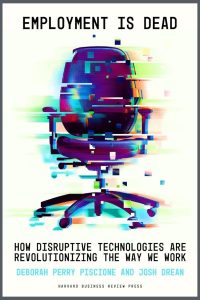
Employment Is Dead: How Disruptive Technologies Are Revolutionizing the Way We Work
One of the things she said in the book is to stop calling them employees and call them contributors. That’s the shift that needs to happen. You guys are way ahead of the curve on that. I’m not sure you called it Entrepreneurial Mindset Challenge, but that’s what I called it in my book. I was inspired by that work. I had a chance to interview many of those students after the fact at the Monterrey campus.
What it does is it teaches the student how to make themselves useful to other humans in highly ambiguous circumstances and highly ambiguous resource-constrained circumstances without the benefit of a professional teacher telling them exactly what to do, a predetermined pathway, and a predictable outcome.
To my mind, the money they come back with is evidence of usefulness. It’s not just about money-making. That’s all it is. Learn how to function in ambiguity on your own. If you go out with MX$2,000 and come back a week later with MX$3,000, you not only have evidence of usefulness, but you have evidence that your entrepreneurial self-efficacy has increased a little bit.
Students recognize themselves. That self-awareness is also important, that self-recognition. It’s not the teacher telling you or giving you, assigning you a grade. You know. You don’t know. In this case, it is the student. Students got proof of that themselves, how they felt challenged and how they recognized themselves as not feeling comfortable selling something, approaching a stranger, and getting rejected over and over again, but then coming out stronger from that ‘no’ repetition.
That’s the future of learning right there. This might be more of a US phenomenon, but I said in my book, what if we treated entrepreneurship, at least in the United States, with the same reverence that we do baseball or soccer? In my neighborhood park, 1/2 mile that way, there are five baseball diamonds with bleachers. There are posters on the fence from all the local community sponsors that have sponsored that. Why don’t we have the equivalent for entrepreneurship, where twelve-year-olds are encouraged, and parents bring lawn chairs and little coolers and cheer on their little kids for coming up with ideas that can solve problems?
I don’t know if you and I talked about this last time we were together in Mexico. There’s some modicum of absurdity in my mind that we wait until a student is at university to start teaching them about entrepreneurship. If you take a ten-year-old and say, “My ten-year-old kid wants to be a soccer star,” it’s too late. At ten years old, it’s too late to start playing soccer. It seems crazy that we would expect the first time someone picks up a baseball bat or sees a soccer ball when they’re nineteen years old.
Also, to get it right at nineteen.
To develop those challenges that you were doing with freshmen, we should be doing that from age 8, 10, 12, all through school.
That’s a great opportunity for us to not only design activity challenges and strategies, but also align with the cognitive development of humans. What is appropriate for a kid? What is appropriate for a teen? What is appropriate for a young adult? What is appropriate for an adult? That is a challenge and an opportunity that we have to keep on contributing to the entrepreneurship field itself.
I love that. I was inspired by this quote I saw at the William James Hall at Harvard. The quote is something like, “The community needs the impulse of the individual, but without the support of the community, that impulse will die away.” I think about the entrepreneurial mindset as the nutrients in the soil of entrepreneurship.
I love the way you said it at the beginning of this conversation. It’s this human thing. It doesn’t mean you’re going to start a business. It means you’re going to contribute in some meaningful way. Without the community there to say, “Yes, keep going. Here’s $50. Keep going. Here’s somebody that can help you. Here’s some little bit of resources we have. Here’s a suggestion,” by the time the kid shows up at university, he’ll be in much better position to solve big problems in the world.
They grow up knowing that that is a possibility. Maybe that’s also a goal, not just, as you said, the six-figure job, but the change-making job.
Episode Wrap-up And Closing Words
That’s human nature. We can end there where we started. The entrepreneurial spirit is the human spirit. It’s not just in some of us. It’s in all of us. What you guys are doing better than any university system I’ve been around is creating the conditions that facilitate that. I’m super excited to have this conversation. I know we’re about out of time, Geraldina. Is there any final thought you have about entrepreneurial mindset development? What would you say to somebody else leading an initiative at a university?
Don’t be afraid of embracing it. You will find it extremely engaging. It’s all about human connection. It’s an opportunity. Fostering an entrepreneurial mindset is a human connection. It’s enabling us to do our job within the university, aligned with a higher purpose. It allows us to learn from each other as well. I would strongly encourage it and also embrace the uncertainty that comes with it.
Geraldina, thanks so much for being on this show. I can’t wait to share your story with the world.
Thank you, Gary. We can’t wait to keep on working on these different initiatives that we have been discussing. Thank you for having me.
Important Links