
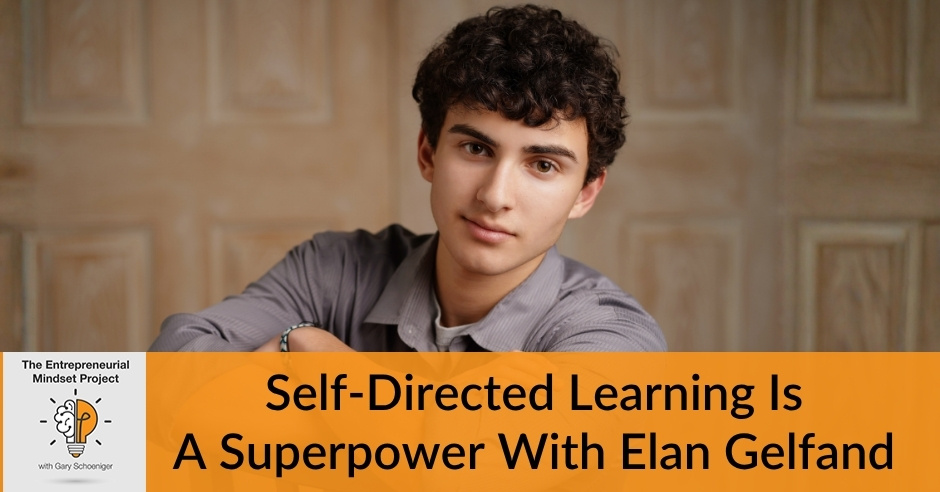
Today’s conversation stuck with me long after we hit stop. My guest is Elan Gelfand, a 20-year-old college student and podcaster who caught my attention almost immediately because of his superpower – self-directed learning. From the moment we connected, I could tell he is not your typical college student. He is not waiting for other people to tell him what to learn and do in order to be successful. He is taking ownership of his learning, asking the hard questions most people avoid, and doing the internal work that rarely shows up on a transcript. Instead of chasing grades, credentials, or social media likes, he chases insights. We talk about the quiet burden of being different, the hard moments that shaped him, and the deep sense of purpose that fuels him. This is not just a story about another Gen Z-er trying to become an influencer, but about a young man determined to make the most of his life.
—
Listen to the podcast here
Self-Directed Learning Is A Superpower With Elan Gelfand
Our conversation stuck with me long after we hit stop. My guest is Elan Gelfand, a twenty-year-old college student and podcaster who caught my attention almost immediately. From the moment we connected, I could tell this wasn’t your typical college student. This kid is a self-directed learning machine. Elan isn’t waiting for other people to tell him what to learn and do in order to be successful.
He’s taking ownership of learning, asking the hard questions most people avoid, and doing the internal work that rarely shows up on a transcript. He’s not chasing grades or credentials or social media likes. He’s chasing insights, trying to understand how people grow, what role mindset plays in that process, and how we can become the people who can take on hard things and grow and become stronger because of them.
We talk about the quiet burden of being different, about the hard moments that shaped him and the deep sense of purpose that fuels him. This isn’t just a story about another Gen Z or trying to become an influencer. It’s a story about a young man determined to make the most out of his life. Let’s jump right in.
—
Elan, welcome to the podcast.
Thank you so much for having me on, man. I’m very excited to have the opportunity to have you ask me some questions.
Why Elan Started A Podcast About Mindset
This is fun for me because you reached out to me to be on your podcast. After I got to know you a little bit, I just became more and more curious to get to know you a little bit better and to flip the script on you a little bit. I forgot why exactly you told me, but you created a podcast, and you’re twenty years old. You’re like you’re in college, right?
Correct.
Why did you create a podcast? Let’s just start there.
I think a lot of my later teenage years, I was trying to do something like that, because I was very interested in business. I was just very interested in learning from other people. I was reading books, and when I got to my freshman year of college, I was thinking about it. I was like, “What is something that I can do for a long period of time that is going to benefit me in the future?” A lot of people my age start with get-rich-quick schemes.
They start things, they’ll make the money very quickly, but I wanted to do it ethically, and I wanted to do it the right way. I thought to myself, “How can I get as much knowledge from people around me? How can I find something I’m very interested in, and how can I put that out to the world?” I came to podcasting because I like talking. You’re going to be able to tell by the end of the episode, but yeah, I love talking.
I feel like I had some really good things to say about mindset, and I’m able to talk to really cool people as well. It gives me even more authority to do that. I decided I’m going to do the podcast, and something that not everybody knows I did, but I set myself a contract, and like not physical, but in my brain. I said, “If I start this podcast, I have to do it every single week for at least two years before I can even think about whether or not it’s for me.”
A lot of people will upload a couple of episodes and then not get that many views. They’ll be like, “This thing’s not for me.” I thought to myself like, “Everything takes a lot longer than people expect.” If I can do this thing for two years, and see if I like it. After two years, I can say, “That was a cool experience. I got to some cool people, but I’m going to take a step back and maybe focus somewhere else.”
I’m going to say, “This is awesome. I’m going to keep doing it and see where it can propel me.” I wanted to think about what a good area to focus on would be. At the time, I was very interested in like mindset, how people think. I think even growing up, I always thought to myself, regardless of what people around me would think. It’s like, “How come this person is in this situation?” I understand that there are a lot of things that are not controllable.
You can take somebody who’s in a very bad situation, and it happens because of something external and not in their control. I look at people who are very successful in running the best companies. I think to myself, like everybody’s shouting and they’re saying, “The rich people are bad. They’re doing this.” I’m like, “There’s got to be something that I’m missing. Like, “What’s that thing?”
I realized I was like, “Everybody has 24 hours in a day. Everybody has their thing that they’re doing, but what is something that can be an exponential factor for them?” Everybody has 24 hours a day. It’s linear. Everybody’s the same exact time, but then people think differently. I thought to myself, maybe that’s the thing. I looked more into it, and it was very promising. I started the podcast about mindset, and have been doing it every week since then.
Also, one of my goals is to get to twenty episodes as fast as I can because I don’t know if this, Gary, but 90% of podcasts don’t make it past episode twenty. I was like, “I want to separate myself from the crowd.” I uploaded twenty episodes as fast as I could. I think it took me like two or three weeks. I was very passionate. They’re not good episodes at all. They’re very unorganized, but I did it, and it was a good thing. I think long story short, to answer your question, I did it because I wanted to learn about mindset and how successful people think.

Self-Directed Learning: A podcast provides an opportunity to engage with extraordinary people and ask them questions that will intrigue your listeners.
Finding Purpose In Self-Directed Learning
What just blows me away about that is, why aren’t more people doing that? I think about this a lot, Elan, specifically like younger people in college-age kids, high school kids, college-age kids, I think about the ways in which formal education undermines or inhibits the intrinsic natural desire to learn. How did you emerge, or like you exceptional in that regard? You’re twenty years old and you’ve got this passion for self-directed learning. Where did that come from? Why are you that way, and why aren’t more of your peers that way?
What you’re getting at, we’ve talked a lot about, is the entrepreneurial mindset. That’s a whole other conversation, but I would say, for me in the most honest way possible, I was never very good at school. I always had a very hard time sitting in a class, studying, and getting good grades. In high school, I didn’t do the best. Honestly, like in college, I’ve been doing so much better for myself.
Why is that? Can I just interrupt? What was the difference there?
I think I will say focus, but also once I found the thing that I was doing, and I’m not saying podcasting is going to be my thing forever, but like I challenge myself in a lot of ways, and we’re going to get into that more. I feel like the latest episode, but there are a lot of really hard things that I do, and then I realized that classes are easy.
It’s not hard to teach myself how to do work when, like outside of school, I’m doing things that are ten times harder. You have people who are my peers on the other end of the spectrum, like most of their lives are ten times easier. They’ll just watch Netflix or they’ll play video games, and then when they go to class, it’s like, “It’s so hard.”
For me, in a way, it’s like I’m desensitized to the difficulty because it’s like “Listen, people complain about studying for four hours a day, but listen, I will work on things for like 87 hours a day, 10 hours a day. Not every single day, but I’m saying I have that ability.” I think the confidence helps a lot with that. That’s a very interesting question that I would need to think I feel like a little bit more, but I do believe that is a big part of it. Going back to your question, yes.
I just don’t want to lose the question if you can hold that for a second, but I was just listening to a podcast, Rich Roll talking with Laurie Santos, who teaches the happiness course at Yale’s super popular course. She speaks to something you just said very clearly. She talks about, “Do you know what hedonistic adaptation is?”
Yes.
You win the lottery, you get a new car, you’re all excited for a little while, but then you just default to your range. What Laurie Santos pointed out is that the opposite is true. When you do hard things, like in the beginning, you’re like, “That’s really hard.” Over time, you’re just like, “I just do those things.” That also becomes normal. That’s what you were just speaking to. You’ve just made it a habit to do hard things. It’s a simple way of saying.
Totally. I would also add, like anti-fragility. It’s a perfect example. It’s like when you do harder things, I think you become stronger and vice versa as well. I have a lot of empathy for people because they have a lot of different situations going on. Some people are just less ambitious, and that’s totally okay, but I’m just not that way. Going back to what you were talking about earlier, like how come I separate myself from those people?
When you do harder things, you become stronger. Share on XI feel like learning was my golden ticket that I had to believe, no matter what, was going to be the thing that got me out. I was never amazing at school, and I saw a lot of people. I went to a very preppy high school. I’ll even tell you, I’ve never shared this before, but I had like a thousand people in my graduating class. I bet you senior year, I knew where 500 of them were going to college because I was so insecure because they were doing so much better than me.
It was very tough for me, I say these observable metrics. The observable metric is like, “This person’s going to Yale. This person’s going to Harvard. This person’s going to this amazing school that I never even had a chance to get into. There’s no way I’m getting into there.” The unobservable metric is that they are not applying themselves as much as they like, not the fact that they should be, but they’re just not applying themselves.
I thought to myself, “There have been people in worse situations who have done better for themselves. I cannot just sit here and moan. “I go to college. I’m not going to like Harvard or Yale,” but I really believe that if I can put my foot to the gas, work really hard, I can separate myself from other people. I still sometimes have the thought, it’s hard to see people go into amazing schools when I’m like, Harvard is like this label.
It’s like this thing that everybody tries to get to. People say, “I go to Harvard,” and their peers go, “You go to Harvard?” For me, saying something like, “I have a podcast,” or “I always try to listen to people and learn lessons from them, that’s so not glamorous.” People are like, “Cool, good for you, man.” They don’t understand not the work that it takes, but the effort and how intentional I am with my things.
When I have guests on my podcast, it’s not a time for me to like tell people like, “I’m going to have this guest on my show. I’m just going to ask them some questions, whatever.” In the future, I’m going to be like telling all my friends that I had this guy on my show. No. I want to learn from people. Funny enough, I learned the most from the people on my podcasts that did not have the most followers, which is such an interesting observation I made.
I had some people on my show who have had hundreds of thousands of followers, and they were amazing people. I’m saying every single person’s like this. I’m not going to say names either, but I left the call, and I was like, “That was so cool that I got to talk to that person,” but something just doesn’t feel right. Gary, you’re a perfect example of this. When I got off my two calls with you for episodes, I was just blown away. I was impressed.
Words cannot describe how optimistic I was after our call because it was a good reminder for me that maybe the thing that I’m doing is going in the right direction. I want to say the biggest problem, but the hardest thing about choosing the path that I’m on, and maybe this could be a reason why people don’t do it, is that there’s no guarantee of success. When you go to college, get your degree, and like, “You go out with a job.” It’s like, “Cool, you’ve done the thing.”
That’s just the original. That’s what you’ve got to do. That’s step A, that’s B, that’s C. You did the thing. For me, I think a lot of the things I do are things that don’t have a guarantee of ever working out for me, but I have to throw the boomerang and hope it comes back to me. Some things are still out in the open, but I believe that if I work hard enough, if I just keep at it, good things will happen, especially if I’m a good person about the thing.
There’s one thing I would say, Elan, that I feel like maybe we’re getting to the punchline too early, but you’re so thoughtful. It’s worth saying now. I’ve interviewed somewhere in the order of 700 everyday entrepreneurs all over the planet, and what it really comes down to, Elan, is that the people who are looking for answers, find them, and the people who aren’t, don’t. Put that in your heart for some solace.
You’re going to be fine, dude. I don’t need to denigrate somebody who goes off to Harvard, gets a law degree, becomes an MD or a professor or whatever. That’s fine. I also think that your ability to tolerate ambiguity, like uncertainty, and ambiguity are two different things. We don’t necessarily need to get into the nuance of that unless you want to. I think as the world is changing, that the rate of change is accelerating, that your ability to live in that uncertainty is a superpower, is an absolute superpower.
Thank you, Gary.
Social Consequences Of Being Different From Your Peers
It’s really cool. Let’s talk about the social consequences of you being exceptional. I mean exceptional in an economic way. You’re just not the norm. You’re an outlier, so to speak, among twenty-year-olds, among your peers. Can you talk a little bit about, like, are you paying a price for that, like socially? Are you aware that you’re paying a price for that, or how do you think about that? How do you experience that?
Gary, that’s a beautiful question. I love that so much. I would say I was talking to one of my friends about this earlier, but something that I’m really trying to get better at is being more open with the things that I do. If I’m being completely honest, the social price that I pay for doing all these things is that sometimes I understand people don’t understand it, and they don’t know what goes into all the things I do.
Telling them feels pointless. I was talking to my friend, and I told him I’m like “I have a hard time telling people I have this podcast and all this stuff because I’ve been punished for it in the past.” I have a YouTube channel, and people would make fun of me for the podcast. People made fun of me before. I know this is something we’ve talked about as well. I’ve had one experience, but nobody is ever going to go into your face and say, “Your podcast is stupid.”
They’re going to make jokes about it. They’re always going to cover it up as a joke. It’s like, “It’s this joke,” but it really hurts. It’s like, in a way, recently I’ve started to become a lot more serious about the podcasting thing. It’s become more of a big deal for me. I’ve started telling those people, I’ve been more authoritative with them, if you will. Before, I’d let it slide. I remember, I’m in a business fret at school and I was interviewing.
One of the things to get into the business fret is that they have to interview you. They should ask some questions, like all these new members, we’re not going to go into the whole process. This one girl was asking me, she’s like, “What do you do outside of school?” I was like, “That’s when I was really trying to work on getting myself more out of the bubble, whatever. I have a podcast.”
She giggled, and she was like, “You have a podcast?” I was like, “Yeah, what’s so funny about that? That’s all there.” She got super serious, and she was like, “Nothing. I just thought it was interesting.” It’s funny because these people point these things out, but they have such a soft shell. You would think these people would stand on their opinions, but they don’t.
You’ve probably seen the same meme I have, but it’s like that criticism will never come from people who are doing stuff. Period. Full stop. I think there’s a biological analogy to be made here. Maybe this would help you not be offended as much. It’s like there are little social groups. When you behave differently from other people in the group, it’s like it’s biology, Elan. That makes the people in the group. You’re a foreign object. As I say, it’s great biology. The group’s going to try to get you to conform. They do that by ridiculing you.
A 100 percent.
It’s making them comfortable. That’s what’s happening. If you zoom out and look at it from that perspective, I heard it put like this, they’re either going to convince you to conform to their norms. You’re going to convince them to adopt yours, or they’re just going to plop you out of the group. “You’re out.” It’s just biology.
A hundred percent. I’ve definitely gotten a lot better at, like, definitely understanding, even what I was talking about earlier, being empathetic, not everybody wants the same thing. It’s not necessarily their fault. It’s just their beliefs and the things that they, I guess, limit themselves to. What I was going to say is I find it a lot easier for me to talk to adults and talk to people who are doing better than me because I’m a very curious person.
I love asking questions, and I love finding out more information. I was at the coffee shop a couple of days ago, and this guy was sitting in front of me, and he had this really nice watch. It was a cool watch. I told him, “I like your watch.” He’s like, “Thank you, cool.” Started a conversation and he told me how he works for a company that’s doing like $2.5 billion in revenue, and they manufacture clothing. For me, like I want to ask him so many questions.
I’m so interested, but then, you put me around people, I would say a lot of people my age, and the base, like the conversations are so base level, and it irritates me a lot. When things like, “How are you doing? I know when I’m going to get back to school.” It’s going to be like, “How was your summer? How was your internship? How was this?”
It’s like, they don’t care. They’re just asking these questions, and I don’t want to answer them, but I feel like I have to. That’s why another reason I love this podcast is that it gives me a great excuse to just talk to absolutely extraordinary people. I’m able to ask questions I may even have for myself and for my listeners out there as well.
Unlocking The Superpower To Approach Successful People
That’s another superpower. Your willingness to approach people who are air quotes more successful than you, older than you, and smarter than you. I’ve said this to my own kids. My boys are like 33 and 35. Your willingness to be the dumbest guy in the room is an absolute superpower. Most people just won’t do it. Elan, if I’m being honest with you, I share the same frustration.
In social gatherings, I’ve developed this MO. I’m not afraid to walk up and start talking to strangers. I’ll observe sometimes for a while, just like listening to what they’re talking about. If it’s like news, weather, sports, he gossipy stuff, I’ll just walk away. In some cases, I’ll just throw like something interesting out and see if it just flops on the floor or somebody picks it up. That’s how I find my tribe.
I totally agree. I think even for me, the price that I pay is not having very many people that I can just talk to. I’m being completely honest, like having a really good conversation with a lot of people is very simple, if you will, which is not for better or worse. I’m not saying it’s a bad thing. For me, I just want to, I guess, talk about interesting things, and I feel like everybody does too, because for some people, sports are interesting. Which is why they talk about it’s not like they’re talking about it just to talk about it.
It’s cool that they have different interests, with different groups. I’m not saying this person’s bad, this person’s good. For me, it just feels more worthwhile to have an amazing conversation. My boss at my old job. I had dinner with him a couple of weeks ago, and it’s always just so fascinating talking to him. I can probably talk to him for eight hours easily, but it’s like, he knows so much more than I, and it’s so interesting for me to try to gather things about him.
Same thing for you, even when I was having you on my show, it’s like, not only have you done the thing, but you’ve talked to 700 everyday entrepreneurs. Why wouldn’t I want to know about that? Some people would look at that and be like, “That’s pretty cool. He seems like a pretty successful guy.” For me, like I look at him or you in this case, and I think like, “He probably has so many lessons he’s learned. He’s probably spoken to so many amazing people I want to know.”
I’ve had people tell me or ask me what’s the word? Some people think the podcast is meant more for like, “You do me a favor, I do you a favor.” It’s like scratching each other’s backs. For me, it’s never been about that. It’s cool. I’ve set up systems in my podcast that have like allowed me to keep up with my guests. It’s cool having access to speak with somebody successful, but it’s just more cool for me to extract how they think, extract their ideas, and extract things that they’ve learned from other successful people.

Self-Directed Learning: Speak with successful people in your podcast and extract their best ideas.
A lot of the guests that I’ve spoken to, let’s say, they’ve had dinners and they’ve had new ideas. If they speak to me about those ideas, it’s pretty much like I just had dinner with the other person as well. Just learning on top of learning. I also think that it separates me a lot because I think a lot differently from people. My friends will ask me for advice on something, and I’ll explain it to them, but it won’t make sense in their minds because we don’t necessarily think differently, but they don’t understand the prerequisites to why I think the way I do.
For example, I’ll define confidence as proof within yourself that you’re able to achieve the things you said you would. Essentially proof. I always tell my friends, “If you want confidence in something, you’re never going to be born with it. It’s impossible.” I think it’s a complete myth that you can just be bored and be like, “I’m going to do this thing and I’m going to be good at it.”
If you put in enough reps, if I locked you, Gary, in your room and I made you read books or I made you do one thing, you’d be pretty good at that thing because it’s like you have the confidence, you have the proof, you’ve been doing the thing. I think confidence is a byproduct of the reps that you’re putting in. That’s what I told my friends. Just one of the examples that I feel like many people don’t understand my system of thinking, because I don’t want this to sound cocky in a way, but I feel like I’m more advanced than they are. That’s only because I’ve spoken to these people and I’ve thought very seriously and intentionally about these systems of thinking.
Going Down A Different Path Than Expected
The thing that keeps coming up for me in this conversation, Elan, is let’s get to the fundamental difference. I think that a typical twenty-year-old is, especially in college, is functioning largely with what a psychologist would call a perceived locus of control is the right term for it. This is why I’m so keen on mindset. You’re not aware of it. I’m not saying like, “My name’s Gary. I have a perceived external or internal locus of control.”
You can figure it out pretty quickly by listening to me for five minutes. It’s these underlying assumptions that drive our behavior in ways that we’re not aware of. I’m using you as an example to point out that standard education is extrinsically motivated. It’s all predicated on punishment and reward systems. The literature on this is quite clear that punishment and reward are extrinsic motivators, or the threat of punishment undermines intrinsic motivation.
I love saying this to educators, by the way. Let that sink in. External rewards or the threat of punishment undermine the intrinsic desire to learn. I think that, like the typical twenty-year-old, they’re already just assuming that they’re in a system and there’s nothing they’re just going along and checking the boxes and they’re abiding by the system.
For reasons that aren’t yet clear to me, you’re not. For some reason, because I was you in high school, I never went to college, but I hated high school. By 11th grade, I was depressed. I was self-medicating. I hardly even showed up. I don’t even know how I graduated. I probably didn’t deserve to graduate. It was just like mental torture to me. I just didn’t fit in. What’s curious to me is that you sound like you had a similar experience.
You’re not going to Harvard. All your friends are going out to these elite schools. Why didn’t you just give up? Why didn’t you just say, “I guess I’m going to be a tradesperson, or I guess I’m not smart enough, so I’m just going to notch my expectations down. I’m never going to be the Harvard lawyer.” What is it about your upbringing, your background, your thought process, where you just said, “I’m just going to have to find a different way?”
I’ll give you a great answer. I’m going to answer it perfectly. One thing I’ll say before that is, and I’m sorry to hear your case in high school. It’s the case for a lot of people, and I’m happy that you got to see the light at the end of the tunnel. Unfortunately for a lot of people, their inability to fit in high school, just groups in general, gives them very bad reinforcement. One, they’re not fitting in. Like, “Maybe I’m just meant to be a failure in society. This is how it is.”
Those people, they’re going to do their thing. They’re going to do good. “I’m falling back. I got to do bad.” To answer your question, very personal, but something I’ve been trying to share a lot more of, especially with the guests that I’ve had on my podcast, and I’ll share it with you and all your audience. I’m very close with both of my parents. When I was eight, they got divorced. At the time, I didn’t really understand it, but I saw firsthand my mom go through just the most difficult.
She even tells me now, in hindsight, she’s like, “It was the most difficult time in her life.” Watching her go through that and not being able to help her, it just really killed me inside, and not that anything has really changed. Now it’s not like I can really help her financially. Not that I can really help her financially, but it’s always been about that. I remember my mom, she would make minimum wage from a job, and then she’d have to take care of my brother and me, drop us off at school, and pick us up.
I don’t even know how she did it. She was unbelievable. Even now, I think one of the things that helps to keep going with my podcast is that she’s been going through some very rough times now as well with her health. I wholeheartedly believe that is a thing for me. When I was in the hardest times, with everything, I think just thinking that I’m giving up my mom was a thing for me.
When you say like, “How come when I wasn’t fitting in school? How come when I was just thinking differently and people don’t understand my thinking? How come I didn’t fall back and like cry about it?” It was because if I were to do that, I would know that I’m giving up my mom, and like giving up on the future, that even right now, I don’t know if I’ll ever be able to help her, but I have to try, and I have to work so hard to do it.
I think being able to talk to people, save my time on their mistakes has been the biggest help for me, like fast routing my route to helping her. Even if I say like for my podcast, there have been so many times I’m demotivated. Many times, I have a hard time doing something. Many times I fail. There were times when I would work on something for ten hours, it was a little project, and then it just wouldn’t work at all. It was just like I would get so upset about it. I’m like, “I cannot stop.” I feel like I have an obligation. I don’t have a choice. It keeps me going under any circumstance.
I don’t know if I’ll stop me if I’ve shared this with you already, but I’m a couple of months shy of being sober for 40 years. It’s like you’re sharing that story gives other people permission to be real. Just from that perspective, thank you for sharing that. Let me just put that out there. I think to go back to something we were talking about earlier, Elan, I remember when I walked into my first AA meeting, and my life was a mess.
I had just f**ked my life up big time. I was 26 years old. What I was attracted to was people being real with each other. If being sober is what I have to do to be part of this, I’ll quit drinking. That’s why that’s part of the reason I just don’t have a lot of capacity for small talk. I get it. I understand the social value of small talk. “How are you doing? How about those Indians or the Browns or whatever city you live in?”
I’ve never watched a football game in my entire life. I’m not lying. I might have been in a room when it was the game was on, but I only have a child’s grasp of how the rules work. I’m just not into sports. I appreciate you sharing that from that perspective. There’s another component to what you’re saying that’s common in entrepreneurs that I’ve interviewed, and the adversity becomes the advantage. I’m a little bit afraid to say that, “You’re victim-blaming or whatever.” I’m just saying like, “No, it’s like natural.”
The entrepreneurs aren’t even aware of it, but they’re just in the literature on this. The research is really clear. What’s happening is that we optimistically interpret adversity. You mentioned anti-fragile a minute ago, Nassim Taleb’s work. People who learn to optimistically interpret adversity tend to become healthier, happier, and stronger than people who’ve never suffered adversity in the first place.
I have a friend who’s like a retired Marine Corps special forces recon sniper, Iraq, Afghanistan, he’s been through the worst. He’ll tell you like my childhood s***ed, but it made me who I am. He had a stepmom who was beating him and locking him up, and he had a pretty unpleasant childhood, but he’s interpreted it optimistically. There’s that.
There’s another part of your story I want to get to, and I don’t want to get lost here. I’m very quickly realizing that an hour is not going to be long enough. From what you’ve said so far, Elan, like you’re not trying to be an influencer. Doesn’t seem like you are anyway. That’s also very curious to me that there are a lot of twenty-year-olds who are trying to be influencers. That doesn’t seem to be your motivation. Do I have that wrong?
No, you’re definitely correct.
That’s pretty astonishing. What are you studying in college?
I’m doing marketing.
How Elan Built A Mindset Community
Before I ask you the next question, I want to go back to something we were talking about. You’re talking about helplessness. If you look at it from a biological perspective, we are born helpless, and we learn control. Nobody’s born confident. We’re born helpless, and we learn how to have control. The question I want to ask you, Elan, is, do you have clarity on where you’re going, or is it vague?
I would say it’s vague, but I like it. It’s hard for me to think that if you were to ask me where I’d be in five years, it’d be hard for me to know. What I do know for certain is every single day, I do everything I can to make sure I’m putting myself in the right direction. A lot of people make ten-year goals and realize very quickly that they’re not going to end up where they think they are, and not saying they’re going to be better or worse.
I guess just life has all these turns and different things to it. It’s really hard to know long-term what something is. I started a mindset community on a platform called School, and I have like 120 people in there now. It’s been pretty cool in the season of life that I’m at. I even felt like I was going to say this on your podcast.
That’s interesting, you brought this up, but I think the season of life that I’m at. One thing that I really aspired to do is have the biggest mindset community in the world because I really think that there’s a lot of uncontrollables, and even like the past that I shared with you, like people come up with any excuse why they cannot do the thing. They won’t know my backstory, and they’ll say, “Okay.” Of course, he’s doing this. He doesn’t have the time.
People have told me that I have access to really good people. I’m like, “Yeah, because I worked for it.” It’s not like they were just given to me. It’s not luck. Luck is a whole other conversation because I think luck is controllable, but we’ll save that. People will call up with any excuse to do anything. I lost my train of thought a little bit, but I’m always pushing myself.
I was asking you about the face is vague.
I was going to say, definitely don’t have a clear picture in my mind, but I’m always making sure that I make the most out of everything. When I have a podcast guest on, I make sure I treat them the best I can. I try to become friends with them. I want them to know that this isn’t transactional. That was the word I was looking for. This isn’t a transactional thing. I want to build a real relationship with them and everything. I’ll go up to somebody in a coffee shop and I’ll compliment them without ever wanting anything in return. I have some crazy things that have just happened to me when I’ve done things that I never would expect to lead to a certain result.
Just putting good stuff out there in the community. Talk to me a little bit about your mindset community. What’s your goal there?
My goal is to have a lot more control over the people that I help. On my podcast, it’s hard to know what problems everybody’s having. I always mentioned that my podcast is in a way like me talking to myself, not when I have guests on, because it’s everybody’s different. When I make something on confidence, and I make something on self-belief, it’s like I used to struggle with this thing. I’m positive that other people struggle with it too. My community is like, “My podcast, this is cool. I want to start monetizing and making it paid, and find a way to do that.”
The thing for me is if I can actually have people in there who are passionate about mindset, I can help them more specifically. It’s like, instead of me making an episode about self-belief and hoping that people resonate with it, this guy will tell me, “I’m just having a problem with confidence.” I’m like, “Here’s what you’re going to do.” I feel like one of my biggest passions I’ve learned is helping people. The more personally I can help people, I would say, the more fulfilled I feel.
My podcasts I love, especially when people are good reinforcement for it and tell me that it’s helped them. It’s hard to know how many people you’ve helped. I actually had a guy, very interestingly, who commented on one of my podcasts, and he said, “Man, I love your stuff. I’ve been listening for the past three months, and you’ve helped me so much.” It’s interesting because for the three months that he was listening, he never said anything. How was I supposed to know I was helping him? It’s like, I mentioned observable.
You need that feedback loop.
Totally. This is what’s taped to my soundboard here. Note from you. I love that so much.
Dude, that’s so cool. I got to tape right up here because of the same thing you just said. My nephew is a professional soccer player. I was like, “Evan, would you be playing soccer if no one showed up for the game?” He was like, “No.” When you’re saying things that I hear from entrepreneurs, either explicitly or implicitly, and I don’t want this point to get lost.
We’re on this planet to become useful to each other. I think people make entrepreneurship way too complicated. I’ve come to believe, I don’t know if I said this in my interview with you or when you interviewed me, but like the entrepreneurial mindset only seems mysterious because we’re steeped in managerial culture.
That’s why you seem odd to your peers. Part of my motivation for asking you about your mindset community is to ask you, like, how you define mindset. Understanding what a mindset is and what its function is from like an evolutionary process. Elan, I give lectures at colleges and universities all the time. I am begging somebody, begging them to create a freshman course on mindset. Don’t ever introduce the word entrepreneur.
Just leave that out of the conversation. If people could understand, and you’re a classic example of it, how our unconscious beliefs and assumptions, values and assumptions influence our behavior without our awareness. That would keep you up at night. Carl Jung put it this way. He said, “Until you make the unconscious conscious, it will direct your life and you will call it fate.”
When I started to write my book, I didn’t understand where the word mindset didn’t really have anything. I couldn’t find a clear definition. In the study of culture, I figured out that a mindset is to a person what culture is to a group. That’s very interesting. It’s the unwritten rules and norms that we abide by that allow us to function without having to think about it.
You don’t go grocery shopping in your underwear. You don’t have to think about that. It’s just like the norm. Once I’ve started to understand how a mindset functions like that, it’s like we learn something, and then our brains try to automate whatever that thing is. It’s the process in the mind that is called automaticity.
Once your brain learns something and it accepts it as the correct way to perceive, think, or feel, it drops to habitual control. It takes that particular schema and automates it so you freeze up your brain for other things. Once it drops to automatic control, you’re not aware of it anymore. That’s the scary thing about mindset. I’m sure we talked about this on our podcast, but I’ll say it again, like Warren Buffett has said, “You got a guy with a 400-horsepower engine, but his mindset is such that he can only get 100 horsepower out of it.”
You got a guy next to him with a 200-horsepower engine, but he knows how to get all 200 horsepower out of it. That’s what I’m hearing in your story, Elan, is that you might not be the best academic, the smartest in academic terms, but you’re trying to figure out how to get all the horsepower out of whatever capacity you have. In my view, those are the people who win. Does that make any sense?
Thank you for the words, Gary. You are so smart. Even if you relate these things to biology, psychology, it’s also interesting. If you’re ever in the Chicago area, I bet we can have a very long dinner and talk about things.
We’d be happy to do it.
Yes. Seriously though.
Breaking Down The Four Different Types of Luck
Let’s go back to talking about luck for a second. Talk to me about how you think about luck.
It’s great that you’re bringing this back because a lot of people assume when they hear the word luck, they think about luck like you’re walking down the street and you find a $100 bill on the ground. That is the uncontrollable luck, and that is like the definition people think about.
It’s random.
It’s random, 100%. I know Naval Ravikant. He has an amazing idea of the four types of luck. I don’t remember all of them.
I do. Go ahead, but keep going. I’ll fill in the blanks for you.
That’s perfect. I know he has like hard work luck where if you work hard enough, you end up getting lucky, but it’s just a process of your hard work.
If you work hard enough, good things will happen. Share on XHe calls it hustle luck. Let’s double-click on that one for a sec because that’s something we’ve already talked about. I want to make the connect the dots. Your peers don’t see you grinding away for ten hours at something that doesn’t work. They don’t see the frustration. You’re trying to help your mom, and you feel helpless to help your mom. Every once in a while, like you get that FBI negotiator guy on your podcast, you get a super famous guy on your podcast, and people ascribe it to luck. They just lump it all in there, with it’s no different than you find it $100 bill. When in fact, it’s very different. Anyway, that’s the second luck. Go ahead. What’s the third one?
As far as third, it’s not on top of my mind. Really quickly, just want to say, I think a lot of people don’t understand it because they haven’t experienced it. It’s hard to understand a concept that has never happened to you because it doesn’t resonate with you as much. I think for the people who have worked hard in something and like actually tugged their bootstraps and done their thing, they find that it happens a lot more often than they would think.
It’s not from the outside. It seems so easy to point out the fact that this happens. This guy’s lucky. At the same time, you’re never going to see all the times where the person was struggling. A perfect example of this is there’s a really good entrepreneur named Alex Hormozi, I’m not sure if him, but he has these two amazing books, and I’ve taken handwritten notes on both of them. The first one was like 40 pages or 50 pages of handwritten notes. I did it during school. It was so hard. I did two hours every day, whatever.
This summer, I’ve dedicated myself to taking handwritten notes on his other book, which is so much longer. Every single day, like after work, I work my 9:00 to 5:00. I’m doing door-to-door, where I’m getting yelled at by people who don’t like me. I go home, and I have to put my head down. I spent so many hours, Gary, reading this book. I just finished it. This is an accumulation of so many days. I’m like happy to say that I finished it today.
I’m happy I got it done today, but 93 pages of handwritten notes, Gary. People don’t comprehend. I can barely even comprehend how much work that is. I had to read the pages, understand what’s going on, and take the notes. Now, in the end, I get to reap the benefits. For people, it’s a business book. I think about things differently now after reading that book.
People who are going to see how I think differently about this book, they’re going to think, “He thinks differently because maybe his dad’s a businessman and he told them, or maybe he had a cool podcast.” I was just like, “No, I’ve probably spent 50 hours on one book for me to have these thoughts.” It’s like, it’s unclear.
People cannot see what you’re doing. This is even a message to anybody listening. Don’t think it’s your fault, but it’s not their fault either. They just cannot see it. It’s not like you’re documenting all the work you’re doing. You just have to be okay with the fact that people aren’t going to know the things that you’re doing and the work that you’re putting in. How can you value their opinions when they don’t know what you did to get the thing to begin with?

Self-Directed Learning: Be comfortable with the fact that not all people will know everything you are doing and the work you are putting in.
Understanding The Concept Of Self-Serving Bias
There’s another piece about the luck, and we’ll pick back up the third and fourth types of luck in a second, Elan. I think there’s another component to people, like lumping in all, let’s just say four to use the Naval’s framework. All four types of luck, just lumped into random luck. I think there’s a cognitive bias. I’m going to go mindset on you here. It’s called the self-serving bias.
It’s the tendency to take credit for things that go properly and then blame or look outside of ourselves to explain why things go wrong or why things don’t go our way. Individuals do it, organizations do it, societies do it. I tell people that a superpower you can develop is when anything goes wrong, like interrupting that natural impulse. Somebody just told me I was full of s***. Stop and think what part of what that guy’s saying might be true.
If you can do that, that’s also a superpower. I just think for a lot of people, it’s a hard pill to swallow. Someone is casually having a conversation with you, Elan. They see you’re a successful podcaster, you’re successful, whatever you are. Their brain are going to tell them that you got lucky because it’s easier than their brains go, “What are you doing differently than what I’m doing?” Does that make sense to you?
I totally agree with it. I’ll give you an example. I’ll run Facebook ads for something. I’ve been trying to learn how to advertise that more. It’s a very interesting concept. I guess I’m not a teenager anymore, but I’m young and I don’t have that much money, but I have spent thousands of dollars putting up ads that don’t work at all.
Every single time I spent so much, so many hours putting into this advertising, and it doesn’t work. Exactly what you’re talking about, the hard pill for me to swallow, because I think to myself, I’m like, “Why didn’t my ad work?” A, it’s because ads just don’t work in general. Maybe it’s because B, I suck at what I’m doing.
Maybe I just don’t know. That’s okay. I think that’s one of the beauties, understanding that I really believe you can learn anything. I really do. If you give yourself ten years, you can be really good at something. If the same exact thing, if I look at the extreme, if I sat myself in a room and I could not leave, you gave me all the time in the world, and the only thing I could do for the rest of my life was advertising.
I’m pretty sure I would be a very good advertiser. Looking at the extreme, I think an extreme. For me, it’s like I did something bad. I didn’t advertise well. It’s possible to be the best advertiser in the world. That person’s not lucky. He developed a skill, which means I can do the same thing. Maybe I’m the reason that I didn’t get the result that I wanted to.
There are two things there I want to touch base on. You just hit on Naval’s third category of luck is that over time, you develop expertise in a space, and you can see things that other people cannot. That’s the third one.
I wrote down long time luck. Similar.
It’s something to that effect. The fourth type of luck was like reputational. People start bringing you problems to solve, which are opportunities because they know you’re trustworthy. They know they can trust you and so forth. Most people just lump all of it together as random luck. I think it’s a cognitive glitch. It’s just easier for my brain to tell myself that Elan was born with some gifts that are mysterious.
That he was raised by rich parents or some other attribution why I cannot do what Elan’s doing. On this podcast, Elan, I feel like my role is I’m interviewing entrepreneurs is to be that interlocutor to interrupt the conversation to make sure someone is listening and doesn’t miss. This isn’t just a really cool person. I don’t want you to walk away from this podcast going, “Elan’s amazing.”
Do Not Sit Around And Do Something With Your Life
I want to break the conversation down so the listener can go, “I learned a couple of things I could do that I could change a little bit in my life.” It’s pretty straightforward. There’s another thing I want to talk about a little bit before I land on hope, like the science of hope, not religious hope. You hit on this a minute ago, and I’ve studied the idea of self-efficacy beliefs. There was a guy at Stanford who just died. He was in his 90s. Albert Van Dure studied self-efficacy, and it’s a little bit more of an academic term.
You could replace it with confidence, but it doesn’t quite get at it. What he points out is really important. People who have low self-efficacy beliefs they’re not necessarily walking around again saying, “My name’s Gary. I have low self-efficacy.” They’re not really aware, but that’s why I’m such a freak about mindset. It’s the underlying values and assumptions that you’re not even aware of that are having an enormous impact on your life.
You have control over them, but control is contingent upon awareness. Here’s what Bandura said. It’s like this, Elan. “You’re an exemplar of this. People with low self-efficacy beliefs set low goals for themselves.” Your belief in your own ability determines the goals you set for yourself. When thing gets tough, they give up easily in the face of adversity. It’s another hallmark of low self-efficacy. They give up easily.
When they fail, they attribute the failure to their own character flaw. I’m just an inherently flawed person. I cannot do it. These lower self-efficacy beliefs make us more prone to anxiety, depression, addiction, and other mental health problems. He does the contrast, Elan, where you’re people with higher self-efficacy set higher goals for themselves. They don’t give up easily in the face of setbacks.
When they do fail, this is what reminded me of it, because you just said this, “When they do fail, they attribute the failure to their lack of effort. I didn’t try hard enough. I didn’t say I got to come at it differently. I got to double down.” People with a higher self-efficacy believe they can achieve higher goals. They experience more life satisfaction, psychological well-being achievement, less vulnerable to anxiety, depression, and so on and so forth.
I like to think that the people right now who are like comfortable, it’s like they’re going down in a way, as far as the quality of their life, like they’re comfortable right now, but then in the future they’re going to be uncomfortable. For me right now, I’m trying. Again, I have no proof that this is how it’s going to be for me in the future, but I’m hoping that I’m in the mud right now, I’m doing the hard work.
All of this is going to be leading me towards something that’s eventually maybe it’s not one thing, maybe it’s not like all this is going to be for me to interview Bill Gates. That’s not what I’m saying, but I’m saying for me to maybe push a certain part of myself, maybe a quality of my life, or maybe a quality of my mind to another level.
That’s what the goal is, it’s more exponential, as in, people who are like my peers, for example, like right now they have a lot of friends who doing okay, but then when they start working, it’s going to go down and they’re going to realize that they don’t have that many skills that they can use. For me right now, I’m making sure I’m not comfortable. I think a lot of times I think about how the things that I do right now are going to affect me in the future.
I know that if I just sit and watch sports and don’t do anything, nothing against anybody that watches sports, but like if I just sit and do nothing right now, I know that my life’s going to be miserable. Again, for my goal, I know I’m never going to be able to help my mom. That’s a life that I’m not prepared to live because that will make me want to not be alive, honestly.
If you sit around and do nothing, your life will be miserable. Share on XWhat Is The Self-Determination Theory
Their story is really powerful, and I want to come back to something else we talked about, then I’ll close with the hope circuit. Something I learned, like I studied human motivation to a fair extent for my book, and the work that I do around the entrepreneurial mindset. I came across this idea called self-determination theory. Did you and I talk about that before?
Yeah, we did, but go ahead.
We all have these fundamental psychological needs for autonomy, for competency, and for relatedness. That means we need to feel valued for our contribution and feel valued by the people we’re surrounded by. If we’re able to attain all three of those psychological nutrients, we tend to experience lifelong growth.
We tend to become self-directed learners like you are. We tend to experience psychological well-being. This all begins with the idea that humans are no different than any other organism and that we’re born with the self-actualizing tendency. We’re all born with the capacity and the desire to become all that we can become.
The soil, sunlight, and water of that is the autonomy, competency, and relatedness. What these guys, Deci and Ryan, pointed out is that if we are not able to attain those nutrients, we start pursuing need substitutes, and those need substitutes further alienate us from our species’ essence. We may just turn on and start doomscrolling. We have just become obsessed with sports. We watch TikTok videos, maybe becoming addicted to drugs, alcohol, whatever. We buy a car we cannot afford because we don’t feel like we’re respected or recognized for our contribution.
You’re the exemplar of that. That’s what I wanted to end on is what researchers talk about is that they distinguish between active hope and passive hope. Passive hope is like, “God’s going to do it for me. I’m going to find a hundred-dollar bill on the sidewalk. I’m going to win the lottery.” Whereas active hope they described as the belief that the future can be better than the present, coupled with the belief that I have the power to make it so.
What I hear in your story, Elan, is that you may not have clarity about your future, but you definitely have a belief that the future is going to be better than the present, coupled with the belief that I have the power to make it so. People don’t realize this. That’s what distinguishes, that’s what empowers the entrepreneur. They have a compelling goal.
Most of us don’t. Most of us are just drawing from the past to navigate the future. We’re just going along to fit in. We’re just doing what we’re told and rolling down the highway and turn on the ball game and let’s go smoke some weed, whatever. That’s what your story embodies to me. The hope circuit in your twenty-year-old brain is wide open.
Thank you.
Episode Wrap-Up And Closing Words
It’s really an impressive story, Elan. Thanks so much for coming on this podcast. I’m definitely going to hit you up for a second interview.
This hour flew by. We have a lot of time. Gary, thank you so much for having me, man. I adore you and your knowledge. You are one of the smartest people I know. You’re talking about hope. It gives me a lot of hope that I’m headed in the right direction because, like I mentioned, sometimes it’s hard to know I put a lot of input, I do a lot of work, but sometimes, like, “What is it for? Is this ever going to work out?” I’ll speak to people, or I guess in this case, I’m not.
We’re speaking to each other and it’s like, “Maybe this could be a small sign that I’m on the right direction, that I’m going on the right path.” Somebody who’s had so many more years of experience is looking at me, and they’re saying they keep doing the thing. I just want you to know that for anybody tuning in and even for me, when I’m about to get off our conversation, you inspire me so much, dude. I’m sure you do it for so many other people. Keep doing this because you cannot imagine how many people you’re helping, and you’ll never know how many people are helping.
Thanks, Elan.
Important Links
- Elan Gelfand
- Elan Gelfand on LinkedIn
- Elan Gelfand on Facebook
- Elan Gelfand on Instagram
- Elan Gelfand on YouTube
- Elan Gelfand on TikTok