
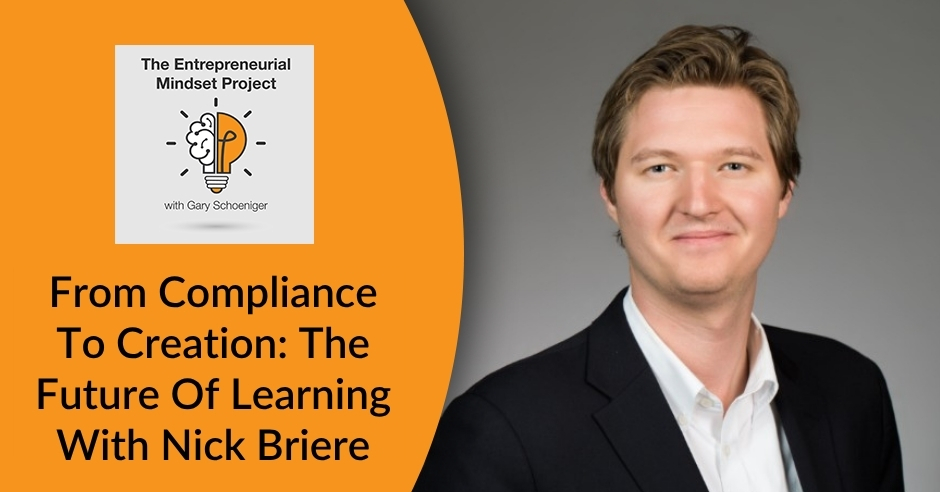
As technology, culture, and creativity reshape how we grow, the future of learning lies in moving beyond compliance to true curiosity and capability. Learning strategist Nick Briere shares how organizations can design experiences that do more than check boxes, empowering people to think, build, and innovate. Drawing from years of designing learning systems that balance human connection with measurable results, Nick reveals how leaders can shift mindsets, foster engagement, and turn every learning opportunity into a catalyst for transformation. He also explores how organizations can cultivate environments where learning feels less like an obligation and more like an invitation to grow, adapt, and create lasting impact across teams and industries.
—
Listen to the podcast here
From Compliance To Creation: The Future Of Learning With Nick Briere
Redesigning Education: Unlocking Student Potential
This episode’s conversation is about what happens when you stop treating students like empty vessels and start treating them as problem solvers, creators, and entrepreneurs in their own right. My guest is Nick Briere, CEO of Next Minds, an organization that is redesigning education to unlock agency, purpose and possibility in young people.
Nick isn’t just talking about reform. He’s building a whole new model from the ground up, and it comes from his own experience. Nick was the kind of student traditional systems often overlook, bright, curious, but boxed in. Yet one teacher saw his potential and gave him real responsibility, and that moment changed everything and it planted the seed for what would become Next Minds.
In this episode, we talk about why so many students feel disengaged and disempowered, and how shifting the focus from content delivery to entrepreneurial discovery changes the game. Nick shares how Next Minds creates learning environments where students take ownership, work on real-world problems, and develop the confidence and skills they need to lead their own learning. We also explore what it takes to support educators, break down outdated paradigms, and build a generation of self-directed, resilient thinkers who know how to create value regardless of where they are. This is the future of what learning looks like. Let’s dive in.
—
Nick, welcome to the show.
Thanks for having me.
Nick’s Entrepreneurial Spark: From Personal Struggle To Educational Innovation
Nick, we met through a mutual friend John Deere at the American Center for Entrepreneurship. Immediately I thought, “I’ve got to have this guy on my show.” You’re doing really interesting work in entrepreneurship education. I want to start with a simple question. What put you on that path?
I guess there are two ways to look at answering that question. The more conceptual one actually goes back to first grade when I went through this program myself at that time. It was just a school-based program that had been conceptualized by a number of professors actually trying to develop a more effective means of teaching unstructured problem-solving to kids.
I won’t belabor you or the audience with the details of my personal academic experience at the time, but suffice is to say I was struggling in school. I’ll never forget, my teacher walked into the class and said, “Today, you all are going to be telling me what we’re going to solve.” I perked up at that. That was unique, certainly. Over the course of a semester, each of us in the classroom identified a problem that was taking place in our own lives, whatever we wanted, and created a product that solved that problem.
You were in first grade?
Yeah. Think Science Fair meets Shark Tank. We created our products, we pitched them to an audience, and I happened to do really well. Ultimately, I went on to the finals competition.
Were you otherwise struggling?
Yeah, I was absolutely otherwise struggling. In fact, I was very much so struggling with basic literacy. Functionally, I was in remedial reading classes and the process of pitching my idea to others and having it validated was, genuinely transformative for me as a learner. It enforces what is my most abiding belief about education that the single greatest tool that you can give a child, and frankly, probably an adult as well, is simple self-confidence.
The single greatest tool you can give a child, and probably an adult, is self-confidence. Share on XIt was an inflection point in my educational career, which was just in its nascency, obviously, but so much so that I realized it at the time. First graders aren’t generally credited for being particularly self-aware about systemic shifts in their outlooks. Anyways, I continued to do the program every year. I volunteered for the organization in high school through college. I wrote the operating manual for the organization when I was in college.
Outside of college, once I graduated, I did the thing that most people do when they graduate, at least the school I attended, and went into consulting it’s always consulting or finance or whatever. At the same time, I decided to start this side project of trying to bring this isolated program that I’d gone through as a kid to the nation to scale it, to bring uniformity to it. What began as a side project, really just fancy, exploded rapidly to the point that within a year or two, we had over 100,000 kids going through this program across the nation, dozens of states participating.
We had our national competition at the United States Patent and Trademark Office in Alexandria. Ultimately, I was able to lead my career in consulting and do it full-time. Interestingly, I celebrated in the metaphorical sense my ten-year anniversary of that project and starting it. It’s been my career and at the risk of sounding maybe a little bit mockish, my purpose ever since has been seeking to scale this program and bring its philosophy and its benefits to communities, in particular, underrepresented communities across the nation.
Why Entrepreneurial Thinking Empowers Disengaged Students
Nick, there’s so much to unpack here, but the first thing I just want to say that got me just so excited about what you’re talking about is the power of entrepreneurial thinking, specifically for kids for whom school is not resonating. I just find it so fascinating that the school had already identified you, I don’t know how you characterize it, I forgot, but as remedial.
It’s flummoxing until you look at it and realize how fundamentally divergent traditional schooling is from entrepreneurial thinking. I read your book, The Entrepreneurial Mindset Advantage, which everyone should read. It was very validating. It also prompted me to collect a list of actual examples to help frame this concept. In school, we teach kids to fear failure. Fundamentally, if you get an F that stands for failing.
It’s stigmatized. It’s to be avoided.
If you do outstanding, flawlessly in school, you’ll never get an F. You’ll never have failed. Of course, in entrepreneurship, that’s malarkey. There are our cornucopia venture studios that will only invest in founders that have at least one failure because they know how pivotally important failing is for learning. In school, we teach kids to expect problems to be handed to them.
That was one of the reasons why my experience with the Invention Convention was so transformative or so distinct when it was first introduced, because we were always given the problems to solve. All of a sudden, it’s our job to find them. That’s new. Of course, in entrepreneurship, no one hands you a problem and says, “Go start a business on this,” notwithstanding very specific venture studio structures. In school, we teach kids that most problems have clear and singular solutions. That’s obviously not the case in entrepreneurship.
In school, we teach kids that most problems have clear and singular solutions. That's obviously not the case in entrepreneurship. Share on XWe teach kids to expect that they’re going to be given a toolkit to solve those problems. That’s not the case in entrepreneurship. We teach kids to avoid comparison with their peers and not to base their solutions or their processes of what their peers are doing that has no basis in entrepreneurship. One of the first things you do when you start a business is competitive analysis. We teach kids to seek structure in their lives.
Entrepreneurship is anything but structure. You’ve got to be constantly pivoting, constantly moving, constantly innovating. Lastly, we teach kids that if they succeed, it’s because they did things right. If they fail, it’s because they did things wrong. I’m a Star Trek fan, and there’s this fantastic Jean-Luc Picard quote in which he says, “It is possible to do everything right and still fail.”
That is not failure. That is life. It is entrepreneurship too. You can do every single thing. In fact, there are plenty of historical examples of businesses that did everything right, and they were just a few years too early. Several years later, a company with the same general philosophy and business model becomes wildly successful. You can do everything right and fail. Given that it’s not super surprising that someone that was struggling in school, and frankly, I wasn’t a flunky, but I was never uniquely successful in school but have found relative success in entrepreneurship. It’s not surprising because they’re fairly divergent concepts.
Managerial Vs. Entrepreneurial: A Deep Dive Into Conflicting Mindsets
They’re very divergent. What I tried to lay out in my book is that there are these two frameworks. One is managerial and one is entrepreneurial. There’s like a conflict of interest for real, Nick. To your point, that managerial values, assumptions, culture, whatever you want to call it, the efficient replication and distribution of useful things. Due to its focus on efficiency, it inherently becomes an error-reducing paradigm. Entrepreneurial is about the discovery of useful things, which is inherently an error-inducing paradigm. How do we reconcile that?
There’s a confidence element at play here too. I think it’s a bit of a trope at this point that you’ve got all these high performing kids in high school decades ago, and that are Millennials now that crashed out that were in an all the advanced classrooms end up getting a degree and now are not realizing what they feel their potential was.
One of the driving forces behind that, in my opinion, is that kids that didn’t perform perfectly in school actually built more self-confidence because they got used to failing traditionally, at least not getting good grades and realizing, “I’m still here. I’m okay,” and went on to graduate with a degree of confidence and not a dependency on being validated by others. That allowed them to go and pursue more ambitious goals and to get back up after they fail.

Future Of Learning: Kids who didn’t perform perfectly in school actually built more self-confidence because they got used to failing.
That’s really interesting, Nick. You’re used to being the outsider or the lower guy that you just have less to lose.
Precisely. That’s why when we first met, you used that truism that A students teach B students to work for C students. That’s why, because the C students developed this armor and confidence that allowed them to go and roll with the punches and endure through hardships where the people that grew up to become dependent on flawlessness sought much less risky pursuits.
There’s a lot of evidence to show that valedictorians don’t wind up distinguishing themselves.
Exactly, and it’s hard. I’m a twin and I learned very early on to just how small my place in the universe was because my twin sister was, and continues to be, frankly, better than me at most things. It was particularly salient because she wasn’t just a relative of mine, she was my twin. To get put this in perspective, we went to the same college when we were sophomores or juniors. She was one of Glamour magazine’s college Women of the Year. I had barely gotten into this school by the skin of my teeth.
In a way, over the long-term, that’s a benefit, I think, because if you’re not constantly seeking to preserve, it’s almost like the difference between investing in bonds in the stock market. If you feel like you already have this great wealth and value that you need to preserve, you’re not going to be as risky, and you’re going to be getting your 3% or 4% annualized return. Meanwhile, someone that says, “Throw caution to the wind. I’m young, let’s take some risks,” is going to be in the S&P 500, they’re going to get 10%. Over a lifetime, that’s a difference in millions. I think that it’s the same concept in our pursuits of ambition in our careers.

Future Of Learning: If you feel you have great wealth to preserve, you’re not going to be as risky.
I also heard something in that narrative, Nick, that somebody of equal or greater capability might have construed that very same dynamic between you and your sister pessimistically. I’m a mindset guy. The way that we interpret anything in life, like optimistic versus pessimistic explanatory styles, have an enormous impact on the trajectory of our life. What I hear in entrepreneurial people again and again, Nick, is this ability to optimistically interpret adversity. It sucked, but I made it work for me. It’s some version of that. You just said it. “MY sister was out doing me in every domain.”
It’s an indulgence. I think if you ever talk with a wealthy and successful person, within an hour of any conversation, they will be naturally drawn to emphasize how they grew up in lesser circumstances, and that this was self-earned because they feel there’s a degree of the delta is larger. There’s a degree of greater significance in a person that pulled themselves out of adversity to become successful compared to the person that was born into greatness and simply maintained it.
The C Student Advantage: Why Underdogs Often Succeed
Let’s double-click on that for a second, if I could. One could even put this to your story. Those of us who weren’t great students in school, whether we’re know it or not, this isn’t going to work for me.
The valedictorian, they’re the stimulus response bunnies. They know how to get the A and I think it’s that alternative, that’s why the C students wind up employing the B students because they step into this self-directed value creating domain whether they realize it or not. You can create as much value as you want. You’re not constrained.
I’d be remiss if I didn’t emphasize the elements that number one, privilege, and number two, luck, have to play. We work in a variety of historically underrepresented communities in STEM. I’ll give you an example of an invention that I saw that I thought was just brilliant. We were in New Haven, teaching at a summer camp. These students, the second you turned your back to them, were tossing around a soccer ball and having fun.
Their problem was that when they went to go get ice cream, their mom would take them to get ice cream once a week, but they could only get one ice cream cone to share between the two of them. On a hot day, you’re going, transferring the ice cream cone back and forth, you’re going to get a lot of drippage. They invented a bowl with a straw that caught the drippings and basically created a milkshake after your ice cream cone.
There are tons of just great ideas that come out of these communities. However, when I look at the inventions that actually went from conceptual project to on the shelves, it was a network effect that really brought it there. It was the kids that had either families or communities that could help elevate that product from concept to commercialization.
That’s one of the great shames and frustrations of working in this space. I’ve seen dozens upon dozens of ideas. I went on to look through Google patents and try to identify competitors and felt like they’d really captured a niche in the market. When you’re fourteen years old, in a single-parent household, and you don’t come from particular means, I won’t say impossible, but it’s extremely difficult to realize that invention or that product and take it to market. It’s this Gordian knot that we’ve been working on for some time. Of course, with a small nonprofit, you can’t overcome a nation’s worth of systemic and opportunity. It is, it can be discouraging sometimes because you see amazing ideas that are never going to get to see the real light of day.
That’s why I’m fond of this idea that the community needs the entrepreneurial impulse of the individual, but without the support of the community, that impulse will die away. What I’ve always encouraged is for entrepreneurial students to find mentors to expose them to other entrepreneurial ventures, people who will help them move beyond that because I think a lot of the problems you’re talking about are mindset limits.
It’s 100% mindset limits. Actually, a step before mindset-wise, where the greatest challenge that we experience is, in my opinion and experience in our work, we take for granted with the privilege that we now have that children will see opportunities for what they are and be inspired to seize them. The problem in many of the communities that we work in is that children have been given no reason to believe in the relationship between hard work and success.
They see their parents working hard, multiple jobs often, every day, working weekends, and bills are still late, and they’re still not getting ahead, and they still don’t own my home. They still are sharing their bedroom with two other brothers and sisters. When you grow up in those circumstances, it’s not surprising that when someone like me comes into the classroom and says, “We’ve got this great opportunity for you,” they roll their eyes.
Why wouldn’t they? They have not been given a reason to believe in the relationship between work and success. In fact, I saw, and frankly I don’t remember the exact number, so I won’t pretend to remember, but a study was conducted that showed that within the Millennial generation, a historic number of Millennials no longer believe in the relationship between hard work and success. That’s a huge problem. It’s cultural. That’s not something that you can ask a teacher with the right curriculum to solve.
It begins with all the institutions that surround children as they’re being brought up. It compounds an opportunity because it means that even when we try to introduce new opportunities into communities that are underrepresented to equal the playing field, they’re not realized at full effect. It’s heartbreaking, but it’s totally understandable. It’s why I challenge a lot of people that get frustrated when they walk into some of these communities or afterschool programs and boys’ and girls’ clubs, and feel like the classroom isn’t giving them their undivided attention. We have, as a society, have not earned the right for their undivided detention. It’s something that I always try to emphasize.

Future Of Learning: It’s heartbreaking that even when we introduce new opportunities into underrepresented communities to equal the playing field, they’re not fully realized.
Default Helplessness: Understanding And Overcoming A Societal Challenge
It’s so interesting to me, Nick. Are you familiar with the work of Martin Seligman, like his work in default helplessness?
No, I’m not.
Seligman is the Professor Emeritus at University of Pennsylvania now, but he was the guy that was studying what we once thought of as learned helplessness. We now understand it as default helplessness. In the late ‘60s, he was doing these experiments where he was shocking dogs, like put a group of dogs in a cage where they were administering a shock to the floor of the cage, but there’s a lever. The dog figures out how to move the lever in order to stop the shock.
That first group of dogs experiences this adversity as escapable. They put a second group of dogs in the same cage with the same shock and the same lever, only they disconnect the lever. The second group of dogs perceives the adversity, the adverse condition as inescapable. He then puts both groups of dogs in what he called a shuttle box, a larger cage with a little divider wall in the middle, and they put them one by one in one side of the cage administer a shock and see how they’ll respond. The first group of dogs jump right over the divider to escape. The second group of dogs just lies down and whimpers.
In the ‘90s now, fast forward, whatever that is, like in the late ‘90s, or 30, 40 years later, he started figuring out because of the advances in neurological science, that helplessness is a default. It’s an evolutionary default. Control is learned and helplessness is a default setting. One of the things that really struck out to me is that he said that, which relates to your comment, your observation, is that one of the insidious effects of helplessness, which he describes as an unconscious assumption that nothing I do will matter. These are almost as exact words, Nick. “The insidious side effect of this is the inability to recognize a solution when it is unambiguously presented.” I think that’s what you’re talking about.
It’s not just exactly what I’m talking about, it’s also the founding purpose behind Invention Convention as a program because this is a program that is designed to untangle that wiring. Students identify a problem in their lives and they solve it. In doing so, they learn agency. They learn that they have control not just over their lives in general, but over the parts of their lives that they don’t like, that they wish were different, that they want to improve.
That’s the power of entrepreneurial mindset education, full stop, right there.
People who are only loosely connected to this work are always surprised when I share with them that despite being typically associated as being entrepreneurship or STEM program, the number one outcome of this program on children is self-confidence. Of course, people that are in this space aren’t surprised by that at all, because that is the number one thing that we are inspiring children to realize.
It gets back to what we were talking about earlier. Those C students that learn to roll with the punches and built that concept of self-worth because, “I’ve got a C and I’m still here. I’m still cranking. I’m going to start this business and if I fail, I’ve gotten Fs in the past. I’ll take I’ll be there for the next class period and I’ll do it again.”
It’s so important to try to reverse, to use the phrase that you invoke default, that default perception that is particularly pernicious and historically underrepresented communities where children don’t just feel like it’s them themselves, personally, that have this lack of autonomy over their lives, but their entire community. Everyone in their family and their neighbors. That makes it so much more dampening.
It keeps reinforcing it. Nick, my first book, Who Owns the Ice House? is a story about a guy born in the Mississippi Delta in the 1940s to a teenage mom picking cotton. Black guy. Glen Allen, Mississippi. He said, “All I could see in every direction is cotton. People look like me.” He got on a field truck and he went out and that was it.
When he was thirteen, he went to work for his uncle who owned the local ice house. His uncle had a fourth-grade education. He was the only guy in town that had money in the bank, and they wouldn’t even let them come in the front door. We developed the Ice House program inspired by this story, and that’s gone all over the world. What’s fundamentally embedded in the Ice House program, Nick, is this idea of default helplessness, and we know how to help people get out of it.
This comes from the work of Albert Bandura and there are four things. Bandura called this Guided Mastery. Number one, he said, “You need small wins.” You need to feel the bat hit the ball once. You see this is possible for me. Bandura was really clear on this. That shouldn’t come too easily, but it shouldn’t be too far out of reach. The learner should struggle a bit for it. It should come with some modicum of effort, number one. That small win is crucial.
Number two, exposure to relatable social models. In the communities you described, there are people that have gotten out of it. That’s what we do. We keep put in case studies, little video vignettes from people who have overcome similar or worse circumstances. That’s the linchpin to getting people to adopt this behavior.
That’s the second thing. Number three is you need a mentor. You need people to believe in you, to coach you, to keep you going. The last thing Bandura put was the ability to self-regulate, to think about your own thinking, to manage your own emotional response. These four things, that’s how you get people out of that default helpless mode. That’s how you get them to think. This is possible for me, whether you know it or not, Nick, you and I are in the business of what Seligman called the hope circuit. You and I are in the business of opening that hope circuit.
I see relatable parallels to each one of those four concepts that we struggle with in advance every day in our programs. For example, you mentioned this concept of trying to strike the balance between the ball being hard enough to hit that there’s meaning when you strike the ball, but that it’s not so hard that you’re routinely streak striking out and therefore will give up.
We struggle with that all the time, this balance between fairness and meritocracy. If everyone gets a prize unconditionally, then the prize doesn’t have meaning. At the same time, if only one kid gets the prize, then you’re discouraging 99.9% of the students that participate. One of the things that we’ve started employing in the classroom that we’ve found has helped try to strike a balance. Make that ball hard enough to hit that there’s meaning, but not so hard that everyone gives up a number of concepts.
First of all, when we’re doing isolated programs, we have the kids vote on who they think the winners are. There’s agency in feeling like you are one of the sharks. When you vote on who you think the winner should be, it stings much less when you’re not the winner, because at least you were a judge. The second part is this concept of the winners get to pick their prize first, but everyone ultimately gets something.
It’s an ever-evolving debate that we have within our organization. It feels like there’s no one unconditionally right answer, because there are great arguments to making it a little bit easier to hit that ball. There are great arguments to making it a little bit harder to hit that ball. The fact that you’re playing in this space of understanding that there is a balance is critical for this program because it ties back to confidence, which again, to me, is the foundation of everything. I am never in my life met a successful entrepreneur that had a fundamental lack of self-confidence and belief.

Future Of Learning: I’ve never met a successful entrepreneur who lacked fundamental self-confidence and belief.
The Journey To Self-Confidence: How Entrepreneurs Build Belief
Let’s talk about that for a second, Nick, if we can because there’s a chicken and an egg dynamic here. In my book, I call this entrepreneurial self-efficacy. Confidence is also a good word for that. What people don’t realize that they see the guy that’s successful and supremely confident, and we equate the confidence to their success as if it were a trait and not a byproduct. It’s like in the beginning, you don’t know what you’re doing. You can’t find a light switch in a dark room.
There’s a very important philosophy amongst early-stage entrepreneurs, and that is fake it until you make it. I think a lot of entrepreneurs, frankly, aren’t actually that self-confident, but they’ve learned to relay a sense of self-confidence that ultimately is self-manifesting.
It’s happening. That’s what I’m saying endlessly, Nick, that the entrepreneurial mindset is in effect of the behavior. It’s not the cause. The cause of the behavior is the self-actualizing tendency that’s in every living thing. I’m extrapolating a little bit from Seligman, but let me lay this out for you. I told you about the dogs. Here’s how this plays out in a human. For the life of me, I’ve tried to memorize the neurocircuitry, which he lays out in his book The Hope Circuit. Essentially, it goes like this.
When you find ourselves in some let’s just call it an adverse condition, for most of us, that’s an unsatisfying, low-paying job. Let’s just use that as an example. We’re not getting shocked or beat or whatever. We find ourselves in some mild to moderate adverse conditions. Our unconscious brain goes into the prefrontal cortex, into the memory to make a determination based on our past.
Is this situation escapable or inescapable? Are you with me? This is all happening unconsciously for most of us. If your brain decides it’s escapable, and I don’t have all the neuro circuitry, some note in the brain releases something called 5-HT serotonin that activates fight or flight. You’ve got to remember, your brain is an efficiency mechanism. That’s evolutionary.
It emphasizes an interesting and important point, which is that self-agency is not necessarily knowing and believing that every single problem or challenge in which you find yourself is solvable. I’m going to paraphrase it, but there’s a very popular phrase in the Bible that says, “God, give me the strength to persevere through the challenges that I can solve, the strength to persevere through.”
You’re talking about the Serenity Prayer.
That is important, and it has ties to entrepreneurship too, because it’s not productive as an entrepreneur to spend time and resources trying to solve a problem that is fundamentally unsolvable or that the odds of solving it are so vanishingly small that it’s not worth it. Confidence isn’t about arrogance. Arrogance would be, I can solve anything, any problem that comes my way. You end up spending time, money, effort, resources trying to solve problems that aren’t moving anywhere. I think that is actually really important distinction. Self-confidence involves a degree of knowledge, discretion and humility to accept when you’re facing a challenge that you just need to endure.
Self-confidence involves knowledge, discretion, and the humility to accept when you must endure a challenge. Share on XHow do you sort that out? I want to come back to that thread, but by way, finish with the Seligman analogy. Your brain decides it’s escapable, 5-HT serotonin releases activate fight or flight. It energizes you to start looking for a way out. Your brain is telling you, “This is worth expending energy. Start looking for a way out.”
If your memory decides this is inescapable, it has the exact opposite effect. It suppresses 5-HT serotonin, it suppresses fight or flight and redirects energy towards coping strategies. For the dog, that was just whimpering. From an evolutionary perspective, your brain is telling you, “Don’t waste the energy, Nick. Redirect.” If you look at the population writ large, you don’t have to go in the inner city to see that.
I was going to say, in my personal experience, I would say that our entire population, especially those within historically underrepresented communities, but our entire population is far too on the side of coping and feeling marginalized, that there’s no escape. That’s a real problem.
That’s the problem you and I are trying to address.
Those that are feel inescapably marginalized are not starting businesses. They’re not coming up with creative solutions. Not only do we need everyone to be doing that, but frankly, in my opinion, it is more important that individuals within historically underrepresented populations have that entrepreneurial impulse because they know what a real problem is. I can’t emphasize how important that is. I went to Duke and I saw in my time, I was very involved in different entrepreneurial pursuits and programs, etc. There.

Future Of Learning: It is more important that individuals within historically underrepresented populations have that entrepreneurial impulse, because they know what a real problem is.
I will never forget how many bad ideas I heard from very privileged people that had no idea what a real problem worth solving actually was. They just wanted to start a business, and they picked a problem they thought was fun or cute or interesting. Almost uniformly, these were all pedantic problem. They were not meaningful. They were not system shifting. Whereas those, in my experience, that have gone through real adversity know what a real problem is. A big part of their origin story is trying to uplift communities. You don’t see that as much amongst the entrepreneurs that have not had to fight and scrape for everything they had.
Unlocking Underestimated Communities: The Strategic Advantage Of Impact
I love where you’re going with this, Nick, because John Deere was right. You guys are brothers from another mother. I write about this, I think about this a lot. Unlocking the entrepreneurial potential and overlooked communities. That’s what our work with The Ice House and what your work has uncovered. There is this extraordinary level of untapped entrepreneurial potential. To ask the question in reverse, what’s the cost for ignoring it?
It goes both ways. It’s not just what’s the cost for ignoring it? What’s the upside for addressing it? I always share with people, our priority to focus on communities that are historically underrepresented relative to STEM programming is a simple, strategic business decision. If our goal is to maximize the delta, maximize the impact, where can we have more impact if we go into an already well-served community and convince administrators or educators to do Invention Convention instead of robotics or the school district that currently has no STEM offering because they’re fundamentally inaccessible and bringing Invention Convention into that community? We can simply have a greatly enhanced impact if we’re focusing on communities that are, to use your term, currently overlooked.
Also, underestimated.
Fundamentally so. I can’t emphasize enough that I think any sustained, maximized, it’d be presumptuous to say solution, but an idea to address our current circumstance. If we want to maximize the impact, we need to be looking at those communities that are currently being least served, because that’s just fundamentally where we will have the most efficient impact.
To maximize our impact, we must focus on communities currently least served. Share on XLet me just add to that, Nick, and tie your story into it. I think the most potent aspect of entrepreneurial learning, what I call entrepreneurial discovery learning, is that it awakens within the individual a desire to learn. That’s fundamentally your story. This method of learning’s not working for me. I’ve already been labeled as difficult or remedial.
That’s so true that in underserved communities, overlooked communities. That’s just not working for a lot of kids. Part of the reason I am in this game, Nick, if I’m being honest, is I didn’t know until later in life that this was quite typical, but I did well in school through elementary. In middle school, it started to get a little wobbly and high school, I barely graduated. It didn’t make any sense to me.
Just like algebra, it wasn’t making any sense to me. I never thought of college as an option. To me, it was like intellectual waterboarding. Four more years of this is not in my future. I didn’t have the grades or the inclination, and I figured out how to make my own way in the world as an entrepreneur. What I figured out is I love to learn. That’s the real power of entrepreneurial mindset education.
It’s funny. I think that’s endemic to humanity. We all love to learn. There’s just a fantastic diversity in what that learning looks like. We all sat through history and science class, and we’re rolling our eyes, learning about completely bizarre and abstract concepts that we knew at the time, as did the educator, that we were never going to employ in our real lives. Yet nowadays, we’re all driving to work, listening to podcasts, happily so about equally abstract and unique and specific concepts.
I believe that the instinct to learn is universal, but the modality or the preference towards it is different. Also, it is so vitally important that people feel agency in that decision. Nobody wants to be obliged or forced to do anything. You probably know more about it than I do, but there was an experiment that was conducted to try to identify if they could effectively incent students to read more by paying them. They ultimately found that the only way to really try to motivate more reading was to make it accessible, but not try to force or oblige kids to read, because they don’t want to be told what to do. Nobody wants to be told what to do. The instinct for freedom and self-determination is nearly universal.
Nick, it’s worse than that. I looked at a meta-analysis of 124 studies. Extrinsic rewards or threat of punishment undermine intrinsic motivation, which is the most potent form of motivation known to man. Our entire system of education relies on punish and reward. I saw a study where I think it was Domino’s Pizza was trying to reward. They realized what happens in underserved communities is the kids don’t read over the summer and the kids from middle-class families do. They come back at the next year at a little bit of a deficit, and it keeps compounding.
They decided they’re going to give free pizzas for the book you read, and it just completely backfires. The kids, the books they read had the least amount of words in it. They didn’t retain any of it, and they just got bad eating habits. What happens is the minute you remove the reward, they’ve done this with little kids. They love to draw, they’ll draw all day long. You introduce a reward expectation for drawing, and they lose interest in something they were otherwise intrinsically motivated to do. It’s really terrifying when you think about it.
It makes systematizing any intervention difficult.
To your point, I think the entrepreneur doesn’t even realize that he or she becomes intrinsically motivated. They’re pursuing something that’s interesting to them as you have in your life in a way that’s useful to other people. You’re doing it autonomously and you become intrinsically motivated and therefore, much more engaged. It’s not really rocket science. When we’re able to pursue things that are interesting in ways that create value, we tap into that level of motivation. The other part of the equation that’s perplexing to me is look at data from Gallup on student engagement. Have you ever read any of that?
I certainly have. I can’t necessarily cite exact figures.
It’s deplorable, like fifth grade, they call it engagement cliff.
The entire average has been shifting in the negative for quite some time.
Yet, we keep doing it. Two thirds of kids leave high school not engaged in learning. I quoted John Dewey in my book. “Imagine how many students or young people lose interest in learning because of the ways in which it was presented to them.”
The Stagnation Of Education: Why Systemic Change Is Imperative
Education is a fascinating industry to me because it is personally the only industry I’ve ever had exposure to where you don’t really see anybody defending the status quo. Pretty much everyone, regardless of political affiliation professional affiliation, their personal circumstances, pretty much everyone universally says what we’re doing right now is not working. Yet we really haven’t conducted as a society much in the way of systemic shift in the industry.
Despite the fact that there is a cornucopia of evidence that shows that education both on a personal basis, on a community basis, and on a national basis, is one of the, if not the most effective investments that we can make for long-term growth, long-term health and economic outcomes and general stability. It is flummoxing to me, frankly.
We keep blaming the students, blaming the phones, blaming the parents. In psychology, there’s this term called the self-serving bias. We take credit for things that go properly.
I think we’re all guilty of that.
It’s a natural thing, but it also happens at an institutional level. It’s like we take credit for the kid that goes off to Harvard and we dismiss the kid that goes off to prison. The last time I went to South by Southwest, I was at in a main stage session. I won’t name names. It was a national figure talking about we’re here looking for good ideas. I just packed up and left because I said, like what you just said, to myself, I said, “There’s no shortage of good ideas. We don’t need good ideas. We already got good ideas.” It’s like we need a political will.
In consensus. I think that is something that we’re sorely lacking now, to your point, we have plenty of good ideas, which are sometimes, frankly, competing. That’s what’s so interesting about this. Sometimes, the very worst outcome is doing nothing. It would be better off if we just took 1 of 2 ideas that are at competing ideological spectrums. Maintaining the status quo is the very worst option.
Sometimes, doing nothing is the worst outcome. Share on XIt’s almost like game theory. Yet the nature of current circumstances just perpetuates it. It can be frustrating and frankly, it can make a lot a heck of a lot of people feel left behind and not represented. It’s really sad to see. I think one of the themes across the board, economically, educationally, in terms of health outcomes, just about any major indices you care to choose is the compounding of inequality. I can’t emphasize enough how shatteringly significant compounding inequality is for communities.
When every single generation only experiences call it 95%, even though I think that’s generous, but an underrepresented community experiences 95% of the opportunity that their peers do. When that happens, generation over generation, suddenly, the separation from the haves and the have-nots is staggering. Even though the last generation, they were provided most of the resources, it doesn’t matter because for decades, for centuries, in some cases, communities have been grappling with a lack of resources, lack of access, a lack of representation.
I don’t dispute anything you’re saying. I want to think about it more as a question or a dilemma. I think what you’re saying is mostly true, but the last thing you want to put in the mind of a young person coming from a marginalized community is how the odds are stacked against them. How do we square that? How do we talk about fixing the bigger systemic problems without poisoning the mind of a young person?
One of the really sobering things for me growing up, and I’m a young person and nowhere near as wise as most of the people that I work with, has been coming to terms with the fact that oftentimes, there are no great solutions. Any decision you choose is going to have significant drawbacks. You have just have to have the will and the humility to pick the best of bad options. It’s a really hard thing to do, especially when you’re in a leadership position.
It’s really indulgent to just do nothing, because then the burden of decision isn’t necessarily on you, but the people before you. You’re 100 % right. By the way, what I mentioned, underrepresentation, takes all shapes and forms from rural America all the way to the coast and everything in between. Every shape and form of underrepresentation from veterans to folks struggling with disabilities, income gaps, etc. It’s a really all-encompassing term, but the last thing you want to do is make people to reinforce this concept of being marginalized by making them feel different.
You’re absolutely right. It is a distinct challenge. We grapple with it at our organization all the time. We want to empower communities and people and young inventors, and we want them to feel different for the good reasons, because their ideas are unique, but we don’t want to make them feel different for the bad reasons. I agree with you. It’s a challenge.
Nick, this is what I’ve been chipping away at for 30 years. In every community, there are certain individuals who have no advantage over anyone else other than the way they think. My job, as I see it, is to go find those people, interview them as ethnographic research and understand what are the underlying values and taken-for-granted assumptions, what are the common and controllable factors in their stories and pull those out and just show those to the rest of the world?
I’m not interested in interviewing Mark Zuckerberg or Elon Musk, sorry. I don’t necessarily mean bad on those guys, but that’s not where my interest lies. I’m obsessed with these underdogs and misfits and ne’er do wells, the dropouts with the eighth-grade education who are millionaires. What were they thinking? How did they do it? What can we learn from them?
That’s what Ice House really started, that moved to my newer book. What’s so interesting to me, Nick, is I’ve now interviewed like 700 of these people like Cameroon, South Africa, like Latin America. It’s common, it’s predictable. These same themes keep coming up again and again, what I would now call cultural themes.
I see entrepreneurial people are like a subculture. Mindset is to a person what culture is to a group. It functions exactly the same. What’s so interesting is the entrepreneurs themselves aren’t really aware of it. They’re abiding by this common and predictable pattern of underlying values and taken-for-granted assumptions of which they themselves are not aware. When I interview entrepreneurs on my show, I hit stop after record, and they’re like, “I feel like you know me.”
It’s like, no. I feel like what my job here, Nick, my role in all of this, in this ecosystem that you and I occupy and work in is to just go through the world, find those underdogs, take from them these nuggets and just put it out there in the world. My role is as an interlocutor to make sure you listen to that story without letting yourself think, “Nick is just gifted or Nick is just lucky.”
Lucky I definitely am and privileged I am. I would never dispute that. I would be remiss if I didn’t acknowledge all the privileges that I had that have helped me from the circumstances. I was born a family that just deeply valued education siblings that I could seek to emulate the role models. My twin sister is one of the pilots for the Dragon satellite at SpaceX, just a brilliant person.
I am objectively more intelligent than I am. People always assume that to me being humble and it’s possible to have confidence in your own abilities and still acknowledge that there are still smarter people out there in the world. I think one of the themes I would hazard to guess that you also probably experience or hear in a lot of the people you interview is that it can be a tad lonely being in this function because a good leader will seek to shield their team and those that work with them from the bad and seek to have them bask and the good while trying to remain just an arbiter.
That can be a challenge in and of itself. I would hazard a guess that while you’re in a more objective sense performing the role of interviewer, you’re a little bit performing the function of therapist too. I think it’s probably therapeutic for entrepreneurs to share perspectives and frustrations too that sometimes they’re just not provided the opportunity to share. I think it can be, especially in education, oftentimes discouraging when you feel like you’re not doing enough or you finally feel like you’ve reached a new milestone institutionally, and then the macro picture takes a shift in the wrong direction. You’re right back where you were before. I wouldn’t be surprised if that’s the case also.
Policy For Entrepreneurial Education: Self-Directed Value Creation
Nick, one of the things I want to dig into, I’ve been asked to make a policy recommendation for Entrepreneurial Mindset Education to the G20 happening in South Africa. I started reading European Commission’s entrepreneurial competencies framework, like the rest of the world is waking up to the need that all students are going to need basic entrepreneurial competencies, but they’re still struggling with how to do that at scale.
I need you to weigh in on this. To my way of thinking, entrepreneurship is about self-directed value creation, whereas most of us are engaged in other-directed value creation. That’s the fundamental difference. We all have to create value as we’re all merchants in some sense, as Adam Smith wrote in 1776.
I think of entrepreneurship as a discovery process. You said it very early in this conversation about like, solving unstructured or ill structured problems is part of it. You’ve got to learn how to function in ambiguity. Resource constraints. You don’t know, there’s no clear path, there’s no benefit of a professional teacher. I don’t think you can teach entrepreneurship with the same top-down knowledge transfer that you teach other subjects.
No, I think other subjects are like a mountain and you have a trail, but you have to climb up it and you, as a guide, need to usher a group up the mountain. Entrepreneurship, in my opinion, is like a river with a current, and if you get in the right river, the current is going to take you where you want to go. That’s why the beginning, point zero, is so instrumental, and in my opinion, it all needs to begin.
The overwhelmingly most important element of instructing entrepreneurship begins with problem identification. Kids need to learn how to identify problems, how to pick problems that they care about because once they have a problem that they care about, that they’ve picked, the instinctive current that is in all of us, the spirit of innovation, that, in my opinion, is the legacy.

Future Of Learning: The overwhelmingly most important element of instructing entrepreneurship begins with problem identification.
It is the human condition. It is what separates us from every other species on earth. It will guide them naturally on the course of entrepreneurship, but if they don’t begin with it, you are going to be dragging them up the hill of entrepreneurship instead of letting them guide along the current of entrepreneurship.
I think what you just said is exactly right. What you’re also saying, Nick, and maybe you’re not using the same language, but you’re tapping into intrinsic motivation. That’s fundamentally what you are doing. My friend Jaime Casap is so famous for saying, “Stop asking kids what they want to be and start asking them what problems they want to solve and what do they need to learn in order to solve them.” I think there’s something more to unpack there that the problem finding component of entrepreneurship education or entrepreneurship discourse is probably the most absent.
I would agree, if only for the reasons that we discussed earlier, that the course of entrepreneurship in many ways is fundamentally at odds with traditional structured schooling. By the way, that is in no way to say that we shouldn’t be providing students with structured problem solving. We have over a decade to instruct students to provide them with skillsets. We teach kids music and gym. We teach kids a plethora of different skills. I am merely suggesting that entrepreneurship in these core principles of entrepreneurial mindset needs to be a part of that.
In order to be a part of that, we need to understand that a portion of a student’s classroom or afterschool experience needs to follow a fundamentally different structure and course from what traditional schooling looks like. It should be a breadth of fresh air. It’s not teaching kids that this is the right way and that’s the wrong way, but rather that we embrace different philosophies, different mindsets, different tools for different goals or challenges that we’re seeking to address.
The Invisible Problem: Empathy As The Key To Problem-Finding
Let me tie these ideas together. Your idea of kids need to learn unstructured problem solving or ill structured problem solving, however you phrased it. I just think that’s fundamentally that what a lot of people who are in the entrepreneurship education game don’t understand or don’t have an articulated is that problems are unarticulated. They’re unarticulated, unmet needs. It’s not like there’s a whole plethora of people walking around with placards saying, “I have this unmet need. If somebody would just provide this for me, then my life will be complete.”
That’s true. Not just from a societal perspective, but in terms of an internal perspective. There is, in my opinion, a great and important relationship between a problem worth solving for a child and a concept that they’re passionate about. If you ask a first grader, “What are you passionate about,” that’s a pretty sophisticated question. A lot will struggle to even under understand what the question really is, much less begin to answer it.
Therein lies the importance in asking it. I had an advisor in college so at this point, I was nineteen years old that said, “What are you passionate about?” I said, “I don’t really know.” He said, “What makes you angry?” I thought that was such a fantastic way to phrase that question, because people often get angry at concepts of injustice or wrong or inefficiency.
People get angry at problem. People get angry at things they wish were a different way. Anger is an emotion that we learn to grapple with and understand far earlier than something as illusory as passion. I think you’re exactly right. We all hold in our hearts and our lives problems that we want to solve, but that doesn’t necessarily mean that we are cognizant of them or actively pursuing a rectification of them.
That’s why programs like Invention Convention that are designed to really dig into that are, in my opinion, so important, especially relative to early interventions. Most of our students are going through the program before eighth grade, and there’s a wellspring of research that indicates that if you want to make significant changes to the future direction of a child’s life, whether that be professionally, personally, economically, etc., you need to do so before they’re in high school because life attitudes, perspectives, plans calcify as you get older.
They definitely do. There’s a great quote from William James about heaven and hell, something to the effect of like, “Heaven and hell of which theology tells us is no worse than the heaven or hell we create for ourselves by fashioning our habits.” If the young could but understand how these habits become so ingrained, they would pay more heat to their conduct while still in the plastic state.
There’s a nuanced thing I still want to click on here, Nick, which is that needs are unarticulated are invisible. You can’t find them with a spreadsheet, you’re not going to find it with a data analysis. Clayton Christensen wrote a book called Competing Against Luck, and it’s the deeper social and emotional dimension of the need.
We spend a whole week with our kids, helping them identify a problem in their life worth solving and bring activities and resources to bear. We have them keep journals to list the problems that they experience at the time because it’s not terribly instinctive, at least for children, to catalog and document the problems that they experience in their lives and that are worth solving.
I would argue that empathy is the tip of the problem finding.
It absolutely is. Most children that go through our program identify problems that are being experienced by someone other than themselves or a group of people, of which they themselves are a part. I think one of the tremendous outcomes of problem solving is that kids learn empathy. They teach it to themselves.
I think they’re more born with it. We learn not to be empathic in a culture or society or familial.
Especially in circumstances where self-preservation is so much more heightened. When you grow up wanting, your capacity for empathy gets denuded or at least you have to fight harder to exhibit it because you have to work harder to protect what you have. That’s really important to be aware of. It’s a big element of what we focus on with our program.
A Grand Slam Outcome: Agency Realized Through Innovation
Nick, I wanted to ask you, it seems like a lot of kids are impacted by your program every year. Can you just talk about 1 or 2 examples of what a typical outcome? Maybe not necessarily the grand slam outcome, but what outcomes are you hoping for?
I am going to share with you a story that while the outcome, frankly, is a grand slam, it is nonetheless perfectly representative of what we do and what we focus on. Years ago, there is an inventor named Lucca Riccio. He was thirteen years old and he was at the hospital because his grandmother was passing away, and the nurse came out and instructed the family that she’s moving on. The family all came in and arranged in a semi-circle around her to say goodbye. She had an oxygen mask on and because of the oxygen mask, they couldn’t hear what she was saying. Her voice was muffled. They wanted to take it off, but she was receiving enriched oxygen.
I’m not a doctor, I don’t really understand everything involved, but suffice it to say, the oxygen mask needed to remain on for the conversation to continue. Thirteen-year-old Luchi is there. His whole family is desperately trying to hear his grandmother’s final words, trying to communicate with her and ultimately, all are robbed of that discussion that back and forth.
He went on to invent a Bluetooth adapter that hooks up inline that can go project to a microphone, a phone, a speaker, so that individuals with oxygen masks on cannot just be heard by their families, but by doctors, by medical professionals. He went on to get many patents on it and commercialized the invention and all that fun stuff. The part that’s important to me about that story is that Lucca picked a problem that had great emotional impact on him and found a degree of not just validation, but purpose in solving that problem.
I mentioned earlier in our conversation that I believe that problem-solving and innovation is not just core to the human condition, it is the human condition. It is the thing that separates us from every other species. Every other species exhibits concepts of love, family, protection and development. We are the only species that develops tools to solve problems and then develops tools that help those tools and compound on each other. Over generations and generations, we’ve now created a better alive for ourselves because of it.
To answer your question, what is so thematically important? The outcome that is so important for our program is agency realized through innovation and problem solving. People coming to believe that they have the power to impact the world and their lives with their brain to make their lives better with their brain, to make the lives of other people better with their brain, and in so doing, really embrace what, again, I feel is just core to the human condition. That’s what I feel is central not just our program, but entrepreneurship education as a whole.
Frankly, it’s what’s kept me in this program for my entire waking life. I started in this program when I was 7 or 8 years old. It has been my thing. It has been a major driving part of my life since I was really able to make memories. I’m only 32 years old, so take it with a grain of salt. It’s been impactful enough for me to dedicate my life to.
We’ve had, at this point, over 350,000 students just in the Connecticut, Massachusetts, Rhode Island, Upper New York area over the past couple decades go through this program. Across the nation, that number is probably at this point pushing 1 million. That’s what it means to me. Of course, impact is in the eyes of the beholder. This program means a little something different to everyone that goes through it and to everyone that teaches it. That’s what it means to me.
Nick, this is so cool. One of the things I just want to add to what you just said, one of the things I love about the work you’re doing is the recognition of the extraordinary ability of children to see things that we can’t see because we are so steeped in accepted norms. I did research in evolutionary psychology, like 10,000 years ago, tribes recognize this, encourage the rebellion and young people. We have to harness that. That’s what I love about your work. You’re harnessing the naivete. It allows young people to come up with ideas.
Harnessing Naivety: Why Children See Problems Adults Miss
They’re not jaded. We don’t even realize as we get older, we come to just accept problems as parts of life. Circumstances are dynamics that are subject to change, and kids don’t accept that because they don’t have to. Every year, we see kids address problems we didn’t even think to address in the first place because that’s just a part of life. Having an oxygen mask on and not being able to speak, that’s just part of being in the hospital.
As we get older, we come to just accept problems as parts of life. Share on XEverybody else in the room accepted it. The example I use, you’re too young to remember this, but when I was a kid, people carried their suitcases through the airport.
I lived in New Zealand for a while and I did a domestic flight and didn’t have to go through a TSA. I had never before contemplated the concept that it was possible that that not be the case, and it is. You just wonder how many more things out there that we take for granted every day from the moment we wake up to go to sleep that are just waiting to be solved. Rest assured, this upcoming generation is hard at work addressing them.
Nick, thanks for being a part of this show. Where can people learn more about your work?
Our organization is Next Minds. We run the Connecticut Invention Convention in Massachusetts. Those who are interested in learning about Invention Convention programs that are maybe in their communities across the nation can go to Invention Convention Worldwide to learn more. Always open to learn from others to have conversations. If you are interested in helping children solve problems in their lives, then you’re someone I’d love to talk to.
Thanks for being part of this show.
Awesome. Thank you very much, Gary. It’s been a pleasure.